Tag: fitness

  • Staying Fit with a Disability

    Staying Fit with a Disability

    This is a sponsored blog post written by Jorvik Tricycles for Disabled Living.

    If you have from a disability, you may wonder and worry how you can exercise and stay fit. Fortunately, there are lots of ways that you can get out and about or stay healthy from the comfort of your own home. In our guide, we’ll show you the best ways you can stay fit and healthy and feel good about yourself.

    Head outdoors

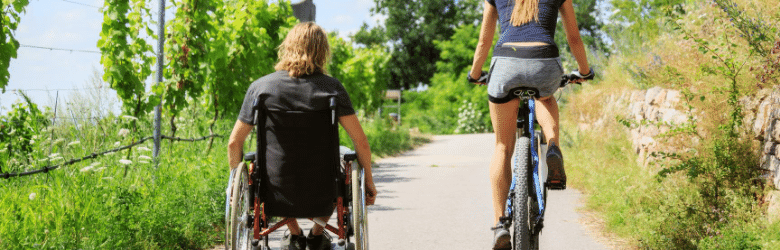
    It’s important you don’t let your disability get in your way of getting out and about into the great outdoors. If you have a powered wheelchair, you can move around with ease on paths and footways. They are powered electrically so you can move along independently without the need of help from others.

    Another alternative, are tricycles. If you have confidence in the use of your legs, then you can propel yourself along on a tricycle. The great thing about them is that they are on three wheels (two at the back and one at the front). This gives you greater stability and makes you feel a bit safer when you’re riding around. There is a great range of tricycles from Jorvik Tricycles so check them out.

    Jorvik Tricycle

    Exercise from home

    There are some great exercises you can do from your home, and even the comfort of your chair. Here are some of the best exercises you can do, taken from a great article by Invacare:

    • Shoulder Movements – Moving your shoulders in a circular motion helps to keep them strong. You’d be amazed how often you use your shoulders so it’s important to keep them mobile and strong.
    • Balloon Squeeze – Find a ball or if possible, a medicine ball and place it on your chest. Start to squeeze the ball as hard as you can. The more you squeeze the ball, the more it works your chest and you will feel the pinch!
    • The Zombie Twist – No, not a Halloween dance. This exercise derives its name from the way you look whilst doing it. Sit up straight in your chair and hold your arms out in front of you (like a zombie). Start to twist slowly from right to left keeping your arms out straight. Repeat 10 times (or less if you’re struggling).
    • The Jazz Toes – If you enjoy bopping along to a song whilst exercising, you will enjoy this one. Sit up straight in your chair or wheelchair and place your feet flat on the ground. All you need to do is point your feet up towards the ceiling and then point them to the floor. You should feel a slight twinge at the back of your foot.
    • Higher Knees – Again, sit up straight in your chair or wheelchair and put your feet flat on the ground or on your footplate. Lift your leg slowly to a manageable point and start to bend your knee in towards you. Hold for 5 seconds and then start to lower your foot down. Try and repeat the exercise around 10 times if you can.

    So, there you have our top tips for keeping fit from home or in the great outdoors. Get in touch with us if you need any more advice. It is incredibly important to stay fit and hopefully this post has helped you see just how easy it is.

  • 7 Sports Activities for People with Disabilities

    7 Sports Activities for People with Disabilities

    This is a guest blog for Disabled Living by Heidi Jones, who outlines 7 sports activities for people with disabilities. 

    Over the past couple of years, sports accessibility has increased for those with disabilities. Since the first official Paralympic Games in Rome 1960, more avenues have opened up for disabled people to showcase their talents. As a result, decorated careers have been made from the Paralympic Games and other disability-based championships.

    Aside from the Paralympic Games there are hundreds of different sports and workout routines that a disabled person can experiment with to ensure they stay in top shape, physically and mentally. Read on to discover more about these activities.

    a disabled person in a wheelchair

    Image Source

    The State of Disability and Sport

    According to recent statistics, around 17% of adults with long-term disability or illness participate in weekly sports activities.

    However, the question isn’t about their unwillingness to engage in physical fitness and sports activities. Instead, it has a lot to do with poorly-equipped gyms, inadequate disability-based competitions, and a few other limiting factors. As a matter of fact, a poll that was conducted by Parallel London revealed that up to 83% of disabled people long to participate in more physical activity than they currently do.

    Top 7 Disability-friendly Sports and Fitness Activities

    1.Sit to Stand

    Sit to Stand is a workout that’s suitable for people with a disability that weakens their lower bodies, hence the need to improve the strength around those areas. Examples of such conditions include multiple sclerosis (MS), rheumatoid arthritis, motor neuron disorder, obesity, peripheral neuropathy, Parkinson’s disease and fibromyalgia.

    Procedure:

    1. Perch your bottom on a chair near the front edge, while ensuring your feet rest flat on the ground and behind your knees.
    2. Gently tilt the upper portion of your body forward and make as if to push yourself up into a standing position.
    3. Return your body to the seated position that you started in.

    You may find it difficult to perform this exercise using your arms, especially when it comes to the part where you have to push yourself up. In that case, your knees might come in handy. Just place your hands on top of the knees and try to push yourself up.

    Also, if the disability has severely compromised your legs such that they can’t lift your body at all, you can always make use of a support. Think of a worktop, a crossbar, or a grab rail. Using these support frames, you can now exert as much force as possible on your leg and pull your body as high as you can, before letting it down gently back to the chair.

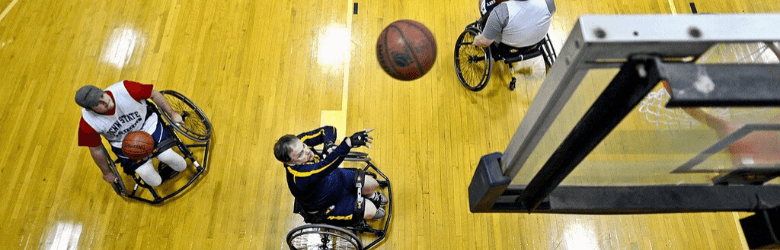
    2. Wheelchair Basketball

    Wheelchair Basketball is suitable for people with varying physical disabilities, especially those that affect their lower extremities. Examples of these disabilities include amputations, spina bifida, cerebral palsy, and disabilities resulting from accidents. To play this sport, you need to have full control of your upper body, including your shoulders, forearm, abdomen, and chest muscles.

    Procedure:

    If you’re pursuing wheelchair basketball professionally, the basketball hoop retains the 10-foot measurement and the court is of standard dimensions. However, if you’re playing the game for leisure, there could be a few modifications suited to the needs of the players.

    Your main intention of engaging in wheelchair basketball is to strengthen your lower extremities. So, when scoring, try as much as you can to lift your body off the seat by pressing your feet against the floor. However, monitor the height that your body rises to, to ensure you have a soft landing.

    two disabled persons playing basketball

    Image Source

    3. Seated Knee Raise

    Seated-knee-raises are excellent for people that are seeking to strengthen their hip flexors. Hip flexors are the muscles located around the hip section that aid movement in that area.

    People with weakened hip muscles often experience difficulties bending or walking. Seated-knee-raises are also best for people who have a degree of control over their lower bodies.

    Procedure:

    1. From a sitting position, raise one of your knees up till your foot is some inches above the ground.
    2. Lower the knee gently to the position where you began.
    3. Repeat the process as many times as possible with one leg, then do the same for the other leg.

    You may experience problems lifting your feet completely off the ground, depending on the level of control you have over them. In that case, you can leverage your calf muscles to help flex the ankle. Better yet, you could take it a notch higher by experimenting with power scooters. Just ensure you purchase your scooters from a reliable supplier.

    4. Seated Tricep Dips

    Seated-tricep-dips are ideal for people with significant strength in and control over their upper bodies. The exercise is intended to boost the strength of your triceps, chest muscles, and the muscles in front of the shoulders.

    If you use a wheelchair, this exercise will greatly help you to maneuver through difficult terrains and when you’re transferring from the wheelchair.

    Procedure:

    1. In a sitting position, rest your hands on your wheelchair’s armrests or another support nearby.
    2. Place the hands such that they’re positioned directly below your shoulders.
    3. Raise your body to a position where the arms are now fully extended.
    4. Lower your body to the original seated position.

    You can always complement the efforts of your arms using your legs, especially if you have more strength in your foot than you have in your hands. However, do much of the lifting using the arms.

    5. Seated Shoulder Press

    This is an exercise that’s perfect for those looking to boost the strength of their shoulder muscles, which translates to improved strength on the arms.

    If your disability doesn’t affect your grip strength, then this is the exercise for you.

    Procedure:

    1. Take weights into each hand, then sit down with your body upright.
    2. Raise the weights to a position above your shoulder line and hold them there for a few seconds, ensuring your palms are facing forward.
    3. With your palms still facing forward, push the weights over your head such that they somewhat meet around the middle.
    4. Lower them gently to the position that you began.

    The convention is to begin with no weight, then proceed to a lighter weight as you work your way up. You could also experiment with a resistance band in the place of weights.

    6. Reverse Crunches

    Reverse Crunches are recommended for people with a disability that doesn’t affect their abdominal muscles. This exercise is suitable for those who want to improve the strength of their abdominal muscles but are unable to perform crunches or sit-ups.

    Procedure:

    1. Sit on the floor and bend your knees at an angle of 90 degrees.
    2. Gradually push your upper body backward till the body rests flat on the ground but facing up.
    3. Gently return to the seated position that you started with, in whichever way that you can.
    4. Lower your body once again, this time rolling your spine and ensuring that your vertebrae touch the floor one after another.

    The secret to excelling in this exercise lies in focusing deeply as you lower your body and roll your spine. You don’t want to suffer a muscle sprain in the process.

    7. Resistance Band Leg Press

    This exercise is appropriate for people with disabilities that allow them a degree of control over their lower bodies. It’s the easier alternative to sit-to-stand, with a couple of more bonuses. This exercise is good for strengthening your thigh muscles and glutes.

    Procedure:

    1. Begin in a seated position and hold a resistance band such that each of your hands holds either end of that band.
    2. Keep the middle section of the band looped beneath one foot.
    3. Exert enough tension on the resistance-band such that your leg now appears bent, and your knee faces your chin.
    4. Maintain that tension for a few seconds and straighten your foot by pushing it towards the ground. That will ensure the band stretches even further.
    5. Now, let the resistance-band draw your leg back to its initial bent position.

    One expert advice while performing this exercise is to vary the intensity of slack in your resistance band, or the tension you exert on it.

    There are several workouts and sports activities that someone with a disability can perform to help stay active. We hope you found these workouts and sports activities helpful.

  • Encouraging Amputees and Individuals with Limb Difference to Get Active and Improve Their Physical and Mental Health

    Encouraging Amputees and Individuals with Limb Difference to Get Active and Improve Their Physical and Mental Health

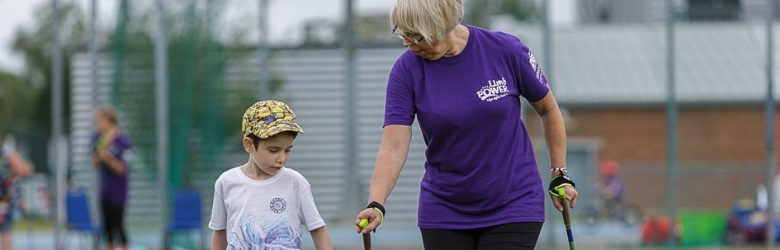
    The charity LimbPower are working throughout the month of August to encourage and engage with people with a limb difference, to help them kick start a healthy and active lifestyle.

    Being active has so many health benefits, including aiding mobility, rehabilitation and improving quality of life. Through sharing and promoting the Ottobock Fitness App (available through the Apple store and on android mobile phones) as well as LimbPower’s exercise videos (available on YouTube and the LimbPower website www.limbpower.com) we aim to support and encourage more members of our community, as they build their independence through increased mobility.  

    Join the social media campaign - #ActiveAugust – to raise awareness of the physical and mental health benefits of engaging in physical activity with a focus on moving more.

    Amputees and individuals with limb difference can join LimbPower for #ActiveAugust and challenge themselves to get fitter through the #OttobockFitnessChallenge. They will be doing a daily morning workout using the OttoBock fitness app, choosing between strength and endurance, condition and balance, or stretch and relax. Participants can do as little or as much as they want to, in the comfort of their own home.  

    “Over 25,000 amputees around the world use the Ottobock fitness app for targeted physical fitness and increasing their strength,” says Amanda Sarson from Otto Bock Healthcare PLC. 

    The exercises available have been designed by Ottobock’s leading physiotherapists and are easy to follow, with videos and guides to ensure users get the most from their rehabilitation and exercise. While the app cannot replace a professional course of therapy, the exercises are designed to help maintain fitness for amputees and can be integrated in their daily routines.” 

    LimbPower will also be running a social media and fundraising campaign called #IPledge for individuals who are already active and want to challenge themselves to do more or achieve a new goal.

    Participants will be encouraged to share their story with other amputees and individuals with limb difference on social media and create a JustGiving page (www.justgiving.com) to raise funds for LimbPower, so that they can continue to support and encourage individuals with limb difference through the provision of participation events, workshops and resources.  

    Active August logo

    To find out more about #ActiveAugust or to get involved contact Kiera Roche atkiera@limbpower.com or Kerry Munroe at kerry@limbpower.com or telephone 07968 760001. 

    #Active August eventJoin up to #ActiveAugust campaign on our Facebook events page

    This post was sent to us by LimbPower, a National Disability Sports Organisation working to support amputees and individuals with limb impairments in physical activity, sport and the arts. We do this through advocacy, events, workshops and resources. 

    Would you like to have your story featured on Disabled Living’s blog? Get in touch with us via info@disabledliving.co.uk

  • David Completes an Incredible 30 Wheelchair Marathons in 30 Days

    David Completes an Incredible 30 Wheelchair Marathons in 30 Days

    Three times HBSA Disabled Sportsperson of the year David Williamson has completed an incredible 30 wheelchair marathons in 30 days. This is something which has never been achieved before.

    David from Petersfield (40) who works for car finance company Moneybarn, had both legs amputated through the knee when he was a few months old, having been born without tibia bones. As well as pushing marathons and being a five-time participant in the Great South Run, David has also completed a 24-hour wheelchair push. He has also played over 300 games for South Hants Sitting Volleyball. In 2016 he was the recipient of the 2016 #wecandoit Personal Achievement Award.

    Since 14th June 2019 David has been pushing a marathon a day, back-to-back with no rest days!

    Using athletics tracks in the South East of England and then down on the sea front at Southsea, David completed his 30th, and final marathon, at Stoke Mandeville Stadium in Aylesbury, Buckinghamshire on Saturday, 13th July. This coincided with the LimbPower MoJo MaraFun Day.

    All funds raised from the 30 in 30 challenge will be split equally between:

    • LimbPower – launched in November 2009, engaging amputees and individuals with limb impairments in physical activity, sport and the arts to improve quality of life and aid lifelong rehabilitation. In July 2014 LimbPower became a National Disability Sports Organisation and working with the Activity Alliance and Sport England, helps amputees and people with limb impairment reach their sporting potential as well as providing support and resources for families and healthcare professionals.

    “What David has achieved with his 30 in 30 challenge is beyond words,” said LimbPower CEO Kiera Roche. “Not only has he raised an amazing amount of money which will enable us to continue our work. But he has also raised awareness of disability sport by taking the dis out of disability.”

    portrait of David smiling in his wheelchair

    • Three-year-old Felicity has undiagnosed genetic conditions which the doctors think cause all of the different problems she has. She has three brain conditions, is visually impaired, has reflux and epilepsy. Felicity also has twitches every day that cannot be controlled by medication. Due to the complexity of her conditions, she needs 24-hour care.

    “It’s just incredible what David has put himself through. He’s an inspiration for everyone – able and less able.” – Felicity’s parents.

    • Four-year-old Emerson developed a cyst on his spine when he was just two years old which paralysed him from the waist down. He lost all movement in his lower body and is unable to walk.

    “David has been such an important part of Emerson’s journey so far. He’s been a real inspiration and a great role model for Emerson.” – Emerson’s parents.

    “I knew going into this event that it would be the biggest, hardest, most daunting challenge of my life, “says David.  “Physically I’m exhausted, I’m beaten up and broken down from day after day of pushing over 26 miles with no time to recover and reboot. Mentally it’s been a roller coaster of days when it’s been tough and days when it’s been even tougher – those are the days when I had to really dig deep and just keep going.”

    “But failure was never an option and at the end of the day I kept reminding myself why I was doing it – for LimbPower and for Felicity and Emerson.”

    “I was told – over and over again – that pushing 30 marathons in 30 days in a wheelchair was impossible. And I agreed. But I did it anyway.” said David.

    To support David in this epic challenge please make a donation at:

    https://www.justgiving.com/fundraising/dw30in30

    For further information please contact:

    • David Williamson on 07850 544637 or email irishego@gmail.com
    • Kerry Munroe at LimbPower on 07798 780533 or email kerry@limbpower.com

    If you would like to feature as our ‘Story of the Month’ on Disabled Living’s blog, please get in touch with us via info@disabledliving.co.uk

Disabled Living