Tag: Dementia

  • Living Changes to Help People Stay Safe and Independent at Home

    Living Changes to Help People Stay Safe and Independent at Home

    This is a sponsored post written on behalf of Agincare.

    As we get older, some of the daily tasks we used to find easy to carry out and take for granted may not be as straightforward anymore. Whether it’s reaching up to find something in a cupboard or making a cup of tea, it’s inevitable that as we grow older in age, our mobility and health can be affected. Although this is something a large number of people are faced with, it doesn’t mean you’re no longer able to live independently and safely.

    Being independent is something we all appreciate, no matter how young or old we are. It’s inevitable that having our independence taken away from us can negatively affect our lifestyles, so it’s important to prevent this. In later life, health issues such as hearing impairments and more severe problems like Alzheimer’s disease become more common, but there are a number of ways individuals who have these problems can still live independently.

    As part of their latest campaign, Agincare wanted to share some simple changes which can be made around the home, for people with some of the most common health issues in later life. Five floor plans have been created and outline how it’s still possible to live independently and safely, even if you have issues such as frailty and Dementia.

    Below are a few examples from the Agincare campaign.

    Dementia

    For someone living with Dementia, their own home is a place of safety and comfort. It’s widely known that Dementia affects people’s memory, so it’s important to take this into consideration if a family member has the illness and wants to live alone.

    To begin with, as Dementia can make people forgetful, it’s important you make sure they can come to no accidental harm. It’s a good idea to fit overflow plugs wherever there are taps, such as in the kitchen and bathroom; which will prevent the risk of flooding. If your friend or relative often tries to leave their home, then sensor alarms are a great way to alert you when this is happening, which then means you can check if they’re ok and need any assistance.

    Visual impairment

    When having a visual impairment, living alone can be challenging, but this doesn’t mean it can’t be done. A number of simple changes around the home can go a long way in this case and they don’t have to come at a price.

    It’s important that during the day, as much natural light is brought into the home as possible. Using different textures for items of furniture and other commonly used products will allow people to easily distinguish where they are and how to safely move around. Bright colours can often help individuals with visual impairments, so opting for contrasting colours when it comes to furniture can make objects become clearer.

    Frailty

    As we grow older, frailty is something we will all experience, but again, simple changes around the home can ensure we live safely and independently.

    Falls are a lot more common for people in later life, so it’s important to minimise any risks as much as possible. Making sure furniture is spaced out means there are no narrow gaps you need to manoeuvre through. Reaching up to find things in cupboards can also result in falling or other types of injury, so it’s wise to put storage boxes on top of units to make life that little bit easier.

    After looking at Agincare’s floor plans and the changes they have suggested, you can start to see that people with health issues can live safely and independently. Whether it’s fitting sensor alarms or making sure furniture is spaced out as much as possible, a number of simple changes can make someone’s life more safe and secure.

    We want to know what you thought of the points mentioned and the floor plans Agincare have created. Join in the conversation on social, using #HomeForTheElderly.


    If you would like to feature on Disabled Living’s blog please send an email to: info@disabledliving.co.uk

  • Disabled Living Host 1950’s Tea Dance and Jive The Afternoon Away

    Disabled Living Host 1950’s Tea Dance and Jive The Afternoon Away

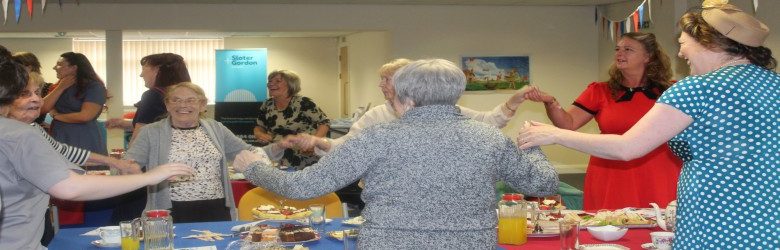
    This Story of the Month ties in with our 1950’s tea dance that we held for people with dementia and their carers. This was the second tea dance that we have hosted since July and we are pleased to say it was another enjoyable day for all.  On Tuesday 27th February, we were joined by our wonderful volunteers from the League of Jewish Women, guests from Future Directions (service users at Redbank House’s multi-sensory rooms), tenants from Bourke Gardens, and other people with dementia and their carers. 

    The room was full of 1950’s decor including neon food and drink signs, a diner girl and chequered pattern wall, small plastic vinyl discs hanging from the ceiling and much more. Once again, we provided our guests with lots of sandwiches, cake, tea, coffee, and juice. This must be where they got their energy from to sing and dance away! Thanks again to Le Mange Tout for your lovely catering service.

    Marylin Snyder recently resigned as a Trustee at Disabled Living after 25 years. She attended our tea dance to support with hospitality, along with her colleagues from the League of Jewish Women.

    marilyn smiling disabled living
    Marylin with her flowers from Disabled Living

    On behalf of the League of Jewish Women I would like to thank you for an amazing Tuesday afternoon. Walking back to our cars some of  the comments made were:-

    • I feel guilty, I went to help and ended up having a brilliant time.
    • I had more fun this afternoon than I had over the weekend!
    • All the staff made you feel so welcome.
    • Anytime Disabled Living would like a volunteer, let me know because I would love to help out again.
    • What gorgeous food and fabulous entertainment.

    All I can add to that is if the guests enjoyed themselves only half as much as the volunteers it would have still been a roaring success. Talking to the guests and seeing the looks on their faces how much they were enjoying themselves, you could see that, all your efforts were worthwhile and very much appreciated by them all.

    We’re absolutely delighted to have received further positive feedback on our tea dance.

    Diane Knowles

    Thank you so much for yesterday we had a wonderful time. You all go to so much trouble to make it lovely for us all.  The pictures are great and I will show dad them to help him remember. Many thanks, to you all.

    Jacqui Woodall

    I wanted to thank you and staff/volunteers for a fabulous afternoon and for making us feel so welcome! Myself and our customers really enjoyed ourselves. Your hospitality was second to none and  the entertainment girls were brilliant too.

    Seeing everybody smile made our day. We look forward to seeing you all again at our 1960’s themed tea dance.

  • Raising Awareness for Alzheimer’s and Dementia

    Raising Awareness for Alzheimer’s and Dementia

    Dementia and Alzheimer’s are affecting more people each year which is why more awareness needs to be made. The confusion of mental processes causes memory disorders and changes in personality. 

    Disabled Living’s Dementia Tea Dance

    We organised our very own 1940’s Dementia Tea Dance to kick-start our celebrations for providing 120 years of service. The day made us realise how important your memory is. All of the precious memories that our brains can store is amazing.

    However, it’s heartbreaking to see some of these taken away from dementia and Alzheimer’s. We are looking forward to welcoming more guests to our next tea dance in December. We hope to raise further awareness and give them a day full of happiness and joy.

    How research and awareness helps

    Raising awareness of dementia and Alzheimer’s can help people recognise the early signs. Without the research from organisations such as Dementia UK and Alzheimer’s Society developments with helping the conditions wouldn’t be able to move forward. Awareness also helps to educate families and carers to understand the different stages and medication procedures to expect.

    Dementia is usually diagnosed by health specialists such as: psychiatrists, geriatricians, and neurologists. Assessments are made and patients will be made aware of the next steps if necessary. There are several research strategies and projects that are implemented within dementia and Alzheimer’s related organisations.

    Take a look at the video below by Alzheimer’s Society.

    The more awareness you raise, the more attention there is to how you can help someone with these conditions. Diagnosis can be challenging and without the awareness there would be less dementia friendly communities. We are proud to see so many wonderful ones in Manchester.

    Memory Walks are taking place across the UK

    Many cities across the UK are participating in the Memory Walk. You can see where your nearest Memory Walk is taking place by visiting: www.memorywalk.org.uk/find-a-walk/

  • Disabled Living’s Dementia Tea Dance – Celebrating Our History of 120 Years

    Disabled Living’s Dementia Tea Dance – Celebrating Our History of 120 Years

    On Tuesday 4 July, Disabled Living hosted our very own 1940’s Dementia Tea Dance in coordination with Health Information Week. The aim of this event was to kick-start our celebrations for providing 120 years of service.

    The event was for people with dementia and their carers to enjoy an afternoon filled with music by The Daisies. Many of our guests got into the celebratory spirit as they danced and sang to songs from the 1940’s, 50’s, and 60’s.

    The Daisies
    Disabled Living hired The Daisies to perform at a 1940’s themed tea dance for people with dementia, their relatives and carers. This event was to mark the start of Disabled Living celebrating 120 years of providing services.

    Debra Evans, Chief Executive of Disabled Living said:

    It was essential we had a very interactive and upbeat performance as photographs and videos which we taken on the day will be used for social media and our website. In addition, Disabled Living have been awarded Heritage Lottery Funding for a range of projects showcasing our history and this event will be captured within elements of these projects.

    Our guests and staff absolutely loved the show The Daisies put on; their compilation of tracks was spot on, with an extremely polished and professional performance.

    Slater and Gordon UK

    Alzheimer's Society

    We were delighted to have representatives from Slater and Gordon Lawyers who came along to provide people with advice about wills, trusts and mental capacity issues.  To ensure our guests, relatives and carers had up to date knowledge on the range of services available to support people with dementia we also welcomed our colleagues from the Alzheimer’s Society.

    To fit into the 1940’s theme, we had vintage posters displayed around the room including ‘We Can Do It!’ and ‘Dig for Victory’.

    Tea was served in our vintage tea pots and cakes were displayed on these lovely vibrant floral two-tier cake stands. The whole selection of food enjoyed by all included sandwiches, cakes, scones and of course, plenty of cups of tea and coffee. The china plates, cups and saucers made a wonderful contribution to our 1940’s theme.

    Thank you to Le Mange Tout for your catering service – you never disappoint us.

    Cakes

    Our guests also had the chance to experience our multi-sensory rooms to get a feel for the vibrant and relaxed atmosphere that they have to offer.

    Members of staff happily joined in with the 1940’s theme and wore clothing which represented that era. Many of the female members of staff wore 1940’s cocktail dresses, polka-dot dresses, and another included a land girl outfit, with our hair styled in waves, curls, and rolls. Lawrence our caretaker suited up for the occasion too!

    Disabled Living's Dementia Tea Dance

    We would like to thank IAS, De Brook Lodge (Ideal Care Homes), all of our guests and members of staff who joined us to kick-start our celebrations for 120 years of providing services and being part of this special occasion.

    A guide to alcoholism and dementia by Oliver Clark. This post also includes an infographic {showing|detailing|outlining the long-term effects of alcohol on the brain.

Disabled Living