Tag: parenting

  • 6 Fun Activities to Help You Bond with Your Autistic Child

    6 Fun Activities to Help You Bond with Your Autistic Child

    Brenda Kimble is a writer and stay-at-home mother of two daughters and a son, plus their beagle named Duke! She loves blogging, crafting, and spending time with her family. She is also a strong advocate for those with special needs and writes to give a voice to the often unheard. She shares some fun activities to help you bond with your autistic child.

    One of the common challenges parents with an autistic child experience is finding an activity or hobby that can help them form a stronger bond while providing their child with a sense of accomplishment.

    But the fact that autistic children do not interact with the world in the same way that neurotypical children do does not mean they are unable to form bonds. It simply means they find a different way to do so.

    mother and son with building blocks

    These six fun activities and hobbies are great, offbeat ways to spend time building a sense of trust and connection that both you and your child can enjoy.

    Video Games

    Today, it’s hard to find a child who doesn’t enjoy video games, and for children affected by autism, video games are especially appealing. This is due in part to the fact that video games are highly visual and structured and provide immediate feedback.

    Video games can also help children on the spectrum practice social and communication skills in a safe and comfortable setting.

    Minecraft, Pokémon and Mario Bros are classic games that can be played in two-player mode, so you can join in on the fun and help children connect social skills and sustained perception with the activity.

    If you or your child don’t know how to play, it’s the perfect opportunity to bond over learning something together. It also gives your child something to talk about with you and others, which allows them to practice their social skills.

    Art Therapy

    range of arts and crafts on the floor

    Art therapy is a form of occupational therapy that helps individuals communicate, understand and cope with the world they live in.

    The art or craft you choose can be as simple or as complex as you and your child would like. It’s entirely up to you! Some autistic children enjoy working with paints and taking a child outside to paint what they see is a great way to expose them to new environments.

    Beading is another excellent choice, as threading beads helps children practice their fine motor, concentration and planning skills. As your child’s interest progresses, incorporate gemstones, pearls or other standout beads to create statement pieces that your child can be proud of.

    Some autistic children have an affinity for understanding how things work. If this describes your child, you may want to try making devices, such as clocks or small engines. There’s a growing community for device makers and inventors, and starting with small, uncomplicated devices can help your child develop their cognitive skills and engage in a community of individuals with similar interests.

    Lego

    boy in grey playing with LEGO blocks

    For many children and nostalgic parents, Legos aren’t just a toy. They open up a whole new world of imaginative play, creativity and possibilities. For children with autism, Legos are a form of play therapy that allows them to develop various skills at their own pace.

    Legos can help your child apply their current interests, such as science fiction or a certain movie franchise, to a new medium and expose them to new challenges or changes that are outside of their calming repetitive play.

    For children who become upset with change, begin slowly. Work with sets that have instructions the child can follow before beginning to show them how designs can be altered to make new creations. In this way, instead of forbidding your child to engage in their repetitive and calming activities, you are using Legos to enhance and complicate those activities while encouraging them to engage with you and not just play parallel to you.

    Science Fiction/Fantasy

    assorted comic books on brown wooden shelf

    Sci-fi comics and novels are popular and, for people with autism, these universes can be engrossing. Autistic children engage with the stories of their favourite characters by reading graphic novels and comics and watching the movies to learn every detail–and they can even socialise with fellow fans in clubs or try out cosplay.

    If these worlds appeal to your child, spend some quality time bonding with him or her by joining in. Try making costumes together, learning the details by reading the books or watching the movies together and ask your child to share their knowledge with you.

    Trains

    Train spotting is a popular hobby that can be very appealing for autistic children, as train schedules, numbers and specs are complicated but logical and easy for children with autism to engage with.

    If you do not live near trains, try watching Thomas The Tank Engine with younger kids and playing with the associated toys and railroad track sets. The franchise is very popular with children on the spectrum, and some speculate this is because the characters are easy to associate with. The trains crash, fall and bump, and the toys can be lined up logically.

    If trains do capture your child’s interest, try expanding on that interest together. Watch videos, read books or consider collecting model trains, as many model train collectors have regular meet-ups, clubs and events your child may like to participate in eventually.

    Animal and Pet Care

    boy holding pet

    Autistic individuals often enjoy the company of animals and pets because they are less invasive and decoding their social cues requires less “work” than interacting with people. In fact, studies have even shown that, after interacting with animals, autistic children become more responsive to people and they are often more able to communicate with people in the presence of animals.

    If your child has an interest in animals, use this interest as an opportunity to bond. Consider fostering animals if you have the means.

    How to choose the right activity

    Bonding with your child is one of the most rewarding experiences you can have, but you need to approach it in the right way. If your child is nonverbal, watch how they play and pay attention to how they try to share this with you. If your child is verbal, you can ask what they like and what they think they might like. Always try to join in where possible. Follow their lead and try to match their structure and pace of play.

    You may also want to consider an activity that expands on your child’s interests. For example, if they enjoy reading, try a trip to the library. If they like baseball cards, they might like to watch a game or try out the batting cages.

    However, remember to take small steps. Going from an interest in baseball cards to watching a full game may be too much for your child. Try a comfortable in-between instead, like watching an inning on TV or at a local school game.

    Finally, stay relaxed and have fun. If you or your child find the activity too stressful to enjoy, take a step back and consider a new approach.

    The Takeaway

    In finding new activities to enjoy with your child, always remember that children with autism don’t interact with the world in the way you might expect.

    Build up to new, more complicated activities slowly, and don’t give up too quickly if your child does not react how you expect them to. Give your child time to get used to these new activities.

    Most of all, be proud of all the new achievements that you and your child accomplish together–no matter how small.

    Do you have an autistic child and would like to share their story on Disabled Living’s blog? Please get in touch with us via email: info@disabledliving.co.uk. We look forward to hearing from you.

  • Summer’s Story of Life with Spina Bifida

    Summer’s Story of Life with Spina Bifida

    January’s Story of the Month has been written by Shaun Finlay from Hastings. He tells us the story of his daughter’s life with spina bifida.

    Summer was born with a hole in her spine. Her nerves were all exposed causing her to be paralysed from her chest down. This has resulted in her now being a full-time wheelchair user, double incontinent and very reliant on those around her for daily support.

    On top of this she was also born with Hydrocephalus (extra fluid on the brain). This is controlled by a ‘shunt’ which drains the fluid from her brain down to her belly. It is essentially a valve, which is programmed using magnets, to control the amount of fluid to be drained. Unfortunately this means she must avoid heavy magnetic fields, e.g. airport scanners, MRI scanners, as they can adjust the setting of the shunt.

    With all of these diagnoses, she has had to deal with much more than the average 6 year old. Currently she has had 4 brain surgeries, 1 major spinal surgery, multiple bladder surgeries and regular scans and check-ups, most of which are done in the Evelina Children’s Hospital in London. She also has many more operations planned for her future, including a full bladder reconstruction.

    Fighting for Summer’s needs

    As a family we often have to fight on Summer’s behalf, for equipment and services that she should be entitled to and should be receiving as standard. For example; when Summer was just 2 ½ years old, her consultant in Evelina recommended she have a wheelchair for her own independence and self esteem. However, her local wheelchair service declined. This then bought our first big fight for her!

    summer practicing moto cross

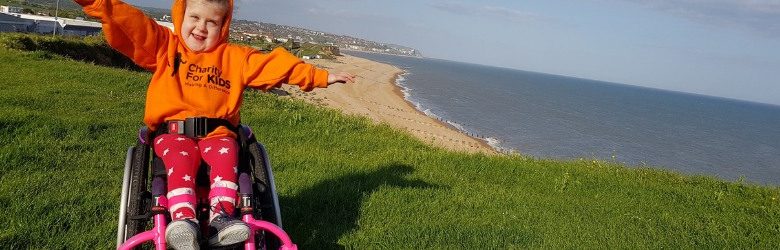
    We were very lucky to come across a small local charity (Charity For Kids) who were able to fund a Quickie Youngster 3. This is a lightweight wheelchair that suited all of her needs. Since then the charity has assisted in the purchase of further equipment which was declined by the NHS, including physio equipment and her 2nd wheelchair, a Ti-Lite Twist. The local community also pulled together to raise money for a specialist bed for Summer, again cementing our faith in the community spirit of Hastings.

    All of this obviously takes its toll on Summer and the whole family, however to meet Summer you would never guess! She is a very bright and cheery little girl, who loves unicorns, fairies and princesses. Summer has an extremely kind and caring nature. She is one of the most selfless people I know, regularly engaging in charity events to ‘give back what they have given’. She is currently training with her dad for her 1st half marathon! Summer is a big personality in the local community, spreading joy and smiles everyday.

    Summer’s favourite hobbies and activities

    summer group photo smiling

    Despite her obvious challenges, Summer loves to join in playing with her peers and is involved with an inclusive cheer group, performing in shows and events. She has recently begun ballet, with the prospect of shows and dance exams in the near future and also involves herself with local charities attending events and raising funds to support others. To date, Summer (with help from family and friends) has raised nearly £10,000 for charity and has more planned for future events.

    When she isn’t dancing, Summer has a daredevil streak within her. Having discovered para-athlete Aaron Fotheringham on YouTube, Summer has been interested and involved in WCMX (wheelchair moto cross). She has followed her older brothers and taken her wheelchair to skate parks and ramps and also to BMX pump tracks. Although she finds it rather daunting and scary to start, she loves the thrill of speed and pushing herself and her chair to its limits.

    Her WCMX dreams came true in June 2016, when she got to meet Aaron. Nitro Circus (who Aaron performs with) were performing in Sussex. Aaron invited Summer to have VIP tickets to watch the show and meet with Aaron afterwards. Here, Summer watched him do his back flip in his wheelchair, off a 50ft ramp! Summer said to her mum and dad, “I want to do that!”

    What we love the most about Summer

    Any parent would agree that, every achievement your child makes will make you proud. As a parent of a child with additional needs those achievements can be very different. With Summer’s paralysis and the challenges that come with that, her sheer determination and perseverance inspires us, her friends, peers and everyone she meets. This was recognised last year when Summer was awarded with the ‘Gold Award’ at the ‘2018 Child Of Sussex Awards’ in Brighton. Today, it’s still a huge highlight in her life. And it gives her the recognition of the brave, strong and amazing little girl she is.

    summer receiving her award

    In the six years of her life, we have become more than just parents. We have become carers and nurses to her, advocates for hers and all disabled rights. We have become specialists in her conditions and a voice to stand up for her rights and needs. This is part of the ‘behind-the-scenes’ of parenting a child with extra needs, which no one ever tells you about. But we wouldn’t change a thing!

    You can follow Summer’s Story through social media on Facebook, Twitter and Instagram using the links below.

    www.facebook.com/summers.story1

    www.instagram.com/Summers.story1

    www.twitter.com/summersstory1

    Does your child have spina bifida? If you would like to submit a story to Disabled Living’s blog please send an email to: info@disabledliving.co.uk

  • Home and Life Modifications for Disabled Parents

    Home and Life Modifications for Disabled Parents

    This is a guest blog written by Ashley Taylor. She offers her advice on the challenges that disabled parents can face. 

    Having a baby is one of the most exciting times in a person’s life. You’re getting to know a new person who depends on you completely. And they will grow up to be an independent human being. How amazing is that? If you have a disability, parenting comes with an extra bit of challenges that you have to learn to overcome. But you can. And you will!

    If you have a disability, you’ve likely already modified your home to accommodate your needs. But with a baby on the way, you’ll probably need a few extra accommodations. You might need to make extra modifications to your home and life so you can get around with a baby in tow.

    Consider consulting an occupational therapist. OTs are especially trained to help people live their lives independently. An OT can take a look at your life, your abilities and needs, and she can work with you to help make modifications or give you special exercises that can help. She can also recommend new ways to handle child care that you might not have thought of, such as ways to put baby in a car seat or adaptive ways to carry the baby.

    Hire a contractor

    Look for a contractor who is experienced in home modifications for people with disabilities. A contractor with experience in disability modifications can discuss your needs with understanding and work with you on what needs to be done. You may need extra ramps to get in and out of your home, expandable hinges for doorways, skid-resistant flooring or more.

    Paying for it

    Many states, cities and organisations offer grants and special loans for people with disabilities to get modifications made in their homes. You can also have fund-raisers and ask friends and family for help in getting ready for baby. If they can’t pitch in money, they might be able to offer their elbow grease and potential babysitting.

    Adaptive furniture

    baby's room with clothes

    You’ll need a crib, stroller, changing table and more. Luckily, there are more options these days than ever before for adaptive parenting. You can find bassinets that attach to the side of your bed, cribs with side-opening doors, adjustable cribs and baby beds and even strollers meant for parents with disabilities. You can even consider hiring someone to adapt a piece of furniture for you, or find a non-profit that can help you for free.

    Ask for help

    Nobody can raise a baby on their own without the help of others in their lives to offer support and encouragement. So, don’t be afraid to ask for help if you need it. You’re responsible for another person’s life. So being a martyr isn’t going to help anyone. Ask your family, friends, other parents or anybody who can help you get what you need. Your baby is worth it.

    Once you have your baby in your home, you’ll be amazed at how she will change your life. Yes, you should be prepared to get little or no sleep and experience the same stress that other parents endure while raising a child. But the love you’ll have for your little one will knock your socks off. You’ll be so amazed at your child’s ability to bring out the best in you, that you won’t remember what it’s like to not be a parent. Watching your little person grow into an independent adult will remind you that life is amazing. And you won’t want to miss a single second of it.

    For more stories like this please visit the Disabled Living blog. Or if you would like to share a story of your own offering advice to disabled parents then please contact us via email: info@disabledliving.co.uk

  • The Story of Vicky and Paul’s Little Miracle with Angelman Syndrome

    The Story of Vicky and Paul’s Little Miracle with Angelman Syndrome

    This Story of the Month is based on a young boy called Sebastian, who attend our Kidz to Adultz North event in November 2017 with his parents. His mum (Vicky) gives her insight along with dad (Paul) about their journey of seeing their little boy grow up with Angelman syndrome.

    Please can you tell us a bit about you and your family?

    We have two sons, Sebastian who is 11-years-old and Harrison 8-years-old. Sebastian was born in 2006 after a very bumpy pregnancy with lots of hospital stays for hyperemesis. Once he was born he had feeding and sleeping problems. He suffered from reflux, which led to him being admitted into Royal Manchester Children’s Hospital at 6-weeks-old for feeding issues. They put a camera down his throat but it revealed nothing.

    However, they found he had sleep apnoea. We were scarily given training in baby resuscitation and Sebastian was placed on a monitor and under a paediatrician until 11-months-old. During this stressful time we had health visitors tell us we were ‘bad parents’ as he wasn’t gaining weight. They accused us of neglecting him because he wasn’t talking and at one point they tried to question family members about our parenting capacity. Sebastian has always been loved, cared for and protected.

    Can you tell us about Sebastian’s condition?

    Sebastian and Simpsons

    When we finally met the physiotherapist, little did we know that when she walked in she knew exactly what condition Sebastian condition was. She insisted we see another medical professional and referred us to a paediatrician in the community who assessed him. After the second appointment we agreed to a blood test. A month passed and we were told that it was something to do with Chromosome 15. It was very apparent that Sebastian had something called Angelman syndrome. We figured this from his delayed mile stones, his non existent language,  and his facial shape and sleep patterns (or lack of).

    We were absolutely heart broken

    But as a first time Mum and a woman who had historically been told she couldn’t have children, we didn’t see Sebastian as being any different. He was still the same little miracle they handed to us when he was born – a beautiful 18 month old who was bright, bubbly, and so very innocent, who had only just learnt to sit up although very wobbly.

    Sebastian scooby doo group photo

    Another month had passed and we were sat in a paediatrician’s office awaiting confirmation it was Angelman syndrome. She confirmed it was Angelman syndrome, a rare condition caused by the gene UBE3A on Chromosome 15 where it’s either deleted, mutated or replaced by two copies from the paternal side (father) in the brain. We were relieved yet still very sad; someone was telling us that our perfect son wasn’t so perfect. She told us that Sebastian could have seizures, struggle to learn to walk and may never utter a recognisable word. We were also told that he may have absolutely no danger awareness.

    We had gone into the appointment with a support worker / portage worker to help us deal with the news. Her first comments were,

    You’ll never be able to go for a meal or do anything normal again.

    Needless to say, she wasn’t working with our little family long. From then onwards we decided that Sebastian would have every opportunity life had to give. At two-years-old Sebastian started with seizures which took years to control and on numerous occasions was in status epilepticus, a prolonged seizure where he was seizing both during being awake and  sleeping. He lost a lot of the skills he’d already learnt and had numerous hospital stays.

    9 years later

    Sebastian with triathlon medal

    Sebastian triathlon photo 2

    Fast forward 9 years, Sebastian has made lots of independent steps. His seizures have become more controlled, with 1:1 help Sebastian attended mainstream nursery and loved every minute being with his little friends. At 3-years-old, Sebastian became a big brother to Harrison, who Sebastian adores and loves to cuddle endlessly. He was a page boy at our wedding and with help walked down the isle.

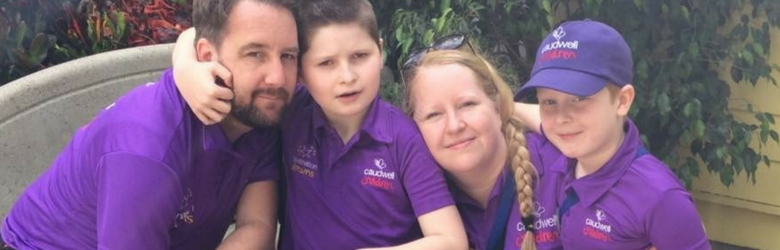
    Sebastian became a Beaver, a Cub, and now he’s now a Scout. He has been on a ‘wish’ holiday with Caudwell Children charity to Florida, a holiday we never thought Sebastian could cope with. And we plan to take him back one day.

    More recently he took part in a super triathlon with his dad to raise money for Caudwell Children charity and Wheels for All. He has been home-schooled and now attends a special needs high school. He’s hardly seen in his wheelchair. There always seems to be something exciting going on there and he’s happy and healthy and loves all of his teachers. He has started using his iPod for communication (mainly for asking for chocolate and telling us he loves us but it’s a start!) And it was only recently that, he muttered that all very important word, ‘Mum’.

    An inspiring journey

    Mickey Mouse and Sebastian

    Sebastian loves life and he loves being in the middle of everything, he has a naughty streak and a loving side. He loves his iPad, YouTube and everything all 11-year-olds love. He’s a typical boy doesn’t want to have a bath or doesn’t want to eat his greens! He sees no evil and has an energy that spurs you on. He makes you a better person and a better parent to help him be all he can.

    Life for us may not be normal but on our journey we have met the most astounding and inspiring people. We’ve lost friends who were scared and didn’t understand. But more importantly, we’ve made new life long friends who are travelling on that same ‘may not be normal life journey’. We thought we were alone but we weren’t.

    Nobody is alone, they just need to find the right support and discover people who are on that same journey.

    If you would like to feature your story on Disabled Living’s blog please get in touch with us via email: info@disabledliving.co.uk

    You might also like to read: ABA Therapy for Autism 

  • Understanding Parenting with a Disability

    Understanding Parenting with a Disability

    Thank you to Chris, our Disability Trainer and Advisor for writing this post about understanding parenting with a disability.

    I’m a wheelchair user who can’t walk at all and have been since I was 7-years-old when I caught polio. But very early on in adulthood I knew I wanted kids. I hadn’t thought it all through then but the thought was always there.

    I graduated and started to work (as a school teacher), and eventually got married.

    By this time I was very confident of what I could and couldn’t do in work, at home, around town, on holiday and so on. But the prospect of bringing up children was something else entirely.

    I had concerns in 3 areas:

    • Could I physically manage? Stairs, transport, carrying baby etc
    • What would other people think? “Is he able to manage?”
    • What came later – how would my growing kids view me? “All my friends Dads are playing football with them…”

    Well I can report that it all worked – not all plain sailing but an incredible journey. Looking back now over the last thirty five years I’m now at the grandparent stage – nine so far with every prospect of many more!

    Of course one short article can’t give you every practical piece of advice you might want.  And the advice is very specific to your disability anyway. I can give you everything you need to know if you’re a wheelchair user and I can give you my general observations on attitudes. This includes ideas for further research (see below). If you are worried there is a tremendous amount of top-quality, specific information out there.

    I think you’ll discover particular solutions that work for you. Disabled people are a very diverse group indeed – the variation across wheelchair users for instance is vast. What’s common though is problem solving and determination.

    close up of baby and parent touching hands

    Okay, so, I can’t walk at all. How do I carry a baby up and down the stairs?

    Why don’t I live in a bungalow you might ask? Well, when I became disabled I already lived in a house and I liked sleeping upstairs so I carried on. Sixty years later nothing has changed!

    I found that if you tightly wrapped up baby in a shawl you could carry him/her in your teeth. Good enough for lions and tigers so good enough for me. I did what I needed to do.

    How do I keep baby safe when I’m out and about if I’ve got my hands on the wheelchair most of the time?

    The standard child harness went over shoulders and clipped to my belt which worked perfectly, just the same as for everyone else.

    What if they run away, you can’t catch them?

    Well, they just didn’t. It’s as if they know you can’t chase so they don’t go running off too far. As they grew I would be trying to give them independence but always telling them not to go too far/too fast. They seemed to take this on board.

    Sometimes you see parents frantically running after their little loved ones and obviously getting really worried that they won’t catch up. But I’d say the child hasn’t been properly primed and that the child absolutely knows the parent will chase. So it’s all a bit of fun to them!

    What did other adults think?

    I’ve always said – most people, most of the time, do the right thing – and that applied here in abundance. There were lots of offers of help and total acceptance of the situation.

    I mentioned I was a schoolteacher. There were some initial reservations about whether I could command a class, deal with emergencies and exert discipline. But the children always responded. They might mess other teachers around but not me!

    I’d often transfer to sit on a higher bench so I could see the class easier leaving the wheelchair empty. The pupils would then argue about whose turn it was to sit in it for the lesson!

    wheelchair users playing basketball

    So, my lads turned out to be very sporty but there were no issues at all around me being unable to participate. They watched me play wheelchair basketball and I watched them swimming, playing rugby and the rest. It all worked so well I found myself running the junior rugby club for years. Interestingly not a single questioning/negative comment ever from players, parents, visiting parents etc I was just decent at the job so they let me carry on.

    There’s lots of hard work but also so much to smile about.

    What’s still happening?

    I park up with one of my lads in the car. He gets out and gets my chair set up. If I’m fiddling with keys, gloves or bags he’ll sit in the wheelchair and scoot off round the car park for a minute. Lots of admiring faces because he’s very skilled (poor lad but doesn’t he do well?).

    He then races back and promptly stands up! Admiring faces change – they’ve been duped. But then I transfer into the chair. Oh, it’s dad and he really is disabled! Conflicted or what?

    Or this – I’m at home in my comfy armchair, wheelchair alongside. Grandchild asks if they can use the wheelchair and zooms off outside. “This is great; can I have one for Christmas?” “None of my friends has got one of these”. “Can I take it to school for “Show and tell?”

    brown wooden empty stair case

    Incidentally, when grandchildren stay over they all copy me on the stairs. If I sit on the top step and start to bump down then so do they!

    Of course I had to sort a lot of these things out as I went along – no computers, no mobiles at the beginning, but now there is a wealth of information out there. If you’d feel safer with more information, then there’s a lot to research relevant to your own specific issues. Just try to approach the situation with some confidence. People have been there before. Disability didn’t just start with the Paralympics. Parenthood will be so rewarding, and you’ll find there are lots of people in the same boat.

    Try these sources of information:

    • NHS Choices – discusses entitlement to support and your needs will be properly assessed.
    • You can also get in touch with other disabled parents via Netmums
    • Scope – where you will find all sorts of useful links
    • Disability Horizons – this website has hundreds of relevant articles and a blog
    • DPN (Disabled Parents Network) – again, endless links here.
    • Super Nanny – lots of useful links
    • Many relevant self-help groups, including specific to your disability
    • Many relevant chat-rooms
    • Lots of online support

    If you would like to share your experience on Disabled Living’s blog about parenting with a disability, send an email to: info@disabledliving.co.uk

Disabled Living