Tag: sport

  • Is Sport Really So Important?

    Is Sport Really So Important?

    Deborah Bell, Enablement Manager at Disabled Living talks about the importance of sport and how it can help you to stay active during the Covid-19 lockdown.

    Yes, sport really is so important because it can develop from exercise! Having been in lockdown for the last few weeks, with one of the few reasons we can venture out, being for exercise, Deborah Bell, Disabled Living’s Enablement Team Manager, has reflected on her involvement in sport as a child, and that of her now adult children.

    Sports England’s Active Lives Research

    According to Sports England, Active Lives Children and Young People provides a world-leading approach to gathering data on how children engage with sport and physical activity. The aim is to enable “children and young people to feel more motivated, confident and able to get active”.

    I thought about my attitude towards sport as a child, my bike was my life, every day in the holidays and after school I could be found freewheeling down the steepest hill I could find, with the scars to prove it. I wasn’t very competitive at school although I was on the hockey team as I was a fast runner.

    As an adult running was my choice of sport, I could lose myself for hours running miles around the town I lived in. It all stopped when I developed an injury as a direct result of my running. I now do no sport and am feeling the consequences. But enough about me. How would I have felt as a child if I couldn’t ride my bike because there wasn’t one adapted for my disability?

    There is an abundance of research proving the various benefits of sport on physical, and emotional health, social value and economic benefits. See the Sports England Active Lives survey: https://www.sportengland.org/research/active-lives-survey/active-lives-children-and-young-people/

    What I am interested in is how we can help to motivate children who are disabled to become more active, it needn’t be a classical sport, it could be gardening or playing outside in the garden. Disabled children often have additional challenges when it comes to things the rest of us take for granted and whilst the range of disability sports has improved massively it can still prove difficult if you have a physical or psychological disability to find the right activity for you.

    How Can We Encourage Our Children to Get Involved With Others Playing Sport?

    We can involve them in what we are doing. We did things as a family so they could learn what motivated us, if we were going somewhere, we talked about it, we read about it. We invited friends so the kids were with their peers.

    When my children were young, I tended to lean towards the things I was interested in, I remember the moans as I made them walk up Ben Nevis one summer. It is only now they are grown up that I hear the pride in their voices if they are talking about it.

    I don’t think it matters particularly what your children are interested in doing, it may not be what you are interested in, but we should encourage and support them as much as possible. I wanted both my children to choose what they wanted to do. My son showed an interest in rugby as a young lad so I rang the local club and duly turned up on a cold Sunday morning so he could run about an extremely muddy field with lads just like him. It caused much amusement for the parents that they were all more interested in the ladybirds under a log at one end of the field than they were in the rugby ball, but hey ho.

    My son likes routines, A LOT so we turned up come rain or shine for the next 7 years, we went in convoy to play neighbouring teams and ate enough bacon butties to feed an army. My son hardly ever touched the ball but that didn’t matter, to him or to me. I encouraged him every game.  He kept all his teeth intact and more importantly built a group of friends he still has today. The teamwork and camaraderie did wonders for his self-confidence, having to stand up for himself in a group of peers was immensely influential  to him becoming a rounded confident adult. He developed a habit of wanting to be fit, now he goes to the gym and boxes, (his teeth are yet again in danger).

    My daughter watched a lot of rugby games, kudos to her for putting up with the rain and snow every week, she was more interested in music than sport but the habits of the family and our attitude to being healthy has impacted on her keep fit routines as an adult, she goes walking , sometimes in the hills and sometimes around the shops  but she is very active.

    A number of Disabled Living’s blogs have concentrated in young disabled people who have overcome whatever challenges they have faced to do a sport they love. You may find a tip on how to motivate your child (or yourself). Sports activities and companies who exhibit at our Kidz to Adultz exhibitions have some great ideas and solutions for you to help your child become involved in sport.

    Have a look at the sensory section of our Supplier Directory for companies who provide toys and outside play equipment. The charities on our Supplier Directory can link you up to organisations in your area who can support you and your child with sport.

    Good luck in your endeavours to introducing sport to your family life, no matter how small it will only be a good thing.

    Get in Touch with Disabled Living

    Our helpline is open if you need to contact us on 0161 214 4590 or email: info@disabledliving.co.uk. You can also join our #DisabledLivingAgainstCorona campaign on Facebook and Twitter.

  • 7 Sports Activities for People with Disabilities

    7 Sports Activities for People with Disabilities

    This is a guest blog for Disabled Living by Heidi Jones, who outlines 7 sports activities for people with disabilities. 

    Over the past couple of years, sports accessibility has increased for those with disabilities. Since the first official Paralympic Games in Rome 1960, more avenues have opened up for disabled people to showcase their talents. As a result, decorated careers have been made from the Paralympic Games and other disability-based championships.

    Aside from the Paralympic Games there are hundreds of different sports and workout routines that a disabled person can experiment with to ensure they stay in top shape, physically and mentally. Read on to discover more about these activities.

    a disabled person in a wheelchair

    Image Source

    The State of Disability and Sport

    According to recent statistics, around 17% of adults with long-term disability or illness participate in weekly sports activities.

    However, the question isn’t about their unwillingness to engage in physical fitness and sports activities. Instead, it has a lot to do with poorly-equipped gyms, inadequate disability-based competitions, and a few other limiting factors. As a matter of fact, a poll that was conducted by Parallel London revealed that up to 83% of disabled people long to participate in more physical activity than they currently do.

    Top 7 Disability-friendly Sports and Fitness Activities

    1.Sit to Stand

    Sit to Stand is a workout that’s suitable for people with a disability that weakens their lower bodies, hence the need to improve the strength around those areas. Examples of such conditions include multiple sclerosis (MS), rheumatoid arthritis, motor neuron disorder, obesity, peripheral neuropathy, Parkinson’s disease and fibromyalgia.

    Procedure:

    1. Perch your bottom on a chair near the front edge, while ensuring your feet rest flat on the ground and behind your knees.
    2. Gently tilt the upper portion of your body forward and make as if to push yourself up into a standing position.
    3. Return your body to the seated position that you started in.

    You may find it difficult to perform this exercise using your arms, especially when it comes to the part where you have to push yourself up. In that case, your knees might come in handy. Just place your hands on top of the knees and try to push yourself up.

    Also, if the disability has severely compromised your legs such that they can’t lift your body at all, you can always make use of a support. Think of a worktop, a crossbar, or a grab rail. Using these support frames, you can now exert as much force as possible on your leg and pull your body as high as you can, before letting it down gently back to the chair.

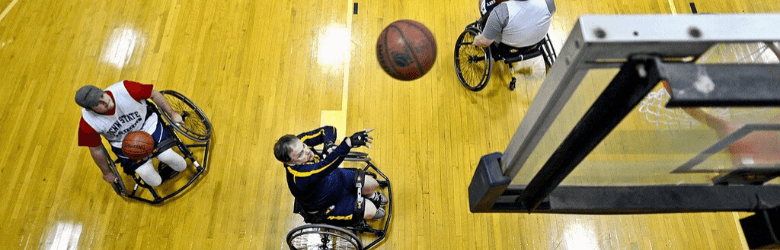
    2. Wheelchair Basketball

    Wheelchair Basketball is suitable for people with varying physical disabilities, especially those that affect their lower extremities. Examples of these disabilities include amputations, spina bifida, cerebral palsy, and disabilities resulting from accidents. To play this sport, you need to have full control of your upper body, including your shoulders, forearm, abdomen, and chest muscles.

    Procedure:

    If you’re pursuing wheelchair basketball professionally, the basketball hoop retains the 10-foot measurement and the court is of standard dimensions. However, if you’re playing the game for leisure, there could be a few modifications suited to the needs of the players.

    Your main intention of engaging in wheelchair basketball is to strengthen your lower extremities. So, when scoring, try as much as you can to lift your body off the seat by pressing your feet against the floor. However, monitor the height that your body rises to, to ensure you have a soft landing.

    two disabled persons playing basketball

    Image Source

    3. Seated Knee Raise

    Seated-knee-raises are excellent for people that are seeking to strengthen their hip flexors. Hip flexors are the muscles located around the hip section that aid movement in that area.

    People with weakened hip muscles often experience difficulties bending or walking. Seated-knee-raises are also best for people who have a degree of control over their lower bodies.

    Procedure:

    1. From a sitting position, raise one of your knees up till your foot is some inches above the ground.
    2. Lower the knee gently to the position where you began.
    3. Repeat the process as many times as possible with one leg, then do the same for the other leg.

    You may experience problems lifting your feet completely off the ground, depending on the level of control you have over them. In that case, you can leverage your calf muscles to help flex the ankle. Better yet, you could take it a notch higher by experimenting with power scooters. Just ensure you purchase your scooters from a reliable supplier.

    4. Seated Tricep Dips

    Seated-tricep-dips are ideal for people with significant strength in and control over their upper bodies. The exercise is intended to boost the strength of your triceps, chest muscles, and the muscles in front of the shoulders.

    If you use a wheelchair, this exercise will greatly help you to maneuver through difficult terrains and when you’re transferring from the wheelchair.

    Procedure:

    1. In a sitting position, rest your hands on your wheelchair’s armrests or another support nearby.
    2. Place the hands such that they’re positioned directly below your shoulders.
    3. Raise your body to a position where the arms are now fully extended.
    4. Lower your body to the original seated position.

    You can always complement the efforts of your arms using your legs, especially if you have more strength in your foot than you have in your hands. However, do much of the lifting using the arms.

    5. Seated Shoulder Press

    This is an exercise that’s perfect for those looking to boost the strength of their shoulder muscles, which translates to improved strength on the arms.

    If your disability doesn’t affect your grip strength, then this is the exercise for you.

    Procedure:

    1. Take weights into each hand, then sit down with your body upright.
    2. Raise the weights to a position above your shoulder line and hold them there for a few seconds, ensuring your palms are facing forward.
    3. With your palms still facing forward, push the weights over your head such that they somewhat meet around the middle.
    4. Lower them gently to the position that you began.

    The convention is to begin with no weight, then proceed to a lighter weight as you work your way up. You could also experiment with a resistance band in the place of weights.

    6. Reverse Crunches

    Reverse Crunches are recommended for people with a disability that doesn’t affect their abdominal muscles. This exercise is suitable for those who want to improve the strength of their abdominal muscles but are unable to perform crunches or sit-ups.

    Procedure:

    1. Sit on the floor and bend your knees at an angle of 90 degrees.
    2. Gradually push your upper body backward till the body rests flat on the ground but facing up.
    3. Gently return to the seated position that you started with, in whichever way that you can.
    4. Lower your body once again, this time rolling your spine and ensuring that your vertebrae touch the floor one after another.

    The secret to excelling in this exercise lies in focusing deeply as you lower your body and roll your spine. You don’t want to suffer a muscle sprain in the process.

    7. Resistance Band Leg Press

    This exercise is appropriate for people with disabilities that allow them a degree of control over their lower bodies. It’s the easier alternative to sit-to-stand, with a couple of more bonuses. This exercise is good for strengthening your thigh muscles and glutes.

    Procedure:

    1. Begin in a seated position and hold a resistance band such that each of your hands holds either end of that band.
    2. Keep the middle section of the band looped beneath one foot.
    3. Exert enough tension on the resistance-band such that your leg now appears bent, and your knee faces your chin.
    4. Maintain that tension for a few seconds and straighten your foot by pushing it towards the ground. That will ensure the band stretches even further.
    5. Now, let the resistance-band draw your leg back to its initial bent position.

    One expert advice while performing this exercise is to vary the intensity of slack in your resistance band, or the tension you exert on it.

    There are several workouts and sports activities that someone with a disability can perform to help stay active. We hope you found these workouts and sports activities helpful.

  • The Links Between Abi Rehabilitation and Sports and Social Life

    The Links Between Abi Rehabilitation and Sports and Social Life

    Sarah Jones, Senior Associate at Clarke Willmott LLP, attends our In the Dock with a Expert Witness workshop. We recently spoke to Sarah to hear all about the ‘Boots, Balls and Brains’ event discover the links between ABI Rehabilitation and sports and social life. 

    About ‘Boots, Balls and Brains’

    For football fans, those interested in rehabilitation, social media and social lives of anyone who works with, supports or lives with an acquired brain injury… we have a wonderful and different event happening in Southampton this month called ‘Boots, Balls and Brains’.

    This is a joint event hosted by Clarke Willmott solicitors and Outer Temple Chambers which will also raise funds for Saints Foundation with a unique day of interactive lectures and information at St Mary’s Stadium, home of Premier League Southampton FC.  The day will be focusing on the links between ABI Rehabilitation and sports and social life, by offering expert advice on the practical ways leisure time activities can be a vital component of and motivator towards the rehabilitation of those affected.

    Headline speaker Dr. Magdalena Ietswaart of the University of Sterling will be speaking about her much debated research into the effects of repeatedly heading a football and will share her thoughts on Brain Health in Sport: Neuroplasticity, Football Heading and Dementia.

    Dr Richard Maddicks, neuropsychologist, talks about the risks of social media and Internet usage for injured clients.

    Additional presentations will come from Susie Quinlan at ILS on the use of therapeutic activities from a case manager’s point of view and Anita Pascoe of West Country Case Management on the practical implications of social media in the world of case management.

    Beneficiaries of the work of Saints Foundation will speak about their own positive experience of sport and ABI, with the support of Saints Foundation personnel.  Legal teams from Outer Temple and Clarke Willmott will provide the latest legal updates.

    Incredible value at only £50 per head for the day (a reduced rate of £25 to delegates from other registered charities), with all proceeds going to Saints Foundation, the event is a must for all neuropsychologists, clinical psychologists, occupational therapists, SALTs, case managers, support workers and sports scientists or anyone with a professional interest in ABI, rehabilitation and sport and social media.

    More information

    Please visit the link for more information and to sign up: https://www.clarkewillmott.com/events/boots-balls-and-brains/

  • LimbPower Create New Player Pathway Resource to Increase Engagement in Activity

    LimbPower Create New Player Pathway Resource to Increase Engagement in Activity

    LimbPower have introduced their new player pathway resource to increase sport activity for athletes and non-athletes with a limb impairment. Sport is for everyone, whatever your age or physical ability. Access can be more challenging for persons with a limb impairment and there can be a myriad of questions, challenges and barriers to overcome, whether you’re just starting to get active or progressing from beginner to a higher level.

    Questions such as, where do I start? How do I access opportunity to try a particular sport? How do I return to a sport I used to play? How do I achieve my goals and ambitions?

    The new Player Pathway resource for athletes and non-athletes with a limb impairment produced by LimbPower (with support from Sport England’s Inclusive Sport Fund and the Activity Alliance), answers some of these questions and will support you in knowing where and how you can access physical activity and sport.

    “One of the major barriers to participation in physical activity and sport is access to information. This new Player Pathway resource is an excellent addition to LimbPower’s suite of information sheets on Accessing Sport and Physical Activity. Each resource we create is designed to fill a knowledge gap to enable individuals with limb impairments to access physical activity and sport.” – Kiera Roche, LimbPower CEO

    The resource clearly shows the different opportunities from grass roots to elite level and highlights the organisations who can support you on your journey and how you can access this support.

    The resource also highlights where and how LimbPower can support you at the different levels of participation.

    “The Player Pathway is a fantastic new resource,” says LimbPower Patron Richard Whitehead. “Not only does it support individuals who want to take part in social physical activity, it also provides guidance for those who want to aim higher and compete at events or games meetings. In addition, importantly the factsheet enables coaches to understand where to sign post for the next opportunities available.” he adds.

    This new resource sits alongside LimbPower’s suite of Accessing Sport and Physical Activity Fact Sheets created to engage individuals with limb impairments in physical activity and sport. The new resource factsheet is available free to download from the LimbPower website www.limbpower.com. For further information please contact LimbPower’s Sports Development Officer Andy Brittles at andy@limbpower.com.

    If you would like to share your news with Disabled Living, please get in touch with us via email: info@disabledliving.co.uk

  • David Completes an Incredible 30 Wheelchair Marathons in 30 Days

    David Completes an Incredible 30 Wheelchair Marathons in 30 Days

    Three times HBSA Disabled Sportsperson of the year David Williamson has completed an incredible 30 wheelchair marathons in 30 days. This is something which has never been achieved before.

    David from Petersfield (40) who works for car finance company Moneybarn, had both legs amputated through the knee when he was a few months old, having been born without tibia bones. As well as pushing marathons and being a five-time participant in the Great South Run, David has also completed a 24-hour wheelchair push. He has also played over 300 games for South Hants Sitting Volleyball. In 2016 he was the recipient of the 2016 #wecandoit Personal Achievement Award.

    Since 14th June 2019 David has been pushing a marathon a day, back-to-back with no rest days!

    Using athletics tracks in the South East of England and then down on the sea front at Southsea, David completed his 30th, and final marathon, at Stoke Mandeville Stadium in Aylesbury, Buckinghamshire on Saturday, 13th July. This coincided with the LimbPower MoJo MaraFun Day.

    All funds raised from the 30 in 30 challenge will be split equally between:

    • LimbPower – launched in November 2009, engaging amputees and individuals with limb impairments in physical activity, sport and the arts to improve quality of life and aid lifelong rehabilitation. In July 2014 LimbPower became a National Disability Sports Organisation and working with the Activity Alliance and Sport England, helps amputees and people with limb impairment reach their sporting potential as well as providing support and resources for families and healthcare professionals.

    “What David has achieved with his 30 in 30 challenge is beyond words,” said LimbPower CEO Kiera Roche. “Not only has he raised an amazing amount of money which will enable us to continue our work. But he has also raised awareness of disability sport by taking the dis out of disability.”

    portrait of David smiling in his wheelchair

    • Three-year-old Felicity has undiagnosed genetic conditions which the doctors think cause all of the different problems she has. She has three brain conditions, is visually impaired, has reflux and epilepsy. Felicity also has twitches every day that cannot be controlled by medication. Due to the complexity of her conditions, she needs 24-hour care.

    “It’s just incredible what David has put himself through. He’s an inspiration for everyone – able and less able.” – Felicity’s parents.

    • Four-year-old Emerson developed a cyst on his spine when he was just two years old which paralysed him from the waist down. He lost all movement in his lower body and is unable to walk.

    “David has been such an important part of Emerson’s journey so far. He’s been a real inspiration and a great role model for Emerson.” – Emerson’s parents.

    “I knew going into this event that it would be the biggest, hardest, most daunting challenge of my life, “says David.  “Physically I’m exhausted, I’m beaten up and broken down from day after day of pushing over 26 miles with no time to recover and reboot. Mentally it’s been a roller coaster of days when it’s been tough and days when it’s been even tougher – those are the days when I had to really dig deep and just keep going.”

    “But failure was never an option and at the end of the day I kept reminding myself why I was doing it – for LimbPower and for Felicity and Emerson.”

    “I was told – over and over again – that pushing 30 marathons in 30 days in a wheelchair was impossible. And I agreed. But I did it anyway.” said David.

    To support David in this epic challenge please make a donation at:

    https://www.justgiving.com/fundraising/dw30in30

    For further information please contact:

    • David Williamson on 07850 544637 or email irishego@gmail.com
    • Kerry Munroe at LimbPower on 07798 780533 or email kerry@limbpower.com

    If you would like to feature as our ‘Story of the Month’ on Disabled Living’s blog, please get in touch with us via info@disabledliving.co.uk

  • Advice from Paralympian Sophia Warner: Motivate Your Child Through Sport

    Advice from Paralympian Sophia Warner: Motivate Your Child Through Sport

    This post has been written by Jennifer Grey on behalf of Paralympian, Sophia Warner.

    Taking your child through the challenges of a cerebral palsy diagnosis can be a difficult process. For many parents, cerebral palsy is something they only become aware of when their child is diagnosed with the lifelong condition.

    But, with 1 in every 400 babies in the UK being born with some type of cerebral palsy, it’s not as uncommon as it might seem. And, as more and more people share their stories of living with the condition, it becomes easier to find the information, help and support that can be invaluable for anyone dealing with a cerebral palsy diagnosis.

    One such person is Sophia Warner, a Paralympian with cerebral palsy who won Silver at the 2011 IPC Athletics World Championships. Sophia began racing at the age of 19 and has since forged an incredibly successful career in athletics. In 2019, she received the British Empire Medal for voluntary service to disability sports. She’s a great example of how anyone – regardless of their condition – can excel in sports.

    We asked Sophia Warner to share with us some tips and advice for helping children with cerebral palsy (and similar conditions) find motivation through sports. Here are her top four tips for embracing sports:

    Disability has no limits

    Sophia swears by the benefits of sport, not only for improving her fitness, but also for allowing her to have a better quality of life overall. Not to mention the massive benefits to her mental health that go hand-in-hand with the improvements in her physical health (particularly as exercise helps keep her cerebral palsy symptoms at bay).

    As you look for ways to motivate your child through sport, however, Sophia recommends taking it slow and exploring as many options as possible. Try lots of different things, in order to find the sport or activity that best suits your child’s ability and interests.

    “It’s all about finding something that your child wants to do every day, and then supporting them through it,” says Sophia.

    Your confidence will come to you

    When it comes to introducing your child to sport, “it’s important to get over the initial barriers which are usually lack of confidence and motivation,” says Sophia, adding that “people with disabilities tend to be the ones who see the greatest benefits from exercise.”

    So, if your child is feeling nervous or self-conscious before starting a sport, try to be a source of gentle encouragement. Hopefully, as they gain a better understanding of their bodies and which sports work best for them, they’ll gain confidence as well.

    Whatever your favourite sport, add swimming to the list

    Sophia says that, while it’s important to explore the sports that you enjoy doing, swimming is one she absolutely recommends for all children with cerebral palsy.

    “From my experience,” she says, “swimming complements other sports and I know that I benefited from swimming sessions alongside my training.” To start off with, find a warm indoor pool and a swimming instructor with experience instructing children who have cerebral palsy.

    Choose a team sport to meet like-minded people

    One of the great benefits of sport is the boost of happy endorphins that exercise releases. But, Sophia reckons there’s more to it. “We all know that being active is great for your physical health, but it can also boost your happiness by enhancing your social life.” If they’re willing and ready, take your child to group sports to help them mingle with other children like them.

    As you adjust to your ‘new normal’ with your child, it can be useful, encouraging and empowering to read stories like Sophia’s. Read her full story in the Cerebral Palsy Advice for Parents hub, which also includes resources and information on other areas of life after a cerebral palsy diagnosis.

Disabled Living