Month: June 2018

  • My Journey with Autism from a Teenager to an Adult

    My Journey with Autism from a Teenager to an Adult

    This blog post is written by a young woman named Aspling who shares her journey of life on the autism spectrum. This is also featured on Redbank House, who are part of Disabled Living.

    Let’s be honest here, when you think of autism or being on the autism spectrum, you generally think about children, with adults being an afterthought. And in terms of support this is the same. There’s so much support for children, but for adults there’s next to nothing. I received my diagnosis early in 2017 at the age of 25. And for me, my diagnosis came as a relief. I’d spent my teenage years feeling lost, like an outcast, always on the edge, never included, like a misfit. In myself I knew I was different. But I couldn’t identify how or why. I knew I acted different and I couldn’t explain my behaviours (which I now identify as my autistic traits).

    The idea of camouflaging

    Like myself, many adults are receiving a late diagnosis, one reason for this is the idea of camouflaging; something that has been brought to light over the past years. Researchers have identified that many people with autism ‘camouflage’. This means masking behaviours to better fit in with culture and society. It is said to be a distinct trait of women and girls on the spectrum. This however, has also been identified in boys and men.

    Moving on… I don’t remember much from my early childhood, it’s a bit of a blur. I was a fussy eater and to this day I still am. I won’t eat salad, fruit, certain types of meat, fish… the list goes on. Next came the obsessions and collections, specifically My Little Pony and nailbrushes in a variety of colours, shapes and sizes. These were kept in baskets under the bathroom sink. I also had sensory difficulties, which resulted in my Barbie dolls having no feet, as I’d spend hours chewing them off. I even chewed the toe of my sister’s dolls.

    As an adult I’ve switched to munching on ice cubes, which may seem strange. But it gives me sensory pleasure. I was a rigid child, in the sense that I needed routine, and any changes sent me through the roof. I’d meltdown over the smallest things. But as a child my parents just thought I was having a tantrum like many toddlers.

    For me growing up was difficult, looking back I would say I masked a lot of the time, mostly because I didn’t quite fit in and I longed to.

    Aspling

    I had friends in high school. And I could hold a conversation. However I was very literal and couldn’t pick up on social cues, and eye contact was a big no no for me. As a teenager I knew I was different, I was the weird girl in my friend group. And I felt lost, like I didn’t know who I was. I had anxiety issues, I was bullied at school and I was behind academically. I struggled in high school on multiple fronts. And because I didn’t have a label or a piece of paper I had no support.

    Over the years, I struggled maintaining friends, managing my work load and handling my anxiety as the pressure mounted. I found myself unable to cope. I had days where my emotions got the better of me and I’d spend the morning crying; refusing to attend school. There was one subject in particular that I dreaded. I was failing, even though trying my best, and I had zero support from anyone.

    My parents’ perspective

    My parents didn’t think anything of my odd behaviour, and at the time I don’t think they had a full understanding of Autism. Around the time of my diagnosis my mum was working for a local special educational needs service so her understanding of autism grew. And aspects of her work she could see reflected in me. I have a close bond with my mum. She’s helped me so much over the years and her professional understanding of autism has really helped me grow as an adult.

    Eventually I pushed for a diagnosis, which as an adult is much harder. Traits aren’t as apparent, and people think ‘well you’ve coped this far’. My diagnosis was a relief as I had a reason for all my difficulties and deficits. Once you have that magical piece of paper the world sees you differently. However, it’s finding support which is the issue. I’m hoping in the future this will change to accommodate adults as well as children.

    To learn more about Aspling please visit her blog: https://thegirlonthespectrum.wordpress.com

    Are you on the autism spectrum and would like to share your story? Get in touch with us via email: info@disabledliving.co.uk

  • Angela’s Accessibility Training at Manchester Airport with TryB4UFly

    Angela’s Accessibility Training at Manchester Airport with TryB4UFly

    This post has been written by Angela Christian, one of our Occupational Therapists at Disabled Living. Angela took part in some training by Graham Race on Wednesday 23rd May 2018 at Manchester Airport with TryB4UFly. Function Specialist, Ashley Horsfall and Customer Experience, Susan Dean were also present from Manchester Airport.

    Manchester airport tour

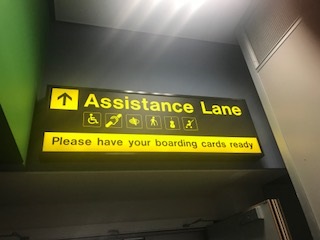
    Assistance Lane at Manchester Airport

    Manchester Airport contract work to OCS, to support their passengers needs throughout the journey from the car park, during the airport and when accessing onto the Aircraft.

    At all the main entrance points; Passenger can locate an Assistance Point, where they can call for assistance from OCS staff who responds in person within 15 minutes maximum.

    Prior to checking in passengers with physical or hidden disabilities can locate the reception point for assistance, where they can wait in quiet area before check in. Passengers can get help to with check in and board via an Assistance Lane.

    Hidden Disabilities

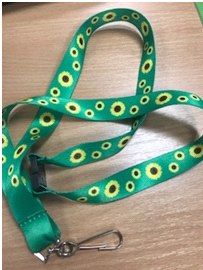
    green and yellow sunflower landyard
    Landyard

    Reception points can provide a special lanyard (Green with Sunflowers) which informs staff members and airline companies that a passenger has additional support needs. The lanyards can be collected from Reception Point for Assistance. This allows passengers to use assistance lanes when boarding and also priority and family lanes at security.

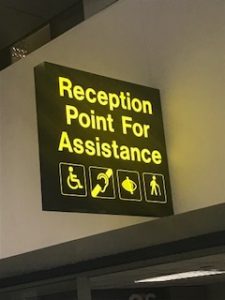
    Reception Point for Assistance Terminal 2

    airport reception point for assistance

    Manned desks at the reception points are available (Terminal 2 above). These are centrally located near shops and restaurants and if passengers want to shop or eat, there is no need to stay in one place. The OCS staff use Customer Call to locate Passengers when its time to board, staff will buzz to locate Passengers ready to board.

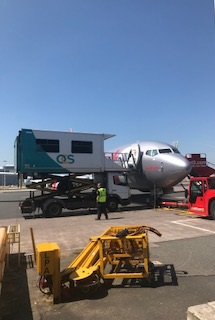
    plane at manchester airport
    Ambulift

    OCS support passengers throughout their journey from the car park, throughout the airport and when accessing the Aircraft, via the use of the ambulift, Eagle Hoist or other transfer aids.

    Disability and Toileting

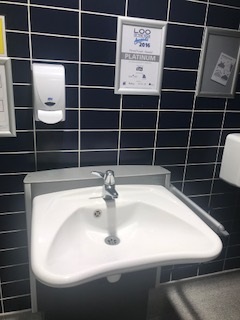
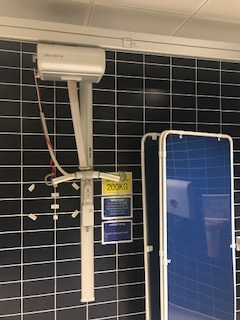
    Equipment provided in the Manchester Airport Changing Places above.

    • Overhead full room coverage hoist system

    IMPORTANT: Sling not provided

    • Mobile hydraulic height adjustable changing bench
    • Wide tear off paper dispenser
    • Privacy screen
    • Peninsular conventional close coupled WC with grab rails and support arms
    • Electrical height adjustable sink.

    Manchester airport currently have a transformation plan, to improve airport facilities for people with special needs. Passengers will see an increased number of changing places; air side and land side, more central assistance points. Dog assistance areas, sensory/quiet rooms, first aid rooms, new assistance points and more.

    Useful resources

    Manchester Airport – Special Assistance 

    Seat Guru

    TryB4UFly

    Accessible Tourism

    Enable Holidays

    Accomable

    Mobility Equipment Hire Direct

    Travel advice with a mobility aid

    BHTA – Air Transport Advice

    Flexel Mobility

  • SeatPlan Help You To Find Accessible Theatres in the UK

    SeatPlan Help You To Find Accessible Theatres in the UK

    This post has been written by Laura Kressly for Disabled Living.

    Commercial theatres aren’t known for being access friendly, but this is finally starting to change due to a shift in attitudes. Unfortunately, theatre buildings struggle to keep up.

    Many buildings in London’s West End are old, including most of the theatres. They date to Victorian times or, in some instances, are even older than that – the fourth version of the Theatre Royal Drury Lane was built in 1812, seven years before Queen Victoria was born. Historical buildings are notoriously bad for access, and with many of the biggest and best theatres in the country having listed status, it can be difficult for people with access and mobility needs to go to the theatre.

    Fortunately, theatre owners and managers are aware of the need to improve in this area and are doing what they can to install access provisions around budget and planning restrictions. With growing awareness of these building’s power to exclude non-disabled audiences, there have been a lot of recent changes. It’s now normal for theatres to have infrared hearing systems, access performances, removable seating, downloadable visual stories, dog-minding services and staff specifically trained to support theatregoers with access requirements. When building regulations allow, ramps and lifts have been installed, as have low-level service counters.

    But it’s still not perfect…

    Theatre seating is usually spread over several levels, and many venues are unable to install internal lifts. Main entrances often have at least a few steps. Most theatres request that patrons with access requirements notify the venue in advance, and arrive at least half an hour early. Some theatres don’t even have adapted toilets.

    This means that theatregoers have to take on much of the responsibility of arranging the logistics of their theatre trips and ensuring their access requirements are met well in advance of the performance date they want to attend. Every building is different and access provisions vary across theatre land, so prospective audiences need to conduct a lot of research to find the information they need. Whilst most West End and large regional theatres have access information on their websites, if you are considering seeing different shows at different venues this is a time consuming process. Search results tend to cater towards outlets selling tickets rather than providing comprehensive information about the whole theatre-going experience, so locating information for each venue you are considering booking tickets for takes a long time.

    Access pages on SeatPlan

    Because of the lack of comprehensive theatre access information for the West End in one place, theatre website SeatPlan added an access page to each of their venue profiles. The site lists all of the major West End theatres, and many regional ones. They provide detailed descriptions containing entrances, numbers of steps, whether or not there are lifts and so forth. There is also contact information for the access teams at the theatres.

    These knowledgeable staff members will be able to provide you with all necessary information relating to your access requirements and assist you in booking appropriate tickets. They can also advise on the availability of touch tours, audio description, captions and BSL interpreted performances. Some shows also schedule relaxed performances, which are suitable for people who may experience over-stimulation, or have ASD or other learning difficulties.

    So whilst theatres have much to do in order to increase accessibility further, they are taking steps in the right direction. Independent resources like SeatPlan also help by making the process quicker and more streamlined. The theatre industry as a whole is finally waking up to their accessibility shortcomings so change is fortunately afoot.

Disabled Living