Month: November 2020

  • Can Live-in Care Help with a Physical Disability?

    Can Live-in Care Help with a Physical Disability?

    This is a sponsored blog written by Elder for Disabled Living.

    Physical disabilities can affect a person at any stage of their life – whether it be in their younger years, or as they begin to age. However, having a physical disability should not stop you from living a happy and stable life from the comfort of your own home.

    This is where live-in care can be the perfect option for either yourself or your loved one. Here, Elder, discuss how live-in care should be considered for someone with a physical disability.

    What is live-in care?

    Live-in care is an at home, one-to-one service offering twenty-four-hour care and support for those who need it most. A specialised and professional carer will move into the person’s home, assisting with all they need, whether it be daily tasks or personal care.

    More importantly, for many, their home is where they feel most comfortable and happy. As a familiar environment, home can often be easier to navigate for someone with a disability such as sight loss. Therefore, live-in care offers the essential support, as well as the stability and independence they had prior to needing the extra assistance.

    When to consider live-in care

    Live-in care is suitable for those of all ages who are no longer able to care for themselves due to a physical or cognitive disability, but would prefer to remain in the comfort of their own home.

    If your loved one, or yourself, needs support and assistance, a live-in carer could be the perfect option to ensure that both practical and emotional needs are catered for. It’s important to consider additional care options when needs become more complex, or the individual needs more support in completing daily tasks.

    It can also be common for family members who are caring for someone to need support and respite, and a live-in carer can provide just that. It is important that the ongoing mental health of the carer in addition to the wellbeing of those being cared for is looked after.

    How can a live-in carer help?

    A live-in carer can help in many ways, offering all aspects of practical and emotional support, whilst being a reliable point of contact for family members. Depending on the person’s individual needs, whether it’s arthritis care where assistance may be needed with exercises, using mobility aids, or helping with daily tasks, or perhaps MS where the care needs may be more complex and symptoms can change day to day – professional live-in carers will be there 24 hours to support.

    A live-in carer can help with mobility and daily tasks such as showering, getting up and down stairs and in and out of bed. They can also help ensure any treatments and medication are adhered to and arrange trips to the physiotherapist as required.

    Carers can also provide a level of companionship, which can be especially comforting in the current climate, and for those who may not be able to get out and about without assistance.

    For those who have pets, there is no need to part with their companion as a carer allows you to keep your furry friend living with you in the house. Pets can promote general activity, as well as spending time outdoors despite suffering with limited mobility, both of which are essential to a person’s wellbeing.

    How to organise care

    Finding the right carer for each person is extremely important, both for the person in need and the carer themselves. Therefore, each individual will go through a unique journey to find their live-in carer, dependent on their needs, personality, interests, likes and dislikes. Live-in care agencies, such as Elder, carefully select one of their specialist carers who are perfectly matched to all of these preferences to ensure the perfect match.

    Funding for home adaptations

    When living with a disability, adaptations may have to be made to the surrounding environment to make it safe and comfortable. Local authorities can provide funding towards minor adaptations to the home and equipment which can include things such as grab rails, ramps and disability compliant door and window fittings.

    Additionally, major adaptations to the home can be funded by the Disabled Facilities Grant, which is funded by local councils. If eligible, this grant can be up to £30,000 to help make significant changes to the home. Changes can include, fitting a stairlift, widening doors, implementing a wet room or wheelchair accessible shower, and altering the kitchen so it’s accessible and easier to navigate.

    A care needs assessment will identify the available funding for the individual’s situation.

    As live-in care is full time and tailored for each individual, there are many benefits no matter a person’s physical condition. Allowing for the freedom and comfort for your friend, relative or loved one is at the core of live-in care and is the reason why so many consider it for those with physical disabilities, regardless of their age.

    For more information about live-in care, contact a professional who will carefully guide you through your options and offer the most beneficial outcome for you, and most importantly, for the person in need.
  • Eliminating Bacteria and Viruses with Sterilight Robots

    Eliminating Bacteria and Viruses with Sterilight Robots

    This is a guest blog by Grant from Sterilight Robots.

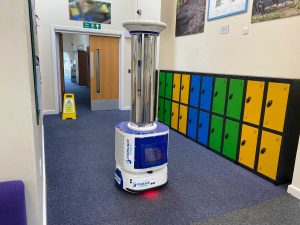
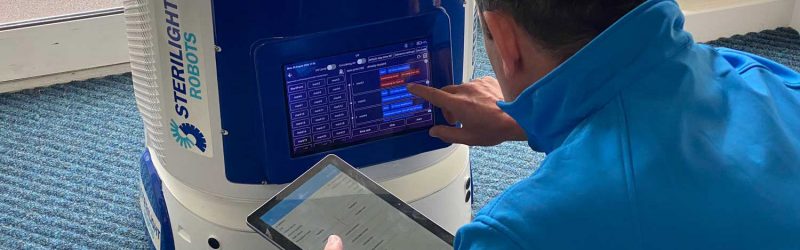
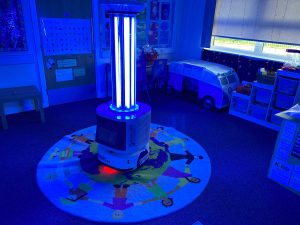
    Sterilight Robots was proud to be able to assist Redbank House and Disabled Living with a specialist disinfection using the Model X autonomous robot.

    It uses high power UV-C bulbs by Phillips and an internal HEPA filter to eliminate bacteria and viruses within the air and on all surfaces. Redbank House wanted to ensure that every area had a deep disinfection to maintain the highest levels of hygiene for their visitors.

    Coronaviruses Reduced 99.9999% in 25 Seconds

    At Redbank House, particular attention was allocated to the sensory rooms to ensure sufficient UV-C exposure was given to all high touch and high traffic areas. The University of Boston in Australia conducted a study on the effectiveness of UV-C exposure against Coronaviruses and they identified that with 25 seconds of exposure, Covid-19 could be reduced by 99.9999%. Sterilight Robots planned the route within Redbank to allow much longer exposure times across all areas and used Dosimeter Labels as a means of measuring the effectiveness of the disinfection. The labels are proven to accurately measure the total UV-C exposure so that a sufficient dose of ultraviolet light could be given to all areas.

    Sensory room sterilight robot

    Sterilight Robots are able to assist businesses and premises with a fully managed disinfection service. We will visit your location, perform an exposure assessment and then program the Model X to autonomously clean the entire location for a fixed, low cost. For locations that require a daily disinfection, we are able to offer a range of Autonomous robots, UV-C Static Towers and other effective UV-C solutions that can be purchased and used by your own team. Full training (face-to-face or virtual) and extended warranties are given for your peace of mind.

    For more information please visit: sterilightrobots.co.uk

  • Baywatch Results Reveal Disabled Parking Abuse

    Baywatch Results Reveal Disabled Parking Abuse

    Disabled Living are pleased to support Disabled Motoring UK’s Baywatch Campaign. Read all about the latest results below.

    In August, DMUK asked the public to help us with our Baywatch Campaign by completing a survey on their parking experiences over the past 12 months. The results have now been calculated.

    DMUK would like to thank everybody who participated in this year’s Baywatch Campaign. This year we had the biggest number of responses that we have ever seen which goes to show how important the problem of disabled parking abuse remains. The total number of responses was 777. We would also like to thank all our sponsors, the British Parking Association and BBFI Public Sector Investigations, and our supporting organisations that promoted the campaign and encouraged their members/supporters to take part. Without them the campaign would not be so successful.

    Traditionally the Baywatch Campaign asks the public to survey supermarket car parks for levels of disabled parking abuse. We were unable to undertake this type of campaign in 2020 because of the Coronavirus pandemic. Instead we asked the public to complete a survey from home which asked them questions on their more general parking experiences. This allowed DMUK to expand the scope of the campaign to other parking settings.

    Findings

    Local Authorities

    One of the most alarming statistics that came from the survey results was that 95.6% of participants did not think that local authorities were doing enough to tackle Blue Badge abuse. This is a very high percentage, but not at all surprising to DMUK. Every year the ‘Blue Badge Statistics’ are released and every year the number of local authorities actually prosecuting Blue Badge fraud is disappointingly low. The Baywatch Campaign also showed that only 20.8% of Blue Badge holders had ever been asked to have their Blue Badge inspected by an official and that 96.4% of participants supported more inspections of Blue Badges.

    The disabled community has spoken, and local authorities must do more to support their parking needs. DMUK wants to see far more Blue Badge inspections and enforcement of the on-street concession.

    Supermarket Parking

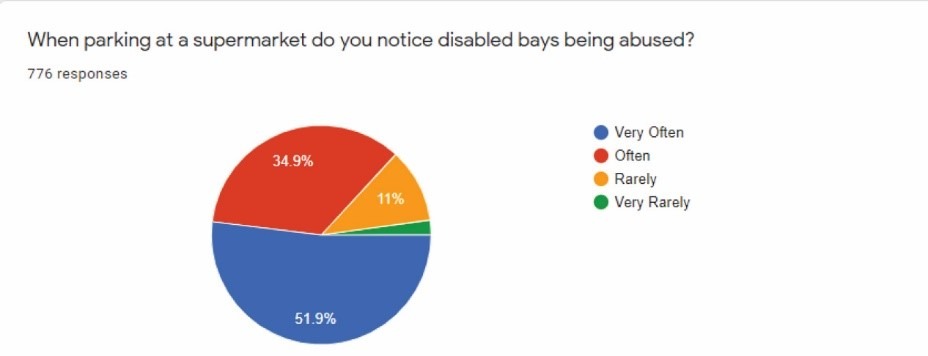
    With the data gathered we cannot do our usual supermarket league table with who is performing best and worst. However, the results have shown that 53.4% of participants either find it ‘Difficult’ or ‘Very Difficult’ to find suitable disabled parking in general at supermarkets. Also 86.8% found that disabled parking bays were either ‘Often’ or ‘Very Often’ abused. (Abused is defined as vehicles parking in disabled bays not displaying a Blue Badge.)

    supermarket pie chart

    These statistics show that supermarkets are not doing enough to support their disabled customers. Disabled parking is not managed properly, disabled parking bays are clearly not enforced, and abuse of the bays is rife.

    Looking specifically at enforcement DMUK asked the question: When parking at the supermarket do you ever see signs of enforcement? In response to this 55.1% of respondents said No. The next question asked was: If you have reported disabled parking abuse to a member of staff, do they take action? 86.7% of respondents answered ‘No’ to this question. This is distressing and shows that when a disabled customer asks for help their concerns are ignored by supermarket staff.

    General Findings

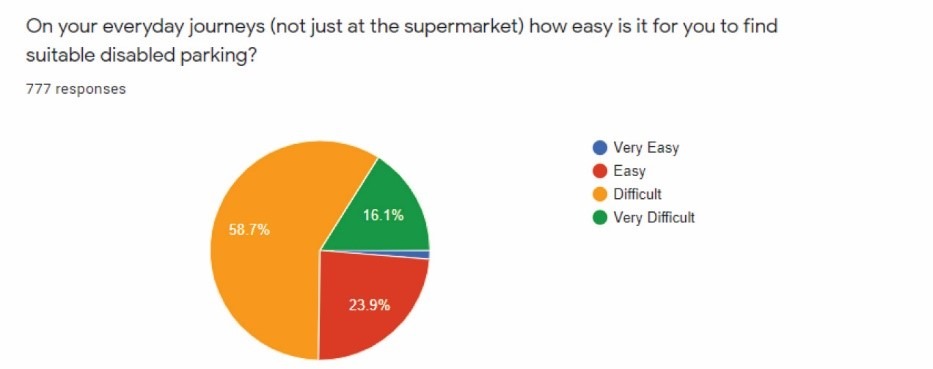
    The survey also asked participants about parking on their everyday journeys, not just at the supermarkets. On these types of journeys 74.8% of respondents said that finding suitable disabled parking was either ‘Difficult’ or ‘Very Difficult’.

    baywatch pie chart

    Also, generally when parking 87.7% of respondents said that they ‘Often’ or ‘Very often’ saw disabled bays being abused.

    These statistics are appalling. Being able to drive and park at their desired destination is imperative to the independence of disabled people. The figures show that disabled people are being disadvantaged and prevented from living independent lives because of the state of the nation’s disabled parking provision and enforcement. These statistics should be the wakeup call that the parking industry needs to once and for all provide adequate parking provision to disabled motorists and make sure it is enforced correctly. The level of deterrent needs to reflect the importance of keeping disabled bays free for genuine users and at present the deterrent clearly isn’t enough.

    The Impact of the Coronavirus Pandemic

    Earlier in the summer we started to receive anecdotal evidence that disabled bays were being removed from car parks to make room for socially distanced queuing. As lockdown restrictions eased, this became a more common problem. We posed the question in our survey: Due to the COVID-19 pandemic have you seen disabled bays being removed? Eg, for queuing. 65.8% of respondents answered ‘Yes’ to this question. Once again the needs of disabled people have been pushed to the back of the queue and equality has been forgotten.

    Graham Footer, CEO at DMUK, said: “DMUK is delighted with the level of support it has received for this year’s Baywatch campaign. However, we are very concerned about the levels of disabled parking abuse in all parking settings. The parking industry and local authorities all need to do more to support disabled people. Accessibility starts in the car park and without proper parking provision and enforcement of disabled parking, disabled people find it increasingly difficult to live independent lives. DMUK demands that this issue is taken seriously”

    Baywatch Appeal

    To help DMUK to continue campaigning on the issue of disabled parking abuse we have a fundraising initiative called the ‘Baywatch Appeal’. This is a fundraising appeal which will help the charity raise vital funds to keep advocating the need for proper management of disabled parking bays. The charity encourages all supporters of the Baywatch campaign to donate if they are able. Please visit https://www.disabledmotoring.org/donate

Disabled Living