Month: July 2019

  • David Completes an Incredible 30 Wheelchair Marathons in 30 Days

    David Completes an Incredible 30 Wheelchair Marathons in 30 Days

    Three times HBSA Disabled Sportsperson of the year David Williamson has completed an incredible 30 wheelchair marathons in 30 days. This is something which has never been achieved before.

    David from Petersfield (40) who works for car finance company Moneybarn, had both legs amputated through the knee when he was a few months old, having been born without tibia bones. As well as pushing marathons and being a five-time participant in the Great South Run, David has also completed a 24-hour wheelchair push. He has also played over 300 games for South Hants Sitting Volleyball. In 2016 he was the recipient of the 2016 #wecandoit Personal Achievement Award.

    Since 14th June 2019 David has been pushing a marathon a day, back-to-back with no rest days!

    Using athletics tracks in the South East of England and then down on the sea front at Southsea, David completed his 30th, and final marathon, at Stoke Mandeville Stadium in Aylesbury, Buckinghamshire on Saturday, 13th July. This coincided with the LimbPower MoJo MaraFun Day.

    All funds raised from the 30 in 30 challenge will be split equally between:

    • LimbPower – launched in November 2009, engaging amputees and individuals with limb impairments in physical activity, sport and the arts to improve quality of life and aid lifelong rehabilitation. In July 2014 LimbPower became a National Disability Sports Organisation and working with the Activity Alliance and Sport England, helps amputees and people with limb impairment reach their sporting potential as well as providing support and resources for families and healthcare professionals.

    “What David has achieved with his 30 in 30 challenge is beyond words,” said LimbPower CEO Kiera Roche. “Not only has he raised an amazing amount of money which will enable us to continue our work. But he has also raised awareness of disability sport by taking the dis out of disability.”
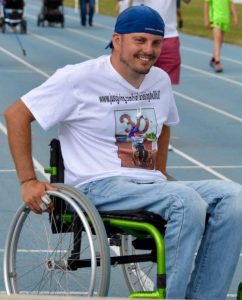
    portrait of David smiling in his wheelchair

    • Three-year-old Felicity has undiagnosed genetic conditions which the doctors think cause all of the different problems she has. She has three brain conditions, is visually impaired, has reflux and epilepsy. Felicity also has twitches every day that cannot be controlled by medication. Due to the complexity of her conditions, she needs 24-hour care.

    “It’s just incredible what David has put himself through. He’s an inspiration for everyone – able and less able.” – Felicity’s parents.

    • Four-year-old Emerson developed a cyst on his spine when he was just two years old which paralysed him from the waist down. He lost all movement in his lower body and is unable to walk.

    “David has been such an important part of Emerson’s journey so far. He’s been a real inspiration and a great role model for Emerson.” – Emerson’s parents.

    “I knew going into this event that it would be the biggest, hardest, most daunting challenge of my life, “says David.  “Physically I’m exhausted, I’m beaten up and broken down from day after day of pushing over 26 miles with no time to recover and reboot. Mentally it’s been a roller coaster of days when it’s been tough and days when it’s been even tougher – those are the days when I had to really dig deep and just keep going.”

    “But failure was never an option and at the end of the day I kept reminding myself why I was doing it – for LimbPower and for Felicity and Emerson.”

    “I was told – over and over again – that pushing 30 marathons in 30 days in a wheelchair was impossible. And I agreed. But I did it anyway.” said David.

    To support David in this epic challenge please make a donation at:

    https://www.justgiving.com/fundraising/dw30in30

    For further information please contact:

    • David Williamson on 07850 544637 or email irishego@gmail.com
    • Kerry Munroe at LimbPower on 07798 780533 or email kerry@limbpower.com

    If you would like to feature as our ‘Story of the Month’ on Disabled Living’s blog, please get in touch with us via info@disabledliving.co.uk


  • Colours vs. Special Needs Individuals: What You Need to Know

    Colours vs. Special Needs Individuals: What You Need to Know

    One of our contributors, Brenda Kimble, talks about the link between colours and people with special needs.

    The language of colour

    Tiny babies see best in black and white. But once they reach their first birthday, they will already begin to recognise and name colours. Colour is one of the first concepts we learn, and we use colour to convey emotion, messages and meaning. Red means passion, danger and stop! We feel sad when we listen to the blues.

    Colours also seem to have a deeper effect than the common meanings we give them. To see a colour, you must have light. The colour of an object is determined by how much light bounces off it. Light is made of electromagnetic waves, and each colour has its own wavelength and magnetic frequency that interacts with the neuropathways in the brain.

    Modern colour psychology is still in its infancy. There is little scientific evidence yet as to whether Chromotherapy, the ancient practice of healing using colour, has any basis in fact. What is clear is that the colours we choose to use around us, their intensity level and their interaction with lighting, can affect our moods, behaviour and performance.

    Colours and special needs individuals

    While everyone may benefit from optimising their choice of colour, some individuals may be more sensitive to colour. This is because some people have increased sensory responses, stronger visual processing abilities and differentiated cognition pathways. Typically, these might include individuals with Attention Deficit/Hyperactivity Disorder and Autism Spectrum Disorders.

    Decoding the colour chart

    Responses to colour are both physiological and psychological. Studies decoding the physiological effects of colours have shown changes in sensory sensitivity, blood pressure, heart rate and brain development. Psychological impacts include changes in levels of aggression, length and quality of attention span and ability to communicate effectively.

    little boy with hand on his head looking down

    Warm colours

    Colours like red, orange and yellow provide a high level of stimulus and increase energy and encourage creativity. This may make them a good choice for individuals with reduced sensitivity to external stimuli, such as the hyposensitive variant of autism, but a poor choice for individuals with ADHD and similar disorders.

    Orange is a popular choice for fast food environments as orange increases noise perception and stimulates hunger and activity. Red raises respiration, heart rate and blood pressure. It also heightens the sense of smell.

    Yellows, particularly strong yellows, can cause feelings of aggression, anger and frustration. Babies cry more in yellow rooms, and people argue and fight more in yellow environments.

    Pink is neither warm nor cool and has a sedative effect. It has been shown to reduce aggression in prisoners.

    Cool colours

    Green, blue, grey and violet promote calm and a feeling of well-being. Blue reduces appetite and lowers body temperature. Blue is also the preferred colour for those with a visual impairment. Green helps to relax the nervous system and lessens feelings of stress. It seems to help with communication and developing speech skills. Cool colours may be a good choice for individuals where reducing stimulation is a high priority, such as those with ADHD or the hypersensitive variation of autism.

    Colour preferences

    Each individual will have their own colour preferences, and in some cases, these choices will be very strongly felt and expressed. This can lead to distress if colour preferences are not acknowledged and respected. To identify colour preferences in individuals who are pre-verbal or struggle with communication, you can try laying out some clothes in different colours and see which ones they choose to wear. Or assemble a bowl of beautiful and tactile coloured beads or bright and cheerful crayons and let them pick out the ones that they like.

    colouring in at home

    Colour at home

    When decorating at home, you have the freedom to choose from a vast variety of possible colour schemes. Alongside aesthetic and colour preference considerations, consider making design choices that will enhance the mood and behaviour of the individuals in your family, including those with special needs. Consider basing your scheme around pink if reducing aggression is a priority for you.

    Muted greens and blues are an excellent choice if you are trying to create a calming environment, if you are catering to the visually impaired or to enhance communication abilities. Use bright reds, yellows and oranges sparingly as small pops of colour to accent your decorating scheme unless you are deliberately setting out to create a highly stimulating environment.

    Colours in the learning environment

    The use of colour in a learning environment can profoundly affect student attention, behaviour and achievement. Many students with special needs are particularly sensitive to colour within the classroom. The trend for inclusive education in public schools and the increase in the number of students with special needs, including the wide range of learning disabilities, means the colour choices you make in your classroom are more important than ever.

    As classrooms are communal spaces serving learners with a range of needs and responses to colour, deciding upon a suitable colour scheme presents some special challenges. Research into this subject shows that balance is the key. Classrooms which are too stimulating can have a strongly adverse effect upon learners with disabilities leading to behaviours such as hand flapping, repeated blinking, fixed gazing at lights and moving fingers back and forth in front of the face. These sorts of responses show links with reduced communication, weak concentration and less social interaction.

    Young boy colouring in

    Classrooms which are too neutral and unstimulating are, in many ways, as bad as classrooms that overstimulate.

    Colour schemes for classrooms

    You might not have much say in the primary colour scheme for your classroom but, if you do have a choice, warm neutrals such as tan or sand would be an ideal choice. A slightly deeper hue in a similar colour would be a good choice for the main wall that students look at for learning purposes. Large blocks of bright primary colours are unhelpful, but you can try using soft shades of blue or green in moderation. Small amounts of brighter colours are used to define boundaries or as a background to charts and small displays.

    Colour is one of the simpler ways parents and teachers can ensure they optimise the living and learning environment for individuals with special needs. Even in a communal space such as a classroom, there are plenty of ways to satisfy the colour preferences of individual learners. Coloured items such as paper and lenses and craft items such as beads all work well. For parents of children with special needs, using preferred colours as accents in clothing and decor is a great solution where individual colour preferences would not represent the best choice regarding the impact on mood and behaviour.

    More blog posts by Brenda can be found by searching our main blog page: www.disabledliving.co.uk/blog 

  • An Interview with Margaret Ellis on Accessible Toilets

    An Interview with Margaret Ellis on Accessible Toilets

    Deborah Bell, Enablement Team Manager at Disabled Living recently interviewed Margaret Ellis. Maggie originally qualified with a Diploma and later graduating as an Occupational Therapist, working in a range of service provision including management of physical disability, mental health and learning disability services, sometimes combining NHS and Social Services.

    Margaret photo
    Can you tell us a bit about yourself?

    I qualified as an Occupational Therapist, working in a range of service provision including management of physical disability, mental health and learning disability services, sometimes combining NHS and Social Services. Now, I run an Independent OT practice, West Square Associates.

    I have been Chairman of the British OT Association (now RCOT) and of the European OT Committee and I have also been a member of several university and research boards.

    My membership of EU and ISO Technical Committee brought wider experience and the opportunity to link user needs with planners and policy makers, especially concerned with Appropriate Design and Practice for People with a Disability, including Accessible Transport.

    I am currently a Member of some ISO Technical Committees for similar topics and also Coordinate the European Group for eTechnology which started at LSE in 2010.

    Why are you interested in discussing accessible toilets?

    I am part of the Cross Party group for Disability in Holyrood and the All Party group in Westminster which have recently been looking at the need for accessible toilets. Part of this involves gathering facts about existing and lacking facilities.  Part of this information gathering has emphasised a well known fact that in some parts of the country there are open facilities for men and women while the ‘accessible’ facilities provided are in fact inaccessible because they are locked.

    In a remote village in Scotland, in the Highland Region, the ancient notice on the door of the “accessible toilet” tells potential users they can get the key to unlock the door from the Post Office. The Post Office is about a mile away and is only open for twenty Hours a week. When I wrote to all the members of the council concerned about this a disabled council member wrote back to me to tell me it was wonderful because he had purchased a key (costing about £5) so he could always use a loo whenever he needed. Should he have to buy a key to have a wee?

    The opportunity to visit Kidz to Adultz Wales & West presented itself and Disabled Living is one way we can get the message across that disabled access to toilets around the country is being looked at.

    You say Councils are failing to comply with Equality Law, why do you think this is?

    We discovered early on that Central Government does not force Local Government to provide Public toilets. In fact, in some parts of the country facilities are under threat as part of the general thrust for savings in our society.

    One thing we have determined is that the Equality Laws require that providers offer similar or even the same facilities to all users. If a council only offers locked facilities to accessible toilets it could be inferred that they are failing to comply with Equality Law.

    There is the misconception that Accessible Toilets are locked to prevent them being defaced. What is your response to this claim?

    So far the All Party Group and All Party group have only had one report of such action in Disabled Facilities although many of us are faced with vandalised public toilets. There is also the theory that anybody might use them. Fortunately there is now more awareness about hidden disabilities with some supermarket chains adding the excellent slogan ‘not all disabilities are visible’.

    What has happened so far?

    The convener of the Cross-Party Committee in Holyrood was so concerned about the locked facilities that he has managed to get the Planning Laws changed in Scotland so that planning permission will prohibit locked facilities. It’s a start but not the whole solution.

    Some work has been done about the development of Changing Places Toilets which offer a wider range of disabled facilities including hoists and changing plinths. The UK government has funded a £2 million review with the Multiple Sclerosis Society of some motorway Changing Places toilets.

    There are many instances where the toilet facilities are inadequate and inaccessible preventing people from living the independent life they want to. We must continue to highlight the issues and push for equality in accessing facilities which are fit for purpose. The more information people have the louder we can shout.

    We do now more greatly appreciate the requirements of the Equality Act – www.gov.uk/guidance/equality-act-2010-guidance. This requires that facilities should be equal for us all wherever they are provided. So no place should be locked against anybody.

    This post has been written by Margaret Ellis, Lead Academic and Co-ordinator EKTG, Enterprises, London School of Economics.

  • Nilaqua – an Eco Revolution Is Bathing!

    Nilaqua – an Eco Revolution Is Bathing!

    Do you find it difficult to bath? Do you know someone who has dementia or sensory issues and struggle with bathing? Or they would like to remain in their home with palliative care? Nilaqua is a wonderful range of waterless shampoos and body washes that uses “towel off” technology to clean you thoroughly and easily without additional water or rinsing.

    This is NOT a dry shampoo or alcohol gel, but a kind and gentle water based solution that easily removes dirt, sweat and odours. It is used daily in the NHS. Even NASA use this method!

    Nilaqua 500ml Save Water shampoo

    So why would you consider trying Nilaqua?

    Apart from ease of availability in the likes of Boots, most mobility stores and online, Nilaqua has years of testimonials and is quality assured. The reason it is so popular not only shows the brilliant way in which it works but also promotes dignity and independence while reducing manual handling risks.

    Nilaqua is made in the UK and is an easy alternative for the eco conscious, who worry about disposing of wipes etc.

    Nilaqua 500ml Save Water bodywash

    As a multiuse item the 200ml and 500ml bottles provide multiple washes from one bottle. This can save thousands of litres of drinking water per annum. This is essential in our “water short” climate where only 3% of the world’s water is naturally drinkable. –https://www.nilaqua.co.uk/how-can-i-save-water/

    Nilaqua is made from 25% recycled plastic and further recyclable.

    • It’s a water based product with no paraffin or aerosols
    • It is vegan friendly endorsed and cruelty free, supporting charities such as Greyhound Rescue Wales
    • Does not require the need of wipes
    • Nilaqua reduces carbon miles and supports local businesses

    After exhibiting at the Kidz to Adultz exhibition this month we are offering readers an exclusive 25% off purchases if they would like to try for themselves! Just visit www.nilaqua.co.uk and enter K2A2019 in the coupon box. This offer expires on 31st August 2019.

    This post has been written by Jess Efford on behalf of Nilaqua, who are listed on our Supplier Directory.

  • The Benefits of Technology for Disabled People

    The Benefits of Technology for Disabled People

    ‘Technology is only beneficial if it is accessible to the user’. Over the years, companies have worked harder than ever to ensure that anyone can use their products. In the past, the elderly and disabled have had reason to believe that technology was out of their reach. For some, it was because there weren’t features that could assist them. For others, it was because there was a lack of understanding as to how the use of technology could benefit them. Fortunately, there are now some admirable pieces of technology for disabled people that are easier to use than ever.

    When talking about using technology to assist disabled people, there’s a whole range of products to consider. There are mobile phones on the market that can help people with a variety of disabilities and there are computer keyboards that anyone can use. Vast advancements have been made to ensure that no member of society feels unable to use technology.

    There are so many pieces of technology that benefit people with completely different requirements. The key to success is having the right technology for each individual. Here are just some ways disabled people can benefit from technology.

    Digital assistants

    There has been an increased use of digital assistants in homes throughout the UK. These ‘assistants’ answer to the names of Siri, Alexa, and Cortana. They are voice controlled devices that have been designed to lighten the workload of an individual. They are programmed to become more intuitive over time as they become used to different commands that they are presented with. By being voice activated, users with physical disabilities can find themselves some ease. These devices can control lights, televisions, and more. According to Helping Hands, they will never be able to replace the human touch of carer but they can be a very valuable home assistant.

    Ergonomic keyboards

    Communication is incredibly important regardless of the level of disability. Everyone needs to feel connected. There are so many different platforms available for staying in touch. Mobile phones allow people to speak to each other but laptops and computers enable users to stay in touch over email or video calls. For some, however, typing proves to be an impossibility. Suffers with Repetitive Strain Injury (RSI) have been excluded from using an accessible keyboard. Fortunately, there are fantastic alternatives. PCD Maltron have available a brilliant ergonomic keyboard that allow users to feel relief while on the computer.

    Smartphone apps

    There are enormous amounts of apps available to use on mobile phones. With mobile phones that are accessible to people with disabilities, there is an array of assistance available. There are apps that can be used to remind people to take their medication or to highlight when their next doctor’s appointment it. Wheelmap shows all of the wheelchair accessible places in the world and HearYouNow amplifies sounds so that conversations can be heard more clearly. Perhaps even more impressive, there is an app called MagicCarpet, enabling users with the counterpart software to engage with interactive displays and learn in unique ways. BEMyEyes is an app that connects visually impaired users to volunteer helpers who can aid with everyday tasks. The magnitude of apps available to use ensures that there is something for everyone.

    Everyday tasks

    When the everyday life of someone is made easier, it’s hard to argue against the benefits of technology. Computers, for example, have enabled users with limited mobility to shop online. They can now reorder medication and medical supplies and have it delivered directly to their door. If users have limited eyesight, there are fantastic products that can ensure that they have the same experiences. VisionAid have created desktop magnifiers and extendable monitor arms to combat the issue. There is software that reads text from the screen for people who suffer with dyslexia. Technology can give disabled people greater autonomy over daily life because online technologies are more accessible than the real-world alternatives.

    Medical assistance

    Technology is pivotal in modern times to assist with medical issues. There are many practical reasons for someone with recurring health problems to get used to a mobile phone or laptop. Connecting with health professionals via email enables people with disabilities lessen their dependence on others. Most mobile phones come with health trackers (Google Fit and Apple Health). However, there are more sophisticated apps that can help with harder to manage illnesses. Qardio have created a smart blood pressure monitor that connects to your mobile phone. For disabled people with limited movement, this technological advancement ensures independence and gives the option to take charge of a difficult situation.

    People with a disability should not feel excluded or left behind when it comes to technology. Find the most suitable options and with practice, the benefits can be bountiful.

    This is a guest post written by Leanne White.

    You might also like our ‘Call Handling for Technology Enabled Care‘ course.

Disabled Living