Tag: blue badge

  • How do you get a blue badge?

    How do you get a blue badge?

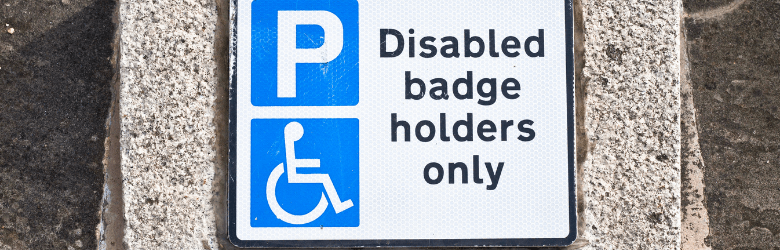
    Blue badges enable people to park in spaces reserved for people with disabilities. In this article, find out more about a blue badge, who is eligible for one, and how to get your own.

    What is a blue badge?

    A blue badge is an aid put in place for disabled people or those with a health condition that affects their mobility. It is linked to the person as an individual, not a vehicle, so it can be used in any car you are in, whether as a driver or a passenger. This includes taxis, hire cars or any vehicle you are travelling in.

    The badge holder is entitled to free parking in disabled parking bay, at parking meters and pay and display bays. Parking is also permitted on some single and double yellow lines up to three hours (where restrictions don’t apply). You can find more information about the specific parking restrictions on your local council website.

    You can apply for a badge for yourself, a child in your care with a mobility issue or for an organisation if you regularly transport those eligible for a blue badge.

    How do I get a blue badge?

    The application process is slightly different depending on the specifics of the mobility issue.

    Automatic eligibility 

    If you are automatically eligible for a blue badge the application will be straightforward. If any of the below are relevant to you, you are automatically eligible :

    • You are registered blind
    • You have the highest rate of Disability Living Allowance (this will be stated on your decision letter)
    • If you receive War Pensioners’ Mobility Supplement
    • You received tariffs 1 to 8 of the Armed Forces Compensation Scheme and were certified as having a permanent and substantial disability

    When you receive Personal Independence Payments (PIP) you are automatically eligible for a badge if you meet certain scores on your assessment:

    • If you scored 8 points or more in the ‘moving around’ area
    • If you scored 10 points in the ‘planning and following journeys’ area and were put in category ‘E’. This means that your stress, anxiety or other mental health issue stops you leaving the house

    You can check your decision letter if you need clarification

    Other eligibility conditions 

    If you are not automatically eligible you can still apply, and will need to provide some additional details on the mobility condition you need assistance with. This will be the case if you:

    • Have long term problems walking or going places (including problems caused by mental health conditions such as stress or anxiety)
    • Are applying for a child aged over 2 who has a problem walking or going places, or a child under 3 who needs to be close to a vehicle due to a health condition
    • Have severe problems using both your arms

    Problems walking or going places

    The problem you are experiencing should be as a result of a severe and permanent disability. You will be asked to explain this in as much detail as possible.

    It is important to estimate how far you can walk without support before you start to feel pain or need a rest. This can be counted in distance or number of steps.

    It is important to include how long it takes you to walk this distance, how you walk and how this makes you feel.

    A child who needs to be close to the vehicle

    In the application you will be asked to specify why the child needs to be close to the vehicle.

    You can do this by explaining how the condition requires you to get home or to the hospital quickly, or by listing the medical equipment you need to transport and why.

    Try and describe the requirements in as much detail as possible, including how often you need the equipment, and how frequently or quickly you need to get to the hospital.

    Are you applying on your child’s behalf? Find up to date advice and information from our Kidz to Adultz team here

    Non-visible or hidden disabilities

    The problems walking or needing to be close to the vehicle could be caused by either a physical or non-visible (hidden) disability.

    Anyone with a disability that causes difficulties or distress when walking when part of a journey can apply for a blue badge, not just those who experience an issue as a direct result of walking.

    Local authorities will seek the advice of expert healthcare professionals for example a gastroenterologist, for any disabilities such as crohn’s disease, ulcerative colitis or inflammatory bowel diseases that might cause difficulties when walking as part of a journey.

    These professions were drawn upon by the department for transport when laying out the guidelines for eligibility and will be consulted by local authorities when determining an applicants need for a blue badge.

    If you are experiencing difficulties due to bladder or bowel related issues you can find useful resources and our confidential helpline here

    Problems with your arms 

    People who have problems related to their arms also are eligible for a blue badge. However, this only applies if they are the driver.

    If applying for a blue badge on these grounds you will be asked to explain the severe problems you have in both arms. You must explain why you need to drive regularly, or why you have difficulty using parking ticket machines or meters.

    What do I need when applying?

    Blue flooring with white symbol from disabled parking space

    As well as the completed application form you will need also need:

    • A passport size photo
    • Proof of your disability
    • A form of ID
    • Proof of Address

    You can find more information on what is accepted at the government website.

    The blue badge costs up to £10 in England, £20 in Scotland and is free in Wales.

    Once you’ve applied 

    It might take up to 6-8 weeks for your application to be processed. If you haven’t heard back after this time frame you should contact your local council.

    As part of the application process, you might be required to take part in a mobility assessment. During this you will be assessed by a health care professional who will watch you carry out a range of mobility activities. They will report back to the council regarding your suitability for the badge.

    If your application is refused you can ask your council to reconsider. Details of how to ask for this will be in the decision letter you receive.

    The badge usually lasts for up to three years. You will need to renew if you still require a blue badge before your old one expires.

    You can find the application to apply or renew your blue badge on the government website.

  • Baywatch Results Reveal Disabled Parking Abuse

    Baywatch Results Reveal Disabled Parking Abuse

    Disabled Living are pleased to support Disabled Motoring UK’s Baywatch Campaign. Read all about the latest results below.

    In August, DMUK asked the public to help us with our Baywatch Campaign by completing a survey on their parking experiences over the past 12 months. The results have now been calculated.

    DMUK would like to thank everybody who participated in this year’s Baywatch Campaign. This year we had the biggest number of responses that we have ever seen which goes to show how important the problem of disabled parking abuse remains. The total number of responses was 777. We would also like to thank all our sponsors, the British Parking Association and BBFI Public Sector Investigations, and our supporting organisations that promoted the campaign and encouraged their members/supporters to take part. Without them the campaign would not be so successful.

    Traditionally the Baywatch Campaign asks the public to survey supermarket car parks for levels of disabled parking abuse. We were unable to undertake this type of campaign in 2020 because of the Coronavirus pandemic. Instead we asked the public to complete a survey from home which asked them questions on their more general parking experiences. This allowed DMUK to expand the scope of the campaign to other parking settings.

    Findings

    Local Authorities

    One of the most alarming statistics that came from the survey results was that 95.6% of participants did not think that local authorities were doing enough to tackle Blue Badge abuse. This is a very high percentage, but not at all surprising to DMUK. Every year the ‘Blue Badge Statistics’ are released and every year the number of local authorities actually prosecuting Blue Badge fraud is disappointingly low. The Baywatch Campaign also showed that only 20.8% of Blue Badge holders had ever been asked to have their Blue Badge inspected by an official and that 96.4% of participants supported more inspections of Blue Badges.

    The disabled community has spoken, and local authorities must do more to support their parking needs. DMUK wants to see far more Blue Badge inspections and enforcement of the on-street concession.

    Supermarket Parking

    With the data gathered we cannot do our usual supermarket league table with who is performing best and worst. However, the results have shown that 53.4% of participants either find it ‘Difficult’ or ‘Very Difficult’ to find suitable disabled parking in general at supermarkets. Also 86.8% found that disabled parking bays were either ‘Often’ or ‘Very Often’ abused. (Abused is defined as vehicles parking in disabled bays not displaying a Blue Badge.)

    supermarket pie chart

    These statistics show that supermarkets are not doing enough to support their disabled customers. Disabled parking is not managed properly, disabled parking bays are clearly not enforced, and abuse of the bays is rife.

    Looking specifically at enforcement DMUK asked the question: When parking at the supermarket do you ever see signs of enforcement? In response to this 55.1% of respondents said No. The next question asked was: If you have reported disabled parking abuse to a member of staff, do they take action? 86.7% of respondents answered ‘No’ to this question. This is distressing and shows that when a disabled customer asks for help their concerns are ignored by supermarket staff.

    General Findings

    The survey also asked participants about parking on their everyday journeys, not just at the supermarkets. On these types of journeys 74.8% of respondents said that finding suitable disabled parking was either ‘Difficult’ or ‘Very Difficult’.

    baywatch pie chart

    Also, generally when parking 87.7% of respondents said that they ‘Often’ or ‘Very often’ saw disabled bays being abused.

    These statistics are appalling. Being able to drive and park at their desired destination is imperative to the independence of disabled people. The figures show that disabled people are being disadvantaged and prevented from living independent lives because of the state of the nation’s disabled parking provision and enforcement. These statistics should be the wakeup call that the parking industry needs to once and for all provide adequate parking provision to disabled motorists and make sure it is enforced correctly. The level of deterrent needs to reflect the importance of keeping disabled bays free for genuine users and at present the deterrent clearly isn’t enough.

    The Impact of the Coronavirus Pandemic

    Earlier in the summer we started to receive anecdotal evidence that disabled bays were being removed from car parks to make room for socially distanced queuing. As lockdown restrictions eased, this became a more common problem. We posed the question in our survey: Due to the COVID-19 pandemic have you seen disabled bays being removed? Eg, for queuing. 65.8% of respondents answered ‘Yes’ to this question. Once again the needs of disabled people have been pushed to the back of the queue and equality has been forgotten.

    Graham Footer, CEO at DMUK, said: “DMUK is delighted with the level of support it has received for this year’s Baywatch campaign. However, we are very concerned about the levels of disabled parking abuse in all parking settings. The parking industry and local authorities all need to do more to support disabled people. Accessibility starts in the car park and without proper parking provision and enforcement of disabled parking, disabled people find it increasingly difficult to live independent lives. DMUK demands that this issue is taken seriously”

    Baywatch Appeal

    To help DMUK to continue campaigning on the issue of disabled parking abuse we have a fundraising initiative called the ‘Baywatch Appeal’. This is a fundraising appeal which will help the charity raise vital funds to keep advocating the need for proper management of disabled parking bays. The charity encourages all supporters of the Baywatch campaign to donate if they are able. Please visit https://www.disabledmotoring.org/donate

  • DMUK Baywatch Campaign

    DMUK Baywatch Campaign

    This is a guest blog written by Heidi Turner on behalf of DMUK for Disabled Living

    DMUK’s Baywatch campaign, which looks into levels of disabled parking abuse at supermarkets, is changing format for 2020.

    A common problem for many disabled motorists is not being able to park at their desired destination, especially at their local supermarket. The major complaint is that the disabled bays are all occupied with cars not displaying a Blue Badge.

    baywatch campaign logo

    Disabled Motoring UK’s Baywatch campaign seeks to address this. This campaign researches the level of disabled parking abuse at supermarkets, by asking disabled motorists to survey their local supermarket car park. Specifically, they count how many disabled bays are provided and how many cars that are parked in them without displaying a Blue Badge.

    We launched this year’s campaign in March 2020 with a great response from supporting organisations and the campaign’s sponsor, the British Parking Association. DMUK is so pleased with the positive response it gets from its members, the public and organisations. Last year was our best campaign yet with record numbers of participants. However, this was before the world was swamped by the current Coronavirus pandemic. Even though many areas of the UK are seeing a decrease in infections and deaths from Coronavirus, and the government are easing lockdown restrictions, DMUK has decided that it is not appropriate to ask individuals to physically go to a supermarket car park and count cars not displaying a Blue Badge which are parked in disabled bays. This could put participants in a position where they find it harder to social distance and we would never ask people to put themselves at an increased risk of catching the virus.

    Join our Survey

    Instead we will be running a survey for the month of August which participants can complete without leaving their home. DMUK will ask individuals to think back over the last 12 months to consider their general parking experience and ask them to answer some questions about this experience at supermarkets and on their everyday journeys. We will use this data to tackle the supermarkets and other parking providers over their disabled parking policies. As a thank you for taking part there will also be an opportunity for one participant to win a £25 M&S voucher.

    The survey will be printed in the August issue of Disabled Motoring and there will be an online version going live in August which can be accessed through the website: https://www.disabledmotoring.org/baywatch-2020

    We hope that in August 2021 to have this pandemic long behind us and run our usual Baywatch Campaign.

    The campaign has support from Baroness Tanni Grey-Thompson, she commented: “It’s so sad that Disabled Motoring UK has to run its Baywatch Campaign. Disabled bay enforcement should be mandatory, especially for the big supermarkets that can afford to invest in policing their car parks. I see disabled parking abuse every day, it’s never a surprise to me, including at my local supermarket. There is a real lack of understanding about how essential these bays are to disabled people and I applaud DMUK’s Baywatch Campaign as it plays a vital role in highlighting the issue of disabled parking abuse at supermarkets.”

    Heidi Turner, Communications and Campaigns Director at DMUK, said: “Baywatch is one of the charity’s longest running campaigns and is really important to draw attention to the parking problems that disabled people face when just trying to do their everyday grocery shopping. The charity has decided to change the format of Baywatch this year in order to keep our supporters safe. Nevertheless the new survey will provide us with some really useful data to keep the pressure on the supermarkets to do more to manage their disabled parking bays properly. Disabled motorists face parking problems in all aspects of their life and the new survey will also encompass some more general parking questions which will expand the scope of the DMUK Baywatch Campaign.”

    DMUK Baywatch Appeal

    In October 2019 DMUK launched its Baywatch Appeal as a way of raising additional funds to support the charity’s campaigning efforts. Since its launch the charity has raised an extra £5740.58 in added donations. Any extra money the charity can raise to support campaigning is so helpful. We understand that many people are under financial pressures at this time  and ideally the best thing that individuals can do is to fill in the Baywatch survey in August, but if you can help with a donation too that is very much appreciated. Donations can be made through our website www.disabledmotoring.org or by calling 01508 489449.

    DMUK Baywatch Sponsor

    DMUK has worked for many years with the British Parking Association (BPA) to improve parking for disabled motorists. The BPA sponsored the campaign in 2019 and is once again sponsoring it for 2020.

    Kelvin Reynolds, British Parking Association, Director of Corporate and Public Affairs, said:  “We wholeheartedly support DMUK’s annual Baywatch campaign. With one in every five disabled parking bays being misused at supermarkets, this campaign is a great way to raise awareness of the importance of only using disabled bays if you are a Blue Badge holder. We encourage as many people as possible to participate in the survey.”

Disabled Living