Tag: Disability

  • Baywatch 2021 campaign: Tackling disabled parking abuse

    Baywatch 2021 campaign: Tackling disabled parking abuse

    In this guest blog by Disabled Motoring UK, we learn about their excellent campaign to stop the misuse and abuse of disabled parking spaces, Baywatch 2021. Baywatch is supported by Baroness Grey-Thompson. 

    The issue of disabled bay enforcement

    A common problem for many disabled motorists is not being able to park at their desired destination. The major complaint is that the disabled bays are all occupied with cars not displaying a Blue Badge. Last year Disabled Motoring UK (DMUK) changed the format of the parking survey so that participants could fill it in at home. This allowed the charity to also expand the scope of the survey to gauge your opinions of other aspects of parking and the Blue Badge Scheme.

    The results are calculated and published when the survey closes. The charity presents this data to the parking industry and encourages it to take the parking problems of disabled motorists more seriously and manage their parking provision correctly. The Baywatch campaign also aims to change public attitudes by highlighting the impact of disabled bay abuse.

    Baywatch 2021 – improving disabled parking provision and enforcement

    The only way to keep the pressure on the parking industry is to run the DMUK Baywatch Campaign annually and this year it takes place in August and you’ll  be able to participate online by visiting the DMUK website.

    We hope to make this year bigger and better than ever before. We have a number of organisations supporting Baywatch 2021.

    The campaign has support from Baroness Tanni Grey-Thompson. She commented: “It’s so sad that Disabled Motoring UK has to run its Baywatch Campaign. Disabled bay enforcement should be an imperative, especially for the major supermarkets that can afford to invest in policing their car parks. I see disabled parking abuse regularly, There is a real lack of understanding about how essential these bays are to disabled people and I applaud DMUK’s Baywatch Campaign as it plays a vital role in highlighting the issue of disabled parking abuse at supermarkets.”

    Graham Footer, Chief Executive, at DMUK, said: “Baywatch is one of the charity’s longest running campaigns and is really important to draw attention to the parking problems that disabled people face when just trying to go about their daily lives. It is now an annual campaign for the charity. We hope this will allow us to gather momentum and keep the pressure on the supermarkets and other car park owners to do more to support their disabled customers. It’s fantastic that the campaign has support from Baroness Grey-Thompson again this year. This campaign relies on public participation and we hope her support will encourage others to get involved.”

    Supporting organisations

    These organisations support DMUK/s Baywatch campaign:

    We’d like to get as many organisations involved as possible to spread awareness of the campaign. There is still time to get involved and we welcome all support with this vital campaign.

  • Sensory Wellness Inspired by People with Profound Disabilities

    Sensory Wellness Inspired by People with Profound Disabilities

    This is a guest blog for Disabled Living written by Joanna Grace from The Sensory Projects. It has been written in Joanna’s perspective around the pandemic and her thoughts on sensory wellness, inspired by people with profound disabilities. 

    As lockdown began, many people with profound and multiple learning disabilities who had been used to leading rich and varied lives, attending schools or care settings, suddenly found themselves at home, isolating with their families or their care teams.

    Whilst some people around them struggled, many of the people with profound and multiple learning disabilities that I know thrived. And as they did so, they reminded those closest to them of the resources available to use all to boost our wellbeing.

    Here are three top tips that I have learned from them.

    Take joy in simple things

    Overthinking stuff can really clog up the capacity for fun in our lives. One family sent me a video clip of their son laughing hysterically at a sneeze, and another shared the bubbling joy of their son’s experience of an ice lolly: the surprise on his face at the coldness, the grasping of his hands against the slippery ice, and the chase of this strange object around his lap tray. What started out as bemusement quickly slipped for him into a joyful exploration.

    Sometimes we do not allow ourselves these pleasures, would we look silly if we let ice slip out of our hands, do we politely supress our giggles at how funny that sneeze sounded?

    In your own life watch out for the simple things that bring you joy and welcome them, one of the perks of lockdown is that you are not in a public space, you are in the privacy of your own home and you make the rules here. If you want to play with your food: play with your food!

    Spend time in a sensory moment

    Anxiety is born out of a fear for a future that maybe. In a pandemic, when any of our futures and any of the futures of our loved ones, could include a horrible illness we have a lot of reason to feel anxious. Justified as it is, it is no way to live. Taking time to spend in the here and now, in the present, without fear, is immensely valuable.

    I am in contact with lots of teachers, all struggling to provide a meaningful education online, in our chats many of them talk about how much they are missing the steadying presence of their students in their lives. If you are in the company of someone with profound and multiple learning disabilities you are in the company of someone who is a master at connecting with the present moment. One teacher who contacted me spoke of her students being a “daily reminder” to her to connect with the present.
    I have begun a class in sensory-being online. Sensory-being is a form of shared mindfulness based around a wonderful sensory object. A parent who took the class told me it had given her a way in to the peace in a moment that her daughter (who has profound and multiple learning disabilities) knows instinctually. She described how with two other children at home and her husband working from home everything can be very fraught. But by spending time with her daughter, sharing a moment of sensory engagement, it is as if she can take a little step out of the busy chaotic world around her and enter a little pool of quiet and calm.

    Enjoy the nearness of people you love without need for words

    Several families I know made the decision at the start of lockdown to bring their loved ones home from their care settings. One in particular agonised over the decision. Their son’s care placement was so good, he had friends there, access to all sorts of equipment and activities that he didn’t have at home, and although many of them would have to cease no matter where he was because of the restrictions they knew that the care team he was with would go above and beyond to provide him with interesting and exciting days. In comparison, they worried, what could they offer him at home in their terraced house? Ultimately they went with their gut instinct, which was in dangerous times to gather their family close and they bought him home. I have the privilege of watching their lives through the window of Facebook, and aware that they were worried I kept an eye out in my newsfeed for their posts. Initially they seemed to be going above and beyond creating activities for him. Their posts were fun, but something about them was a little too loud, a little too bright. They were trying a little too hard.

    The parents are well into their late sixties and their son is in his late thirties. I had a few brief messenger conversations with the father, asking me questions about colour changing lights and where they could get particular gadgets they’d seen. I do not have a lot of tech knowledge but I suggested they could get a similar effect with a torch, some coloured cellophane and a big umbrella.

    I kept watch, the umbrella was purchased, there was the son’s smile of amusement at the light show cast by the torch upon it and the proud smile of his father beside him. In time there were less posts. Now I see the odd one or two, they take him to a place they love to walk that has path that is easy for his wheelchair at times of day when they know no one else will be there. He sits in the garden alongside his father as he does the gardening, plant cuttings are placed on his lap tray for him to explore.

    I sent a message. “How are you getting on?” I asked. His Mum wrote back. She said they had been so worried about being enough for him, but through wearing themselves out trying they had had to stop, and when they stopped they realised he was happy to just be with them. She said now he is a part of their lives rather than a job they are doing. And she described how he will vocalise along with his Dad singing as he gardens, and that she loves to stand in the kitchen window and listen. She said previously her husband would have sung from time to time whilst gardening but their son’s vocalisations encourage him to do it more and that brings her joy.

    Being close to people you love and trust is incredibly precious. You do not need to be anymore than you are. And you do not need to talk or have words for things. Sharing time is precious.

    The pandemic has been and continues to be incredibly hard, but through its darkness much light has shone. I’ve been impressed by the embodied wisdom of people with profound and multiple learning disabilities, as I’ve shared above. At the start of the pandemic I grumped about possibly delivering my training, that has always been done in person in the past, online. But when I did finally get myself in gear and do it I was touched that people joined it from around the world, in person I can touch lives as far away as the trains in the UK can get me, but online I can touch lives around the world.
    The staggering kindness of people has been one of the brightest lights, we’ve all watched the heroism of the NHS staff and the keyworkers that have kept everything going. Through my little Facebook window I’ve seen glimpses into just how bright that light can be. Recently a man I know who has profound and multiple learning disabilities caught COVID19. He lives in a care setting and it was so frightening for his family to be unable to be with him. But his care team closed around him and supported him as if he were their own son. When some of them got sick too and had to be replaced his family were amazed by the care workers who volunteered to leave their own families at home and move in with him 24-7 so they could be the support he needed. In times of greatest need, strangers to them stepped forward and offered to help.

    I see kindness everywhere, in big ways and in small. Since the start of lockdown I have been curating a list online of free resources people and organisations have been giving away. It is as if, when faced with this awfulness, everyone looked around for what they could do and offered it up. The news will report those not following the rules, but the great majority are, it is one big team effort to keep each other safe, one enormous act of care. People are awesome!

  • What is Trusted Assessor Training?

    What is Trusted Assessor Training?

    This blog was written by Disabled Living’s Occupational Therapist, Jayne Watson.

    A lot of jobs require you to keep up to date with regular training. However, the type of training may differ depending on the organisation. Is E-learning the only approach that is expected of you to keep up to date with ongoing changes? Do you get great satisfaction from online learning or do you prefer to learn in the classroom? We all have different learning styles; I am a visual learner and learn through doing. Do you want to develop your skills by sharing knowledge with others, do you enjoy group interaction? Sharing experiences and ideas with other learners on a course can be invaluable, especially if the topic is an intricate one. During the Covid-19 outbreak, most organisations have adapted to doing online training. However, this does not suit everyone.

    Disabled Living offer a variety of training courses, one being the very popular Trusted Assessor course. If you work in health and social care, provide equipment to people or want to familiarise yourself with a specific type of equipment, this course may be suitable for you. It allows participants to learn knew skills which will both enhance their knowledge and support their service users.

    A Trusted Assessor is often someone who can keep an individual safe and independent at home, preventing or delaying hospital and care facility admission.

    Prescribing low level equipment can provide an individual, and the people caring for them, with a safe environment. Low level equipment can be prescribed by a knowledgeable Trusted Assessor, whilst Professional Occupational therapists can focus on more complex cases needing their time.

    Disabled Living have been delivering Trusted Assessor Courses for years, enabling professionals to gain insight to equipment and other services available, including funding, housing, education, employment and more.

    When delegates attend the course, the feedback has been very positive. Delegates have remained very focused. They have learned from each other about the different services within their own areas and worked well in their groups to encourage discussions and debates. This includes discussing what works and what does not work when supporting individuals.

    See what delegates have to say when previously attending the course below:

    Aisha

    As part of my role as a support worker for a hospital discharge service, we are always assessing individuals. The minor aids that we provide are beneficial to the individual as it promotes their independence and brings back some sort of control to their lives. Attending the trusted assessor course teaches you the variety of aids available and what aids are more beneficial to certain situations; you also learn how to fix equipment and how to measure aids correctly for each individual need which makes it person centred. The knowledge and experience of the trainers is phenomenal. The course is worthwhile attending not only to be fully trained in prescribing aids, but to also gain knowledge from the course. The course involves active participation and group work which makes it interesting and easy to learn. I personally have learnt a lot from this course.

    Michelle

    I attended the Trusted Assessor training course as I feel that it is relevant to my area of practice. Working within an inpatient mental health setting and specialising in dementia care, I feel that I have become deskilled around physical health interventions. The course has enabled me to revisit the provision and safe use of low-level equipment. I feel my practice as an occupational therapist will be enhanced and I am now greater equipped to consider physical health requirements when conducting home / environmental visits. Through the consideration and provision of equipment, we can ensure our service users capacity to retain independence is maximised and their ability to engage in meaningful occupation is enhanced.

    Who is the course for?

    • Handy People
    • Technicians
    • Retail Staff
    • Housing officers/assistants
    • Surveyors
    • Delivery Drivers
    • Social Workers
    • Managers
    • Product Specialist
    • Building Contractors

    If you are interested in booking onto one of our Trusted Assessor courses, please visit: https://www.disabledliving.co.uk/training/our-courses/trusted-assessor-courses/

    To view the other courses we offer, visit: https://www.disabledliving.co.uk/training/our-courses/

  • Disability-Friendly Places to Visit in the UK

    Disability-Friendly Places to Visit in the UK

    This is a guest blog post written by Ellie for Disabled Living.

    England boasts many world-famous attractions. For people with limited mobility or accessibility needs, finding access to ramps, lifts, toilets and other concerns are huge considerations. 

    With some planning, people with disabilities can still visit a lot of fantastic attractions in the UK. To help you get started on your vacation planning, here’s our list of great disability-friendly places in the UK. 

    British Museum

    The British Museum is one of the UK’s top attractions. It is also a fantastic disability-friendly place to visit in the UK. Visitors can spend an entire day here to enjoy the various exhibits featuring Greece, Egypt, the Middle East, the Americas, etc. 

    The main entrance in the front (Great Russel St.) has a wheelchair lift that is self-operable. Disabled visitors can avail concessions for paid exhibitions. Companions/carers can also get free entry. The British Museum offers a lot in aiding the visually impaired. They conduct handling exhibits and touch tours as well as large-print guides and magnifying aids. They also offer a British Sign Language (BSL) guide for free. 


    View this post on Instagram


    A post shared by British Museum (@britishmuseum)

    Tower Bridge

    Tower Bridge is one of the UK’s most iconic landmarks and it is also disability-friendly. It is a magnificent sight to behold from the outside. However, people can also see it from the inside to see how the drawbridge works. 

    Formally opened in 1894, Tower Bridge’s walkway offers one of the most beautiful scenic views. All levels of the tower can be reached by taking lifts. There is a lift in the north side tower which will take visitors to the exhibition centre where the main display can be viewed. Induction loops, subtitles and scripts for the video presentation are also made available to visitors.

    For wheelchair users who want to see the engine, there is an accessible route to the below-ground engine room on the south side of the building. There are accessible toilet facilities throughout as well. 


    View this post on Instagram


    A post shared by Tower Bridge (@towerbridge)

    Eden Project

    The Eden Project in Cornwall is known as the world’s largest indoor forest. The Eden Project’s Rainforest Biome offers visitors the experience of visiting rainforest environments in the Tropical Islands, Southeast Asia, West Africa and Tropical South America.

    It houses rare and exotic plant life that can be enjoyed by its many visitors, including people with disabilities. They offer free admission to companions/carers, free use of manual and powered wheelchairs and provide accessible toilet facilities. 

    There are three main routes that all visitors can use to view the displays. They also offer a hearing loop system, audio tours and a Braille guide book. Wheelchair users can also experience a tropical climate in the disability-friendly Rainforest Canopy Walk. 

    Brighton Dome

    The Brighton Dome is home to three separate venues that make up one big space – The Corn Exchange, Concert Hall and Theatre are perfect for bringing the arts to life and ideal for hosting conferences and private events. 

    In terms of accessibility, the Brighton Dome is highly accessible with its lifts and audio devices throughout the venue and an accessible parking lot for the disabled. 

    The Brighton Dome Concert Hall’s auditorium seating can accommodate 300-1700 people with various sightlines and configurations of the auditorium seats. It also offers a designated area for wheelchairs and mobility buggies at the rear of the auditorium with easy access to the toilet facilities and the foyer.  

    Wheelchair users can also opt for standard auditorium chairs. Staff can assist them in transferring to the auditorium seats and will help store their wheelchairs during the show’s duration. 


    View this post on Instagram


    A post shared by Brighton Dome (@brighton_dome)

    London Zoo

    The London Zoo is one of Regent Park’s best attractions for the past 200 years which boasts of various exotic animals and interactive enclosures that educate visitors.  

    Spread over 36 acres of land in Regents Park, wheelchair access is also available through most parts of the zoo. The London Zoo has a wheelchair-friendly entrance next to the main entrance. It also has a disabled bay in front of the entrance to the zoo.

    There are lifts to viewing platforms for some attractions such as Tiger Territory, Land of the Lions and The Aquarium. Wheelchair-accessible toilets can also be found at various locations around the zoo.


    View this post on Instagram


    A post shared by ZSL London Zoo (@zsllondonzoo)

    Royal Botanic Gardens

    The Royal Botanic Gardens in Edinburgh is another beautiful disability-friendly place to visit in the UK. It aims to provide the best possible access to its visitors so that more people can enjoy their visit.

    The Royal Botanic Garden is accessible for those who are disabled. There are places to sit in the shade, water assistance checkpoint for people that have guide dogs. People with mobility issues can even rent scooters and wheelchairs for free. Accessible toilet facilities are also available in the visitor centre, restaurants and throughout the gardens as well. 

    Life Science Centre, Northeast England

    The Life Science Centre in Newcastle is perfect for people who want to have an educational day out. It also offers facilities for people with limited mobility.

    The Science Centre is wheelchair friendly so wheelchair users can easily enjoy various exhibitions. Companions/carers’ entrance fees are also free of charge. The building’s level layout as well as lifts to different floors, make access much easier. Hearing loops and printed guides are also available for people with impaired hearing and visual abilities. 


    View this post on Instagram


    A post shared by Life Science Centre (@scienceatlife)

    Cadbury World

    Want to know more about the history of chocolate? Cadbury World in Birmingham is a must-visit attraction for all chocolate lovers! 

    Another great thing about Cadbury World is that it is a fun place to visit! Lifts, ramps and low-level exhibits are available throughout the site. Some of their rides have also been adapted for wheelchair users. One example is a bean mobile on the Cadabra ride. 

    Throughout the facility, people will find support for people with limited mobility. There are rails and support arms, height-adjustable sink units and height-adjustable changing beds, automatic toilets, ceiling lifts and modesty screens.

    Guide dogs are also allowed in the building, except for chocolate production areas. Don’t worry. Visitors can avail of a dog-sitting service while they are in the chocolate production areas. Scripts of the video presentations and infrared hearing systems are also available for the hearing impaired. 


    View this post on Instagram


    A post shared by Cadbury World (@cadburyworlduk)

    Giant’s Causeway, Portrush

    The Giant’s Causeway in Portrush boasts of 50,000 natural steps leading to the sea. Since it was purchased by the National Trust, it has become wheelchair accessible so that more people can enjoy this natural beauty. 

    Wheelchair users will find accessible toilet facilities on site as well as free shuttle buses and ramps at the visitor centre. The visitor centre also offers a unisex Changing Places facility that includes an adjustable height changing table, sink, shower and overhead hoist.

    Bournemouth beaches, Southern England

    The Bournemouth beaches are popular seaside destinations. It has also become one of the best disability-friendly places to visit in the UK.

    People with disabilities can enjoy adapted beach huts that have space for wheelchairs. There are also accessible charging points for electric scooters. Visitors can even hire multi-terrain wheelchairs with balloon tyres that are ideal for going to the beach. 

    Visitors who want to enjoy the scenic views can go on three cliff lifts that are open throughout the summer. They can also explore the city while on wheelchairs while enjoying fish and chips during their seaside vacation. 

  • An Exciting Year Ahead for Changing Places

    An Exciting Year Ahead for Changing Places

    This is a guest blog by Rise Adaptations for Disabled Living.

    The campaign for an increased number of Changing Places toilets to be installed across the UK looks set to have a great year, following on from several key campaign successes in 2020.

    Changing Places toilets are a much-needed facilities for people whose needs can’t be met by standard accessible toilets. Featuring adult-sized changing benches, these remarkable bathrooms are the difference between someone with severe disabilities being able to enjoy a day out, or never having the chance to participate in activities many take for granted.

    For people with complex disabilities, the lack of suitable bathrooms has long been an issue – there are many accounts of people sacrificing their dignity and privacy having to be changed on the floor of public bathrooms. They enable so many more people to participate in society in a dignified and humane way.

    Founded in 2006 the campaign has so far had great success increasing both awareness of the issue and the number of facilities.

    There are now over 1,500 registered Changing Places across the UK, but 2020 saw two huge announcements regarding funding and legislation which are set to take effect this year, making a difference to the lives of so many.

    New Year, New Regulations

    One of the most exciting developments for Changing Places – and a major win for disability campaigners – are the changes scheduled to be made to Building Regulations.

    The amendments made to Approved Document Part M, Volume 2, non-domestic buildings, effective now, mandate the inclusion of a Changing Places toilet in specific types of new buildings and buildings undertaking major refurbishment.

    After a consultation process with campaigners and users alike, the Government ruled that the previous regulations, which only mentioned a Changing Places toilet as ‘desirable’, were not sufficient to meet the needs of the most vulnerable.

    Although existing spaces can be adapted to include a Changing Places toilet, the mandatory inclusion of these bathrooms in Building Regulations mean new buildings and attractions will be inclusive of those with severe disabilities, right from the start.

    The amendments to Approved Document Part M mean a Changing Places toilet must be installed in newly built assembly, recreation, and entertainment buildings with a capacity for 350 or more people, shopping centres, leisure centres, and hospitals.

    ‘Assembly, recreation, and entertainment buildings’ includes a wide variety of venues including cinemas, museums, and educational facilities such as colleges.

    Options for Existing Buildings

    The new regulations are greatly welcome and will change the way public spaces are designed to include those with greater needs. But what are the options for existing buildings?

    Most Changing Places toilets are either modular buildings or adapted spaces – the modular option being particularly popular in outdoor locations, such as theme parks and zoos.

    Modular Changing Places providing a safe, hygienic space for visitors to attractions that previously had no provisions. Built offsite and craned into position, modular toilets typically come fully equipped with adult-size changing bench, hoist, and enough space for a user, plus two carers.

    For buildings with the required internal space (12m2), internal adaptions can also be carried out as turnkey service, with both the building work and installation of specialist equipment delivered simultaneously.

    Funding

    Historically, the issue most businesses have encountered when it comes to installing a Changing Places toilet is the financial implication. Costs can be prohibitive for many organisations, particularly public bodies, and charitable organisations. Many existing Changing Places toilets have been installed through a mixture of public fundraising and ad-hoc grants.

    The Government did fund some installations last year across NHS properties and motorway service stations but went further on their promise to do more by pledging an additional £30 million for Changing Places in the 2020/21 budget.

    It is yet to be seen how and where this budget will be allocated, but it guarantees a new period of expansion for Changing Places this year thanks to the additional funding businesses will be able to apply for.

    To learn more about the campaign and see how you can help, please visit the Changing Places Consortium. For further information about design and installation, please visit riseadapt.co.uk

  • Baywatch Results Reveal Disabled Parking Abuse

    Baywatch Results Reveal Disabled Parking Abuse

    Disabled Living are pleased to support Disabled Motoring UK’s Baywatch Campaign. Read all about the latest results below.

    In August, DMUK asked the public to help us with our Baywatch Campaign by completing a survey on their parking experiences over the past 12 months. The results have now been calculated.

    DMUK would like to thank everybody who participated in this year’s Baywatch Campaign. This year we had the biggest number of responses that we have ever seen which goes to show how important the problem of disabled parking abuse remains. The total number of responses was 777. We would also like to thank all our sponsors, the British Parking Association and BBFI Public Sector Investigations, and our supporting organisations that promoted the campaign and encouraged their members/supporters to take part. Without them the campaign would not be so successful.

    Traditionally the Baywatch Campaign asks the public to survey supermarket car parks for levels of disabled parking abuse. We were unable to undertake this type of campaign in 2020 because of the Coronavirus pandemic. Instead we asked the public to complete a survey from home which asked them questions on their more general parking experiences. This allowed DMUK to expand the scope of the campaign to other parking settings.

    Findings

    Local Authorities

    One of the most alarming statistics that came from the survey results was that 95.6% of participants did not think that local authorities were doing enough to tackle Blue Badge abuse. This is a very high percentage, but not at all surprising to DMUK. Every year the ‘Blue Badge Statistics’ are released and every year the number of local authorities actually prosecuting Blue Badge fraud is disappointingly low. The Baywatch Campaign also showed that only 20.8% of Blue Badge holders had ever been asked to have their Blue Badge inspected by an official and that 96.4% of participants supported more inspections of Blue Badges.

    The disabled community has spoken, and local authorities must do more to support their parking needs. DMUK wants to see far more Blue Badge inspections and enforcement of the on-street concession.

    Supermarket Parking

    With the data gathered we cannot do our usual supermarket league table with who is performing best and worst. However, the results have shown that 53.4% of participants either find it ‘Difficult’ or ‘Very Difficult’ to find suitable disabled parking in general at supermarkets. Also 86.8% found that disabled parking bays were either ‘Often’ or ‘Very Often’ abused. (Abused is defined as vehicles parking in disabled bays not displaying a Blue Badge.)

    supermarket pie chart

    These statistics show that supermarkets are not doing enough to support their disabled customers. Disabled parking is not managed properly, disabled parking bays are clearly not enforced, and abuse of the bays is rife.

    Looking specifically at enforcement DMUK asked the question: When parking at the supermarket do you ever see signs of enforcement? In response to this 55.1% of respondents said No. The next question asked was: If you have reported disabled parking abuse to a member of staff, do they take action? 86.7% of respondents answered ‘No’ to this question. This is distressing and shows that when a disabled customer asks for help their concerns are ignored by supermarket staff.

    General Findings

    The survey also asked participants about parking on their everyday journeys, not just at the supermarkets. On these types of journeys 74.8% of respondents said that finding suitable disabled parking was either ‘Difficult’ or ‘Very Difficult’.

    baywatch pie chart

    Also, generally when parking 87.7% of respondents said that they ‘Often’ or ‘Very often’ saw disabled bays being abused.

    These statistics are appalling. Being able to drive and park at their desired destination is imperative to the independence of disabled people. The figures show that disabled people are being disadvantaged and prevented from living independent lives because of the state of the nation’s disabled parking provision and enforcement. These statistics should be the wakeup call that the parking industry needs to once and for all provide adequate parking provision to disabled motorists and make sure it is enforced correctly. The level of deterrent needs to reflect the importance of keeping disabled bays free for genuine users and at present the deterrent clearly isn’t enough.

    The Impact of the Coronavirus Pandemic

    Earlier in the summer we started to receive anecdotal evidence that disabled bays were being removed from car parks to make room for socially distanced queuing. As lockdown restrictions eased, this became a more common problem. We posed the question in our survey: Due to the COVID-19 pandemic have you seen disabled bays being removed? Eg, for queuing. 65.8% of respondents answered ‘Yes’ to this question. Once again the needs of disabled people have been pushed to the back of the queue and equality has been forgotten.

    Graham Footer, CEO at DMUK, said: “DMUK is delighted with the level of support it has received for this year’s Baywatch campaign. However, we are very concerned about the levels of disabled parking abuse in all parking settings. The parking industry and local authorities all need to do more to support disabled people. Accessibility starts in the car park and without proper parking provision and enforcement of disabled parking, disabled people find it increasingly difficult to live independent lives. DMUK demands that this issue is taken seriously”

    Baywatch Appeal

    To help DMUK to continue campaigning on the issue of disabled parking abuse we have a fundraising initiative called the ‘Baywatch Appeal’. This is a fundraising appeal which will help the charity raise vital funds to keep advocating the need for proper management of disabled parking bays. The charity encourages all supporters of the Baywatch campaign to donate if they are able. Please visit https://www.disabledmotoring.org/donate

  • Kidz to Adultz and Redbank House Exhibit at Disability Awareness Day (DAD)

    Kidz to Adultz and Redbank House Exhibit at Disability Awareness Day (DAD)

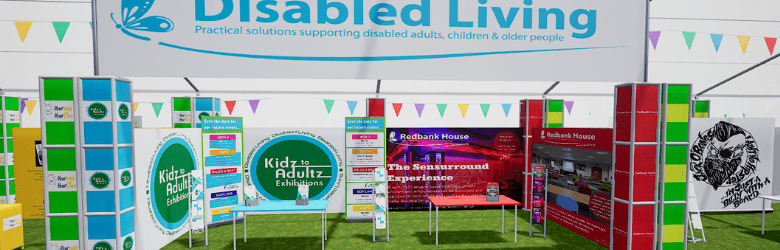
    Kidz to Adultz Exhibitions and Redbank House  (part of Disabled Living) are thrilled to be exhibiting at Disability Awareness Day (DAD). We look forward to promoting our services at this online event and will be located on stand M5.

    Disability Awareness Day (DAD) is recognised as the largest annual event of its kind in the world. Due to COVID-19, the 29th event will be held virtually online via www.dadvirtual.org.uk it is totally free, and goes live at 10am on Sunday 25th October. A week of free, complimentary workshops will also be available the following week between Monday 26th till Friday 30th. The website will remain available online for the year ahead.

    DAD is a ‘pan disability event which promotes a culture that focuses on what disabled people can-do’. Event Co-ordinator Dave Thompson MBE DL co-founded the organising charity Warrington Disability Partnership (WDP) in 1991 and the annual DAD event in 1992. Held in a tented village on the grounds of Walton Hall and Gardens Warrington, DAD provides a wide range of features including information, advice and guidance on products and services, a sports zone, a performing arts marquee, and entertainment for all. It has inspired similar events in over a dozen countries worldwide including Cameroon, Gibraltar, Uganda, Thailand and India, and has attracted special guests including members of the Royal Family and Ministers for Disabled People. The Royal Air Force have also supported past events with flypasts from the Red Arrows and WWII Dakota’s. WDP was presented with the prestigious Queen’s Award for Voluntary Services in 2006 in recognition of DAD’s Army of volunteers who ensure the show runs smoothly.

    In 2019, the event was supported by dozens of businesses, statutory and voluntary service providers including over 100 disability charities, with more than 25,000 visitors attending on the day. Over 600,000 people have attended past events, and charities have not only raised awareness about what they do, they have also raised over £1million for good causes.

    What to Expect

    This year, over 200 virtual exhibitor stands have been booked, as well as an impressive line-up of performers in the Arts Marquee, with 2018 Britain’s Got Talent winner, Lee Ridley, best known as Lost Voice Guy, heading the bill. Plus over a dozen organisations will be promoting a wide variety of inclusive sports and activities such as scuba diving, cycling, wheelchair rugby and basketball, dance, angling and Tai Chi.

    DADV2020 is dedicated to the memories of two members of the DAD team who have sadly died of Coronavirus, Peter Ives and Colin Whitfield, who together contributed nearly 50 years of voluntary work to DAD and WDP.

    Exhibitors from across the region, the UK and as far afield as Israel and Australia will be showcasing their products and services including disability and age related support groups, health and social care, mobility and independent living equipment, education and employment, independent living options, magazines and exhibitions, arts, crafts and activities, sports and leisure, welfare benefits advice, housing and supported accommodation, rail travel, police and hate crime, and performing arts.

    Tony Brown, Managing Director at Expanse Learning Group the event principal sponsors, said “We are all excited about the potential impact of DAD Virtual. Here at Expanse we learn from other organisations who are delivering education and support to young disabled people, and we love to share our achievements across the industry. DAD Virtual provides us with the platform to do both.

    The event has been supported by United Utilities, Warrington & Halton NHS Teaching Hospitals FT Trust, Police & Crime Commissioner for Cheshire, Active Cheshire and the Coronavirus Community Support Fund, distributed by The National Lottery Community Fund, thanks to the Government for making this possible.

    Disability Awareness Day (DAD) is an event organised by the Warrington Disability Partnership (WDP)

    Warrington Disability Partnership is an internationally recognised and award winning user led registered charity founded in 1991. With a team of nearly 50 staff and over 200 volunteers, WDP offers 28 mobility and independent living services in and around Warrington, Liverpool and North Wales, including two Centres for Independent Living and two Shopmobility services.

  • Sensory-Friendly Halloween Costume Ideas

    Sensory-Friendly Halloween Costume Ideas

    For some individuals, Halloween can pose extra challenges. Although dressing up can often be something to look forward to, itchy seams, tight collars, restrictive masks, or strong-smelling face paint may be unbearable for those with sensory issues. Costumes bought from shops may be particularly uncomfortable. However, making simple sensory-friendly costumes is a great solution for this! Why not get creative this Halloween and check out some of our adaptable, sensory-friendly costume ideas below.

    Sweatshirt

    Transform a soft sweatshirt, hoodie or jumper into something spectacularly spooky. To create some bat wings, sew some black fabric (an old sheet would be ideal) onto the arms of the sweatshirt and join it to the sides. Additionally, you could take a plain orange jumper and draw a face on it to create a simple yet effective pumpkin costume. Another option is to stuff some old tights or knee-high socks and attach them onto the sleeves of the jumper and stick some googly eyes onto the front to create a scary spider costume.

    Pyjamas

    Another simple idea that will provide maximum softness for your child is to transform some plain black pyjamas into a spooky skeleton. Simply cut a skeleton template out of a plain white sheet and sew it onto the pyjamas for some custom-made comfort.

    Cardboard boxes

    If your child would rather have a costume that barely touches them, why not create something that they can hop in and out of as they choose? Cardboard boxes are a versatile option which can provide hours of fun for both you and your child to get creative. Whether you are looking to make a car, plane or horse, the possibilities are endless. If your child is a wheelchair user, this is also a great option for an adaptable costume. For more ideas to inspire your creativity for making an adaptable costume, visit: https://costumes.lovetoknow.com/types-costumes/costumes-that-work-wheelchairs

    Alternatively, if there is a specific store-bought Halloween costume that your child has in mind, but you are concerned that it could be uncomfortable, you can always purchase a larger size and layer the costume over comfy, sensory-friendly clothing.

    Before your child wears their Halloween costume, suggest that they try it on a couple of weeks beforehand to ensure they are accustomed to the textures and identify any issues they might have. This will give you time to make any amendments prior to their Halloween event.

    Visit our Supplier Directory, under the Sensory Toys and Play Equipment category to see what the companies are up to this Halloween! You can also tweet Disabled Living with your own ideas at @disabledliving.

  • How Motability Cars Cater for Drivers and Passengers with Disabilities

    How Motability Cars Cater for Drivers and Passengers with Disabilities

    This is a sponsored post written by Stoneacre Motor Group.

    The Motability scheme is relatively unknown to many in Britain, but for more than 600,000 of us, a Motability vehicle is life changing. You probably already see Motability vehicles every day even if you may not realise so and you may certainly know someone who already benefits from the use of one.

    Motability is an extensive collaboration between the charity sector, the Government and the automotive industry. As a charity-led organisation, Motability that has helped millions of people across the country gain access to a car, mobility scooter, or motorised wheelchair. And they continue to do so with more than half a million people currently on the scheme.

    The scheme is open to any citizen who receives one of four higher rate mobility allowances from the Government, who are able to exchange their benefits with the Motability charity to lease mobility equipment that can help improve their independence and standard of living.

    How Does Motability Work?

    Anyone who currently receives any of the four higher rate mobility allowances are eligible to apply for the scheme and lease a vehicle. These rates include disability living allowances, personal independence payments, and other supplements for war pensioners and Veterans.

    The scheme is simple in how it runs. Claimants are able to exchange their cash allowances with the Motability charity who in turn provide a lease vehicle of their choice. Motability are then paid every month by the Department for Work and Pensions who deduct the cost of the lease from the mobility allowances of the claimant.

    The cost of the lease includes all tax, insurance, breakdown and servicing costs, which are taken care of by the charity at limited expense to the claimant. Its effectively a ‘just add fuel and drive’ kind of deal, which typically last anywhere between 3 to 5 years before the equipment must be returned or the lease extended.

    Claimants are able to choose what to spend their allowances on, whether that be a mobility scooter, motorised wheelchair or a Motability car. Those that only travel short distances tend to favour a scooter or wheelchair, with others who need to travel longer distances opting for a car that has special adaptations for disabled drivers and passengers.

    What Cars are Available on the Motability Scheme?

    The majority of major car brands all offer some of their models on Motability, which means there’s a great choice of cars on offer. From compact SUVs and 7 seater family cars, to chic city-cars and hot hatchbacks, there’s plenty to look out for.

    Motability cars come available with a whole range of adaptations that can be made to improve the utility of the vehicle for disabled drivers and passengers.

    You can apply through a Motability dealer who are registered dealers for the charity. Motability dealers help claimants with their application for their scheme as well with their search for a car.

    Adaptations are made to the vehicle to improve the general use of the car and for some people it can mean they don’t require any assistance to travel. For others, adaptations can simply just make a car much more feasible to use, especially for wheelchair users or paraplegics.

    motability accessible vehicles in the showroom

    What Adaptations are Available to Disabled Drivers or Passengers?

    A Motability car can be driven by a nominated driver, which is especially the case for disabled children or for other people who are unable to drive. This means that some may require adaptations as a passenger and others require adaptations as a driver. Both are available on Motability.

    The three categories for Motability adaptations are seating & stowage, driving controls, and access. Driving controls change how the vehicle is driven to cater for drivers who may have limited or no use of their legs and feet. Adapted driving controls include hand controls for braking and acceleration, pedal modification and steering aids, which are all more than often fitted to an automatic car.

    Changes to the seating and stowage of the vehicle can be made to cater for both drivers and passengers who use the vehicle on a daily basis. Motability cars commonly feature altered boot space and storage facilities to carry personal mobility equipment, plus mechanical hoists to load wheelchairs or scooters into the boot or roof-rack facility.

    The third category of adaptation is for access. Adapted access help disabled people enter and exit the car through the front or back doors. Motability cars can be fitted with manual and electric lifts to load people and equipment in and out of the cars. Adapted access can fit transfer plates, electrical hoists and swivel seating to the car.

    All adaptations are made available when applying for a Motability car. The Motability dealer will assess your position and they will be able recommend the necessary adaptations to the car you’ve chosen. What’s more, Motability provide more than 500 different adaptations and many of them are available at no extra cost. You can check your eligibility online now.

    If you would like to feature on Disabled Living’s blog please get in touch with us via email: info@disabledliving.co.uk

  • Staying Fit with a Disability

    Staying Fit with a Disability

    This is a sponsored blog post written by Jorvik Tricycles for Disabled Living.

    If you have from a disability, you may wonder and worry how you can exercise and stay fit. Fortunately, there are lots of ways that you can get out and about or stay healthy from the comfort of your own home. In our guide, we’ll show you the best ways you can stay fit and healthy and feel good about yourself.

    Head outdoors

    It’s important you don’t let your disability get in your way of getting out and about into the great outdoors. If you have a powered wheelchair, you can move around with ease on paths and footways. They are powered electrically so you can move along independently without the need of help from others.

    Another alternative, are tricycles. If you have confidence in the use of your legs, then you can propel yourself along on a tricycle. The great thing about them is that they are on three wheels (two at the back and one at the front). This gives you greater stability and makes you feel a bit safer when you’re riding around. There is a great range of tricycles from Jorvik Tricycles so check them out.

    Jorvik Tricycle

    Exercise from home

    There are some great exercises you can do from your home, and even the comfort of your chair. Here are some of the best exercises you can do, taken from a great article by Invacare:

    • Shoulder Movements – Moving your shoulders in a circular motion helps to keep them strong. You’d be amazed how often you use your shoulders so it’s important to keep them mobile and strong.
    • Balloon Squeeze – Find a ball or if possible, a medicine ball and place it on your chest. Start to squeeze the ball as hard as you can. The more you squeeze the ball, the more it works your chest and you will feel the pinch!
    • The Zombie Twist – No, not a Halloween dance. This exercise derives its name from the way you look whilst doing it. Sit up straight in your chair and hold your arms out in front of you (like a zombie). Start to twist slowly from right to left keeping your arms out straight. Repeat 10 times (or less if you’re struggling).
    • The Jazz Toes – If you enjoy bopping along to a song whilst exercising, you will enjoy this one. Sit up straight in your chair or wheelchair and place your feet flat on the ground. All you need to do is point your feet up towards the ceiling and then point them to the floor. You should feel a slight twinge at the back of your foot.
    • Higher Knees – Again, sit up straight in your chair or wheelchair and put your feet flat on the ground or on your footplate. Lift your leg slowly to a manageable point and start to bend your knee in towards you. Hold for 5 seconds and then start to lower your foot down. Try and repeat the exercise around 10 times if you can.

    So, there you have our top tips for keeping fit from home or in the great outdoors. Get in touch with us if you need any more advice. It is incredibly important to stay fit and hopefully this post has helped you see just how easy it is.

Disabled Living