Category: General

  • Disabled Motoring UK Baywatch 2022 results

    Disabled Motoring UK Baywatch 2022 results

    In this guest blog post, Disabled Motoring UK have released the results of their Baywatch 2022 campaign looking at tackling disabled parking abuse. Disabled Living is proud to support Disabled Motoring UK’s campaign.

    In August we asked the public to help us with our annual Baywatch campaign. We asked disabled motorists to complete a survey about their parking experiences over the past 12 months. The results have now been calculated.

    DMUK would like to thank everybody who participated in our Baywatch 2022 campaign. The level of response completely surpassed all records with 1028 people responding to the survey. It’s the first time in the campaign’s history that we’ve reached over 1000 responses. This level of response shows that disabled parking abuse continues to be a primary concern of disabled motorists. We would also like to thank all our supporting organisations for promoting the campaign and encouraging their supporters to take part.

    FINDINGS

    Local Authorities

    This year’s survey again confirmed that most disabled motorists, 78.12% of respondents, think that local authorities are not doing enough to tackle disabled parking abuse. This figure is significantly lower than last year (95.9%) which does suggest that some local authorities are doing more to tackle this issue.

    The survey also revealed that 67.16% of the respondents had never had their Blue Badge inspected by an official. This was lower than last year’s figure of 85.3% which again suggests more is being done to police the scheme. Respondents were still adamant that they wanted to see more inspections with 94% of respondents answering ‘yes’, they’d like to see more inspections.

    It is clear from these findings that local authorities still need to do more to enforce the Blue Badge scheme to ensure that disabled parking bays are available for genuine Blue Badge holders. However, it does seem that we are starting to see improvements for some. We hope that this positive trend continues.

    Supermarkets

    When it comes to finding suitable disabled parking bays at supermarkets, 39.2% of those surveyed said that it was ‘easy’ and 11.6% said it was ‘very easy’. However, 81.9% of respondents also stated that they ‘very often’ or ‘often’ see disabled parking bays being abused. This would suggest that there is still more work to be done in the correct management and enforcement of those bays.  These figures have remained consistent from last year’s survey so we have not seen much change at the supermarkets.

    We asked participants when they had reported abuse to supermarket staff did they take action and 68.7% said no. Supermarkets are not doing enough to enforce their disabled parking bays and support their disabled customers. The disabled bays still aren’t being managed properly and enforcement is definitely lacking.

    Other Findings

    Similarly, to last year, the survey also asked people to provide details of the parking experiences on everyday journeys (not just to the supermarket). This figure has fallen since last year and in response to these types of questions 56% of the respondents stated that it was either difficult or very difficult to find suitable disabled parking. In 2021 this figure was 79.5%. However, in this section of the survey, we also asked the respondents how often they saw disabled bays being abused on their everyday journeys. In response to this question a concerning 87% of respondents said that they either saw this occurring ‘often’ or ‘very often’. This figure, consistent with last year, is alarming and shows that the wider parking industry is not doing enough to enforce disabled parking provisions.

    Prosecution and Enforcement

    New to this year’s survey we asked, ‘Do you think that abusers of the Blue Badge scheme should face prosecution’ and overwhelmingly 93.2% said yes. We also asked participants if they had any ideas on how to better enforce the scheme. There were several respondents that made similar suggestions of more inspections, higher fines, and putting the picture on the front of the badge. Some people wanted to segregate disabled parking so that wheelchair users had their own bays and asked for more thought to go into disabled bay placement. For example, not to always be right in front of cash points. There were several suggestions that want to utilise technology and involve cameras and scanners in enforcement. Some participants had also clearly read our article on East Sussex County Council and their ‘Blue Badge awareness course’ and wanted to see this in other areas of the country.

    Electric Vehicles

    With the ban on the sale of new diesel and petrol cars in 2030 we are seeing more electric vehicles (EVs) on our roads. We know that much of the current public charging infrastructure is not accessible. We asked participants if they had seen any accessible public charge points in their local area and 58% said no. This is extremely disappointing especially with the EV switchover rapidly approaching

    DMUK finds the overall findings of our Baywatch Campaign very troubling. Being able to park at one’s desired destination is something that is crucial to the independence of disabled people. We are encouraged to see some improvement since the 2021 campaign, but progress is not happening quickly enough. Unfortunately, the survey shows that disabled motorists are still being disadvantaged. The poor state of the nation’s disabled parking provision and enforcement continues to prevent disabled people from living independent lives. It is vital that the parking industry now understands the importance of providing adequate disabled parking and making sure it is properly enforced. It is also important that disabled motorists aren’t left out when it comes to EV.

    DMUK Communications & Campaigns Director, Heidi Turner said: “We are thrilled to have received so much support for this year’s campaign. Getting over 1000 responses is a first for the charity and it also shows how important parking is to disabled people. We are pleased to see some improvements for disabled people when parking on their everyday journeys, but supermarkets continue to disappoint. The charity will continue to seek ways of better enforcing and managing the Blue Badge scheme so it is protected for genuine Blue Badge holders.”

  • Blaenau Gwent Veterans Association fundraise £6250.00 for Bladder & Bowel UK

    Blaenau Gwent Veterans Association fundraise £6250.00 for Bladder & Bowel UK

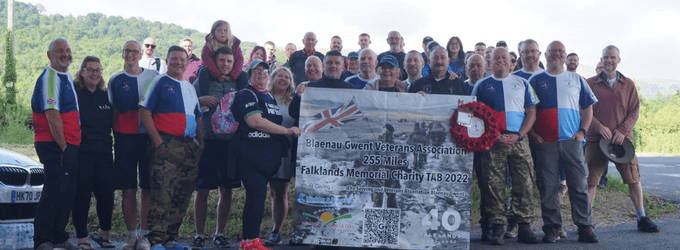
    A huge thank you to The Blaenau Gwent Veterans Association, for undertaking the tough task of walking 255 miles whilst fundraising for Bladder & Bowel UK. The group is set up to support veterans and serving personnel in South Wales, Blaenau Gwent.

    An image of the veterans on their journey walking along a road in the countryside

    The walk is in honour of those who sadly lost their lives in the Falklands War between April and July 1982. This year marks the 40th anniversary and the veterans decided to honour the 255 lives lost by walking a mile for each person.

    The walk began with the laying of a wreath at the National Arboretum, Stafford, as a mark of respect. The group then started their walk to Llandudno in North Wales, heading to Crickhowell and returning to their hometown of Brynmawr.

    An mage of the wreath laid in memory of those lost during the Falklands War. The writing reads 'On behalf of Brymawr Veterans. In memory of the 255 who made the ultimate sacrifice. We will remember them.'

    In this time, the veterans supported each other who have, or have, suffered with mental health conditions and PTSD. Undoubtingly the walk was a strain on the team both physically and mentally; a huge challenge for every mile they took. Persevering through to the end is a true achievement!

    The group of veterans are proud to announce that they have raised a massive £8276.00 fundraising since June 2022 and we are delighted and honoured that the association have donated £6250.00 towards Bladder & Bowel UK causes. While walking to Wales, nearing the end of their journey, they said ‘it’s been emotional, it’s been exhausting… but it’s all been worth it’ from the support they received along the way, and we are so grateful for their hard work.

    An image of one of the veterans being massaged on his leg after a day of walking

    Bladder & Bowel UK offers free and confidential advice from our team of specialist nurses and continence product experts for bladder and bowel health, managing incontinence and signposting to services for children, adults and healthcare professionals. The team also provide ‘Just Can’t Wait’ cards, a free to order toilet access card that helps you gain access to toilets not usually available to the public. The generous donation from Blaenau Gwent Serving and Veterans Association will help Bladder & Bowel UK continue to support the community with guidance and advice on bladder and bowel issues for everyone.

    From sleeping in camper vans for 5 days, to being stopped by the police on the A55 on their walk, the team persevered through out and pulled off a major feat. We’d like to thank each and every person involved in the fundraising and for choosing Bladder & Bowel UK as a charity to support.

  • Baywatch month 2022: Disabled Motoring UK’s annual survey

    Baywatch month 2022: Disabled Motoring UK’s annual survey

    In this guest blog, Disabled Motoring UK is encouraging people with disabilities to fill in their annual Baywatch survey to help improve parking industry standards and stamp out disabled parking abuse. Disabled Living is proud to support Disabled Motoring UK’s campaign.

    Baywatch is here and this month Disabled Motoring UK will be asking you to fill in the Baywatch survey. Every year DMUK runs its Baywatch Campaign which researches opinions about disabled parking abuse. It’s a simple survey which doesn’t take long to fill in and provides the charity with really useful data to take to the parking industry to encourage them to do more to support disabled customers and manage their disabled parking provisions correctly. Last year DMUK received over 850 responses, breaking all records, which goes to show that many of you are still experiencing massive problems when it comes to finding suitable and properly enforced disabled parking.

    Still the most common problem for many disabled motorists is not being able to park at their desired destination. The major complaint is that the disabled bays are all occupied with cars not displaying a Blue Badge and most of the questions in the survey reflect this. However, as time moves on DMUK has noticed new parking worries around electric vehicles and charging infrastructure. So this year we have included a question on EV charging bays. (DMUK also has its dedicated EV survey still running and if you have not already done so please take the time to fill it in. More info available here.)

    When answering the questions please think about your parking experiences over the last 12 months. Have you been able to park easily at the supermarket and elsewhere? Do you think local authorities are doing enough to tackle Blue Badge misuse? These are important questions and if we have some statistical evidence it makes our case stronger when trying to get the parking industry take the management of disabled parking bays seriously.

    We will be running the Baywatch survey for the month of August which you can complete without leaving your home. The online survey which can be accessed through our website www.disabledmotoring.org/baywatch/baywatch-2022

    When the survey closes the results are calculated and published. The Baywatch campaign also aims to change public attitudes by bringing to the attention of disabled bay abusers the impact that their actions can have. We will publish the results later in the year.

    Heidi Turner, Campaigns and Communications Director at Disabled Motoring UK said: “Disabled bay abuse is still one of the main concerns expressed to us by our members and the public. Our annual Baywatch campaign is an opportunity to focus the parking industry on the problems faced by disabled motorists when parking and sends the message that these bays need to be enforced and managed correctly. We are noticing more opinions coming forward on how disabled motorists think the scheme should be enforced and we are also keen to hear these views.”

    Take action now

    As well as filling in the Baywatch survey you could also help by writing to your MP. We have a new template letter on our website available for members and public to download. This letter can be sent to your MP to ask them what is being done in your area to tackle Blue Badge parking abuse. To download the letter please visit https://www.disabledmotoring.org/campaigns/blue-badge Further information on how to contact your MP can be found by visiting https://www.parliament.uk/get-involved/contact-an-mp-or-lord/contact-your-mp/

    DMUK would like to thank all those who participate in this year’s Baywatch Campaign.

    Supporting organisations

    We are thrilled to have the support of so many supporting organisations.

    supporting charities - AccessAble, Phab, Independent living, Honest John, Disabled Living, heycar, Posability magazine, BPA

    Disabled Motoring UK 

    Disabled Motoring UK is the national charity which supports disabled drivers, passengers and Blue Badge holders. We work with government and businesses to improve parking, refuelling and access provision for disabled people, so that they can access the goods and services that they need. Disabled Motoring UK is not just an organisation for disabled motorists; we also campaign for and support scooter and wheelchair users, families and carers.

    The charity is a membership organisation and the charity relies on membership subscriptions to continue its work. Full members receive a monthly magazine, access to our information service and discounts on variety of goods and services.

    For more information please contact:

    Heidi Turner

    Campaigns and Communications Director

    heidi@disabledmotoring.org

    01508 489449

  • How do you get a blue badge?

    How do you get a blue badge?

    Blue badges enable people to park in spaces reserved for people with disabilities. In this article, find out more about a blue badge, who is eligible for one, and how to get your own.

    What is a blue badge?

    A blue badge is an aid put in place for disabled people or those with a health condition that affects their mobility. It is linked to the person as an individual, not a vehicle, so it can be used in any car you are in, whether as a driver or a passenger. This includes taxis, hire cars or any vehicle you are travelling in.

    The badge holder is entitled to free parking in disabled parking bay, at parking meters and pay and display bays. Parking is also permitted on some single and double yellow lines up to three hours (where restrictions don’t apply). You can find more information about the specific parking restrictions on your local council website.

    You can apply for a badge for yourself, a child in your care with a mobility issue or for an organisation if you regularly transport those eligible for a blue badge.

    How do I get a blue badge?

    The application process is slightly different depending on the specifics of the mobility issue.

    Automatic eligibility 

    If you are automatically eligible for a blue badge the application will be straightforward. If any of the below are relevant to you, you are automatically eligible :

    • You are registered blind
    • You have the highest rate of Disability Living Allowance (this will be stated on your decision letter)
    • If you receive War Pensioners’ Mobility Supplement
    • You received tariffs 1 to 8 of the Armed Forces Compensation Scheme and were certified as having a permanent and substantial disability

    When you receive Personal Independence Payments (PIP) you are automatically eligible for a badge if you meet certain scores on your assessment:

    • If you scored 8 points or more in the ‘moving around’ area
    • If you scored 10 points in the ‘planning and following journeys’ area and were put in category ‘E’. This means that your stress, anxiety or other mental health issue stops you leaving the house

    You can check your decision letter if you need clarification

    Other eligibility conditions 

    If you are not automatically eligible you can still apply, and will need to provide some additional details on the mobility condition you need assistance with. This will be the case if you:

    • Have long term problems walking or going places (including problems caused by mental health conditions such as stress or anxiety)
    • Are applying for a child aged over 2 who has a problem walking or going places, or a child under 3 who needs to be close to a vehicle due to a health condition
    • Have severe problems using both your arms

    Problems walking or going places

    The problem you are experiencing should be as a result of a severe and permanent disability. You will be asked to explain this in as much detail as possible.

    It is important to estimate how far you can walk without support before you start to feel pain or need a rest. This can be counted in distance or number of steps.

    It is important to include how long it takes you to walk this distance, how you walk and how this makes you feel.

    A child who needs to be close to the vehicle

    In the application you will be asked to specify why the child needs to be close to the vehicle.

    You can do this by explaining how the condition requires you to get home or to the hospital quickly, or by listing the medical equipment you need to transport and why.

    Try and describe the requirements in as much detail as possible, including how often you need the equipment, and how frequently or quickly you need to get to the hospital.

    Are you applying on your child’s behalf? Find up to date advice and information from our Kidz to Adultz team here

    Non-visible or hidden disabilities

    The problems walking or needing to be close to the vehicle could be caused by either a physical or non-visible (hidden) disability.

    Anyone with a disability that causes difficulties or distress when walking when part of a journey can apply for a blue badge, not just those who experience an issue as a direct result of walking.

    Local authorities will seek the advice of expert healthcare professionals for example a gastroenterologist, for any disabilities such as crohn’s disease, ulcerative colitis or inflammatory bowel diseases that might cause difficulties when walking as part of a journey.

    These professions were drawn upon by the department for transport when laying out the guidelines for eligibility and will be consulted by local authorities when determining an applicants need for a blue badge.

    If you are experiencing difficulties due to bladder or bowel related issues you can find useful resources and our confidential helpline here

    Problems with your arms 

    People who have problems related to their arms also are eligible for a blue badge. However, this only applies if they are the driver.

    If applying for a blue badge on these grounds you will be asked to explain the severe problems you have in both arms. You must explain why you need to drive regularly, or why you have difficulty using parking ticket machines or meters.

    What do I need when applying?

    Blue flooring with white symbol from disabled parking space

    As well as the completed application form you will need also need:

    • A passport size photo
    • Proof of your disability
    • A form of ID
    • Proof of Address

    You can find more information on what is accepted at the government website.

    The blue badge costs up to £10 in England, £20 in Scotland and is free in Wales.

    Once you’ve applied 

    It might take up to 6-8 weeks for your application to be processed. If you haven’t heard back after this time frame you should contact your local council.

    As part of the application process, you might be required to take part in a mobility assessment. During this you will be assessed by a health care professional who will watch you carry out a range of mobility activities. They will report back to the council regarding your suitability for the badge.

    If your application is refused you can ask your council to reconsider. Details of how to ask for this will be in the decision letter you receive.

    The badge usually lasts for up to three years. You will need to renew if you still require a blue badge before your old one expires.

    You can find the application to apply or renew your blue badge on the government website.

  • Screen time and autism: When are screens necessary?

    Screen time and autism: When are screens necessary?

    In this guest blog by Autability, learn about why preconceptions about screen time can be harmful, and the uses and benefits of screens for children with autism, and their families.

    The question of screen time and people with autism

    Screen time. A topic we hear about a LOT in parenting. Some people see it as a treat, some people see it as dangerous. But what if someone has a genuine need for it?

    Many autistic children and adults get lost in their electronics. It’s helpful for so many reasons yet people will often judge parents who let their children use iPads, phones and laptops frequently because they don’t understand what is happening and why.

    So what does screen time actually do for an autistic and/or ADHD child? 

    1. It helps them regulate. Watching familiar videos or listening to favourite songs over and over can actually be a form of stimming. It helps the child regulate their emotions, calm their brain and rest mentally from an arousing and stressful world.
    2. Many autistic children will learn in their own way, in their own space, in their own time. Educational videos can often teach autistic children more than a teacher due to their surroundings at home being more comforting, familiar and quite than a classroom. My child learnt to read fluently by the age of 4 via his iPad.
    3. It allows the child to block out stressful external stimuli such as hospital waiting rooms, supermarkets or restaurants. They absorb themselves in their game, maybe with headphones on, and means they can cope in an environment which would otherwise cause sensory overload.
    4. Autistic children can find relationships in the outside world difficult. Many form friendships online or are able to communicate far easier with their friends online than in person. It can actually be their least stressful way of socialising. Of course, it is important to put online safely measures in place.
    5. It can allow children to take part in family time. ADHD children can really struggle to watch a film without becoming bored. But if they have a tablet or phone to play on, they can happily take part in family movie nights as they can occupy that part of their brain that causes boredom or under stimulation. The same goes for board games and meals out.
    6. Just like everyone else, autistic and ADHD children need time to rest even if they are regulated. Their version of rest often means occupying their brain with games. It’s simply their version of chilling out.

    Screen time and autism.

    About Autability

    Autability exists to educate, train and support people who parent or work with neurodivergent individuals. So much of the advice and training available today comes from neurotypical sources. Autability believes that the best qualification a person can have in order to advise and train others is lived experience.

    Autability has two directors, Charlotte and Danielle.

    Charlotte is diagnosed autistic, ADHD, dyspraxic and dyslexic. As well as her diagnoses she has the following qualifications and experience:

    • Post graduate certificate in autism
    • Working towards a masters in autism
    • Mum to a complex son diagnosed with autism, ADHD and epilepsy
    • Degree in music
    • Degree in history and religion
    • Qualified teacher
    • Director of Supporting Paws CIC
    • Author of upcoming book on parenting autistic children (published by JKP)
    • Fellowship of the royal school of music in piano, singing and flute

    Danielle is diagnosed ADHD. She has the following qualifications and experience:

    • Psychology degree
    • Mum to a complex son diagnosed with autism and ADHD
    • Creator of The Autism & ADHD Diaries blog
    • Experienced trainer in the corporate and not for profit sectors
    • Author of upcoming book on parenting autistic children (published by JKP)

    You can visit Autability’s website by clicking here. Learn more about Disabled Living’s Kidz to Adultz exhibitions by clicking here.

  • Baywatch 2021 campaign: Tackling disabled parking abuse

    Baywatch 2021 campaign: Tackling disabled parking abuse

    In this guest blog by Disabled Motoring UK, we learn about their excellent campaign to stop the misuse and abuse of disabled parking spaces, Baywatch 2021. Baywatch is supported by Baroness Grey-Thompson. 

    The issue of disabled bay enforcement

    A common problem for many disabled motorists is not being able to park at their desired destination. The major complaint is that the disabled bays are all occupied with cars not displaying a Blue Badge. Last year Disabled Motoring UK (DMUK) changed the format of the parking survey so that participants could fill it in at home. This allowed the charity to also expand the scope of the survey to gauge your opinions of other aspects of parking and the Blue Badge Scheme.

    The results are calculated and published when the survey closes. The charity presents this data to the parking industry and encourages it to take the parking problems of disabled motorists more seriously and manage their parking provision correctly. The Baywatch campaign also aims to change public attitudes by highlighting the impact of disabled bay abuse.

    Baywatch 2021 – improving disabled parking provision and enforcement

    The only way to keep the pressure on the parking industry is to run the DMUK Baywatch Campaign annually and this year it takes place in August and you’ll  be able to participate online by visiting the DMUK website.

    We hope to make this year bigger and better than ever before. We have a number of organisations supporting Baywatch 2021.

    The campaign has support from Baroness Tanni Grey-Thompson. She commented: “It’s so sad that Disabled Motoring UK has to run its Baywatch Campaign. Disabled bay enforcement should be an imperative, especially for the major supermarkets that can afford to invest in policing their car parks. I see disabled parking abuse regularly, There is a real lack of understanding about how essential these bays are to disabled people and I applaud DMUK’s Baywatch Campaign as it plays a vital role in highlighting the issue of disabled parking abuse at supermarkets.”

    Graham Footer, Chief Executive, at DMUK, said: “Baywatch is one of the charity’s longest running campaigns and is really important to draw attention to the parking problems that disabled people face when just trying to go about their daily lives. It is now an annual campaign for the charity. We hope this will allow us to gather momentum and keep the pressure on the supermarkets and other car park owners to do more to support their disabled customers. It’s fantastic that the campaign has support from Baroness Grey-Thompson again this year. This campaign relies on public participation and we hope her support will encourage others to get involved.”

    Supporting organisations

    These organisations support DMUK/s Baywatch campaign:

    We’d like to get as many organisations involved as possible to spread awareness of the campaign. There is still time to get involved and we welcome all support with this vital campaign.

  • Surviving or Thriving? Neuro Difference Pre and Post Lockdown

    Surviving or Thriving? Neuro Difference Pre and Post Lockdown

    For Autism Awareness Month, Disabled Living’s contributing writer, Joanna Grace, shares her experience of lockdown, including some of her personal silver-linings in the last year. 

    My father’s nickname for my mother is Pollyanna. He has named her after the child in the book of the same name written by E.H. Porter who always sought out reasons to be glad. Having brought up by ‘Pollyanna’ I am prone to look for the positives in life. When I see a dark cloud, I ask, “where is the silver lining?”

    The pandemic has been the biggest of dark clouds. The loss of life, the suffering and the fear, has been enormous. I’ve looked for silver linings and found a few, and my hope in writing this article is that we might be able to keep one of them, after the cloud has gone.

    Before I tell you what it is, let me give you a bit of background. I run a thing called The Sensory Projects, pre lockdown my life was spent rocketing around the UK on trains (very occasionally hopping on a few planes to work internationally) providing training on sensory engagement. Whilst on the trains I delved into the research archives, and when at home I wrote.

    Then Came the Pandemic

    When lockdown hit, my life on the trains stopped. In common with many people, I suddenly faced a blank canvas of life, a gift of time, the opportunity to do with it what I pleased. Like many people I thought “Now is the time I will write that book I’ve always meant to write, I’ll take up that new hobby, learn to cook, etc.” Most people quickly realised that just getting dressed and getting off the sofa was an achievement.

    But not me. I wrote the book (it’s being published by Routledge in June), I had a baby, I home schooled my elder child, I created a resource bank for my neighbourhood and an online resource bank of inclusive teaching materials supporting everyone with home schooling, I reinvented my working life, I did and did and did. I was SO productive! Joanna Grace book cover

    At the start of lockdown people posted me messages on Facebook and Twitter saying “You’re so busy, I don’t know how you do it” that type of thing. By the time we got to the third lockdown the tone of those messages had changed. One conversation in particular brought it home to me:

    A friend of mine who is a university lecturer asked me how lockdown had been. I buoyantly replied that it had been good, (aside that is from the obvious pandemic). She said, “You’ve done so much” and I smiled and nodded. Then she went on to explain how hard she had found it, how she had found herself less able to do her work, that she felt she had let her students down, that she was struggling with her mental health. She ended it with “I watch you and I just feel so inadequate, you’ve coped so well, and I have not coped at all.”

    I stopped her there. I never want me living my life to make anyone else feel inadequate. I told her quite truthfully:  “I have not coped.”

    The social change required by lockdown has not been something I coped with. The social set up prior to lockdown was what I coped with. Lockdown, for me, gifted me the energy I used to use keeping up with the world. My children and my husband were the biggest beneficiaries, my health and my work the next.

    Lockdown Silver Linings

    Joanna Grace headshot

    I am autistic. Prior to lockdown I don’t think even I realised what it cost me to survive in a neurotypical world. Whereas in lockdown I’ve thrived. To give you a benchmark: in the year before lockdown, I was admitted to emergency medical centres 8 times, and left them dosed up with powerful antibiotics. In the month before lockdown the doctors had decided that I should be given my own supply of emergency antibiotics to travel with. Since the start of lockdown, I’ve not troubled the health services for anything other than the birth of my son. I loved my pre-lockdown life, but I paid a hidden price for the stress of that life with my health.

    Here is my silver lining: Coming out of lockdown, the population as a whole will have a better understanding of what it is like to be asked to conform to a social model that doesn’t suit your neurology, they will have an insight into how disabling it can be, and how it can damage your mental health.

    I do not want the world to return to normal, I want a new-neuro-inclusive-normal whatever that might be! We get to make that. The choices we make as we come out of lockdown decide that new world.

    Here is another silver lining: many companies have realised that if you let people work from home, they do actually work! Many are even more productive at home than they are in the office.

    If we moved forwards into a world where we recognised that different social set ups are okay, and we are not offended by someone’s nonconformity to the set-up we personally prefer, then we would all be free to find a place in society, and in socialising, where we can thrive (rather than survive). In a neuro-inclusive world we would all (not just the neurodivergent among us) be happier, healthier (mentally and physically) and more productive.

    There is an economic argument here, a society that allowed for different social set ups would be more productive and its members would pose less of a drain on services.

    Years ago I had the privilege of delivering a TED talk, and in it I spoke of why we should argue for inclusion from a position of what people personal stand to gain, not from a position of pity or charity for people who are different to ourselves. Here I am again making a version of that same argument. We all gain from a deeper understanding of neurodivergence and neurodiversity.

    If you are interested in learning more about the Sensory Projects, watch Joanna’s latest video series here: https://www.youtube.com/playlist?list=PLi1RQR58BHnVYNE4tF1EOcPVTPNb8DwmM

  • Limb Loss and Limb Difference Awareness Month – Together We Can Do More

    Limb Loss and Limb Difference Awareness Month – Together We Can Do More

    limbA consortium of UK charities working to support children, young people and adults with limb loss or difference have joined forces to celebrate and promote Limb Loss and Limb Difference Awareness Month this April. #LLLDAM

    The COVID -19 pandemic has had a disproportionate impact on persons with a disability, resulting in increased isolation and loneliness, with many community members staying at home and maintaining physical distance to stay safe.

    Since April is Limb Loss and Limb difference Awareness Month (LLLDAM), we will collectively spend the month raising awareness about living with limb loss and limb difference through our social media channels.  We believe that working together we can achieve more and reach more of our collective community members at home when they need us the most.

    We hope our presence will highlight the impact of living with limb difference on both the individual and on their family and support network. We will focus on supporting and connecting community members to reduce their isolation and loneliness.

    By creating a central online hub for Amputees and those with limb difference to access the right support, and learn more about the organisations which can help them, we can cover a greater geographical spread and community reach, bringing our community closer together.

    LLLDAM Image

    How you can get involved

    You too can help the recognition and celebration of #LLLDAM and #LimbLossLimbDifferenceAwarenessMonth by spreading the word using the Limb Loss and Limb Difference Awareness Month social media logo’s and assets.

    Please look for updates and campaign materials on our community website https://www.limblosslimbdifference.co.uk/ and social media channels.

    Article written by LimbPower.

  • Sensory Wellness Inspired by People with Profound Disabilities

    Sensory Wellness Inspired by People with Profound Disabilities

    This is a guest blog for Disabled Living written by Joanna Grace from The Sensory Projects. It has been written in Joanna’s perspective around the pandemic and her thoughts on sensory wellness, inspired by people with profound disabilities. 

    As lockdown began, many people with profound and multiple learning disabilities who had been used to leading rich and varied lives, attending schools or care settings, suddenly found themselves at home, isolating with their families or their care teams.

    Whilst some people around them struggled, many of the people with profound and multiple learning disabilities that I know thrived. And as they did so, they reminded those closest to them of the resources available to use all to boost our wellbeing.

    Here are three top tips that I have learned from them.

    Take joy in simple things

    Overthinking stuff can really clog up the capacity for fun in our lives. One family sent me a video clip of their son laughing hysterically at a sneeze, and another shared the bubbling joy of their son’s experience of an ice lolly: the surprise on his face at the coldness, the grasping of his hands against the slippery ice, and the chase of this strange object around his lap tray. What started out as bemusement quickly slipped for him into a joyful exploration.

    Sometimes we do not allow ourselves these pleasures, would we look silly if we let ice slip out of our hands, do we politely supress our giggles at how funny that sneeze sounded?

    In your own life watch out for the simple things that bring you joy and welcome them, one of the perks of lockdown is that you are not in a public space, you are in the privacy of your own home and you make the rules here. If you want to play with your food: play with your food!

    Spend time in a sensory moment

    Anxiety is born out of a fear for a future that maybe. In a pandemic, when any of our futures and any of the futures of our loved ones, could include a horrible illness we have a lot of reason to feel anxious. Justified as it is, it is no way to live. Taking time to spend in the here and now, in the present, without fear, is immensely valuable.

    I am in contact with lots of teachers, all struggling to provide a meaningful education online, in our chats many of them talk about how much they are missing the steadying presence of their students in their lives. If you are in the company of someone with profound and multiple learning disabilities you are in the company of someone who is a master at connecting with the present moment. One teacher who contacted me spoke of her students being a “daily reminder” to her to connect with the present.
    I have begun a class in sensory-being online. Sensory-being is a form of shared mindfulness based around a wonderful sensory object. A parent who took the class told me it had given her a way in to the peace in a moment that her daughter (who has profound and multiple learning disabilities) knows instinctually. She described how with two other children at home and her husband working from home everything can be very fraught. But by spending time with her daughter, sharing a moment of sensory engagement, it is as if she can take a little step out of the busy chaotic world around her and enter a little pool of quiet and calm.

    Enjoy the nearness of people you love without need for words

    Several families I know made the decision at the start of lockdown to bring their loved ones home from their care settings. One in particular agonised over the decision. Their son’s care placement was so good, he had friends there, access to all sorts of equipment and activities that he didn’t have at home, and although many of them would have to cease no matter where he was because of the restrictions they knew that the care team he was with would go above and beyond to provide him with interesting and exciting days. In comparison, they worried, what could they offer him at home in their terraced house? Ultimately they went with their gut instinct, which was in dangerous times to gather their family close and they bought him home. I have the privilege of watching their lives through the window of Facebook, and aware that they were worried I kept an eye out in my newsfeed for their posts. Initially they seemed to be going above and beyond creating activities for him. Their posts were fun, but something about them was a little too loud, a little too bright. They were trying a little too hard.

    The parents are well into their late sixties and their son is in his late thirties. I had a few brief messenger conversations with the father, asking me questions about colour changing lights and where they could get particular gadgets they’d seen. I do not have a lot of tech knowledge but I suggested they could get a similar effect with a torch, some coloured cellophane and a big umbrella.

    I kept watch, the umbrella was purchased, there was the son’s smile of amusement at the light show cast by the torch upon it and the proud smile of his father beside him. In time there were less posts. Now I see the odd one or two, they take him to a place they love to walk that has path that is easy for his wheelchair at times of day when they know no one else will be there. He sits in the garden alongside his father as he does the gardening, plant cuttings are placed on his lap tray for him to explore.

    I sent a message. “How are you getting on?” I asked. His Mum wrote back. She said they had been so worried about being enough for him, but through wearing themselves out trying they had had to stop, and when they stopped they realised he was happy to just be with them. She said now he is a part of their lives rather than a job they are doing. And she described how he will vocalise along with his Dad singing as he gardens, and that she loves to stand in the kitchen window and listen. She said previously her husband would have sung from time to time whilst gardening but their son’s vocalisations encourage him to do it more and that brings her joy.

    Being close to people you love and trust is incredibly precious. You do not need to be anymore than you are. And you do not need to talk or have words for things. Sharing time is precious.

    The pandemic has been and continues to be incredibly hard, but through its darkness much light has shone. I’ve been impressed by the embodied wisdom of people with profound and multiple learning disabilities, as I’ve shared above. At the start of the pandemic I grumped about possibly delivering my training, that has always been done in person in the past, online. But when I did finally get myself in gear and do it I was touched that people joined it from around the world, in person I can touch lives as far away as the trains in the UK can get me, but online I can touch lives around the world.
    The staggering kindness of people has been one of the brightest lights, we’ve all watched the heroism of the NHS staff and the keyworkers that have kept everything going. Through my little Facebook window I’ve seen glimpses into just how bright that light can be. Recently a man I know who has profound and multiple learning disabilities caught COVID19. He lives in a care setting and it was so frightening for his family to be unable to be with him. But his care team closed around him and supported him as if he were their own son. When some of them got sick too and had to be replaced his family were amazed by the care workers who volunteered to leave their own families at home and move in with him 24-7 so they could be the support he needed. In times of greatest need, strangers to them stepped forward and offered to help.

    I see kindness everywhere, in big ways and in small. Since the start of lockdown I have been curating a list online of free resources people and organisations have been giving away. It is as if, when faced with this awfulness, everyone looked around for what they could do and offered it up. The news will report those not following the rules, but the great majority are, it is one big team effort to keep each other safe, one enormous act of care. People are awesome!

  • New Compact WashPod Model

    New Compact WashPod Model

    This is a blog by WashPod, A Solution for Dignity Access for Disabled Living.

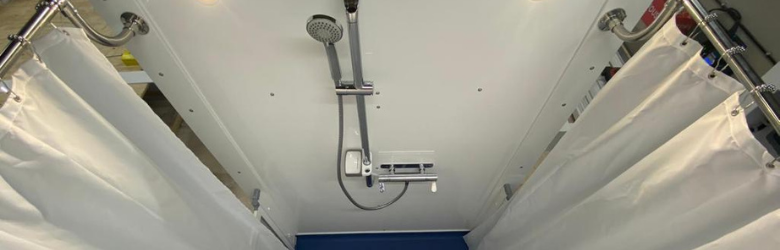
    The new Compact WashPod is the smallest in the range of plug ‘n play, temporary disabled wetrooms and it is designed for the most limited spaces.

    The Compact WashPod will be the answer for many people needing at-home disabled bathing where space is at a premium, a wheelchair is not needed and carer access is not always necessary

    Benefits include:

    • Absolute minimum space required – 1.5m L x 1.2m W x 1.6m H plus ramp
    • Versatile and quick to install (half a day)
    • Plug and play—no need for existing plumbing connections
    • A good option for the Disabled Facilities Grant
    • Bi-fold doors allow carer access from outside if needed

    washpod compact bathroom

    About WashPod

    If access to the bathroom is now difficult, the WashPod range of disabled washrooms offer the perfect interim solution saving the option of prolonged hospital care or an early move to an expensive care home. There is nothing like it on the market. They can be rented and installed in 1 – 2 days.

    In addition to the Compact, there is a standard External WashPod, which can be installed in the garden or on a patio and three other internal models – the Standard, the Mini and the Micro – which can be erected in a spare reception room, garage, bedroom corner or even in an existing bathroom.

    Additional applications are numerous from Housing Associations and Local Authorities who may wish to buy them and lease them out to residents as needed, or hospitals during building works, and commercial enterprises wishing to provide accessible washrooms.

    The WashPods are plug ‘n play and fully fitted to comply with the highest specification of part M of the building regulations. They have been devised by architects who specialise in the designing for disability and endorsed by occupational therapists and case managers.

    For more information, please contact Joanna Sale, Marketing, on 07717 425694 or email joannasale@cowan-architects.co.uk

Disabled Living