Month: April 2020

  • Abbie’s Story About Running a Business With Cerebral Palsy

    Abbie’s Story About Running a Business With Cerebral Palsy

    This is a guest blog by Abbie Hills, 24 year old from Hampshire. She talks about her experience of running a business with cerebral palsy. 

    About Abbie Hills

    I was born with cerebral palsy (mild), which is something I never understood growing up as I found myself being placed in a grey area of being almost able. Throughout my childhood and early teens I would notice that I got tired much quicker than others, and had persistent pains and could not understand why. When I got my first part time job, I noticed that even working a small shift in a tiny hair salon trying to sweep the floor was a challenge.

    I had never been particularly physical (shying away from sports days and other activities in school) but I always had a love for film and tv. Wishing to pursue a career in one of the most fast paced and physically demanding industries there was, I started acting in short films and doing work in small television roles. While this fulfilled a small part of my dreams, it would often leave me wiped out and fatigued for days after.

    Continuing my studies through university (BA Film) I realised I also had a passion for writing. This allowed me to create scripts and stories out of my ideas and watch them come to life – but I still wondered, how did people with disabilities manage a career in Film and TV?

    Fast Forward

    While I was proud of myself for finishing my degree and making a few short films during it, I was worried about what would come next. I knew working in a production role full time would not have been manageable for me, and moving away from my hometown was not an option, so I decided to further my knowledge of the Arts so that I could be in a position to start my own business (MA Arts Management).

    I had always had a thought in the back of my mind that the industry I planned to go into was not yet inclusive, so I wondered what I could do to change that, and throughout my course I picked up business skills and then took the plunge – launching my own Talent Agency and Production Company The Dazey Hills Company. With the experience I had gathered over the years in front and behind the camera I felt that I was in a good position to help others get into the industry.

    portrait picture of abbie hills

    The ethos behind my company is ‘Real People. Real Talent’ and I take pride in offering opportunities to people of all abilities and experience levels, as someone with cerebral palsy this has always been something close to my heart and something that I will continue to believe in throughout my career.

    I have secured paid industry work for people with no prior experience, and continuously look for people with passion in what they do. The nature of my job fortunately means that I can work from home which allows me the chance to have ‘off days.’ All of my clients have an understanding of what cerebral palsy is and alongside finding them work I am happy that I have been able to raise awareness for CP.

    Running my own business has given me a lot of help with recognising my own strengths and weaknesses, while also giving me an understanding of how to manage my condition as a young adult. I still get pains and fatigue regularly, but working on gentle yoga (although my balance isn’t great) between working has really helped.

    As I still act and make films alongside what I do, I have developed strategies in how to help myself while on set. Often the hours can be long, and there can be a lot of waiting around but I will always take simple measures such as making sure I have somewhere to sit and making sure that I keep myself hydrated (sometimes I take hot water bottles or heat patches to set to help with leg cramps). Where possible, I like to make sure I can plan a rest day after a day or two of shooting.

    Looks Towards the Future

    In the future I hope to broaden my client base, while also working with other disabled artists, performers or writers to build a support network and also assist them with securing work in their field. I am proud of myself for how far I have come, and how I have adapted to build my dream job, and I look forward to what the future holds for me and The Dazey Hills Company.


    If you would like to share your story with Disabled Living, please email info@disabledliving.co.uk and a member of our marketing team will be in touch.

  • World Art Day – Celebrating the Power of Art for All Children

    World Art Day – Celebrating the Power of Art for All Children

    Neve Spicer from We the Parents is one of our new guest contributors on Disabled Living’s blog. Neve is a passionate advocate for art, play and creative learning. She talks about the benefits of learning art to coincide with this year’s World Art Day.

    Today, on Leonardo da Vinci’s birthday, people around the globe are celebrating World Art Day. It’s a perfect time to acknowledge and appreciate the power of art and arts education in all our lives.

    Art: A Field of Equals

    All children learn differently. For some disabled children, these learning differences can make it more challenging to engage in and enjoy the same activities as their peers. But when it comes to art and creative expression, each child is on a level playing field.

    The essence of art is self-expression. For as long humans have been around, they have used it to communicate feelings and ideas, the very nature of which are personal and subjective. Like all others, disabled children have a deep well of personal experience and imagination to draw upon. They are at no disadvantage. And, what’s more, there isn’t the pressure to conform or do things in the same way as everyone else.

    The Benefits of Arts Education

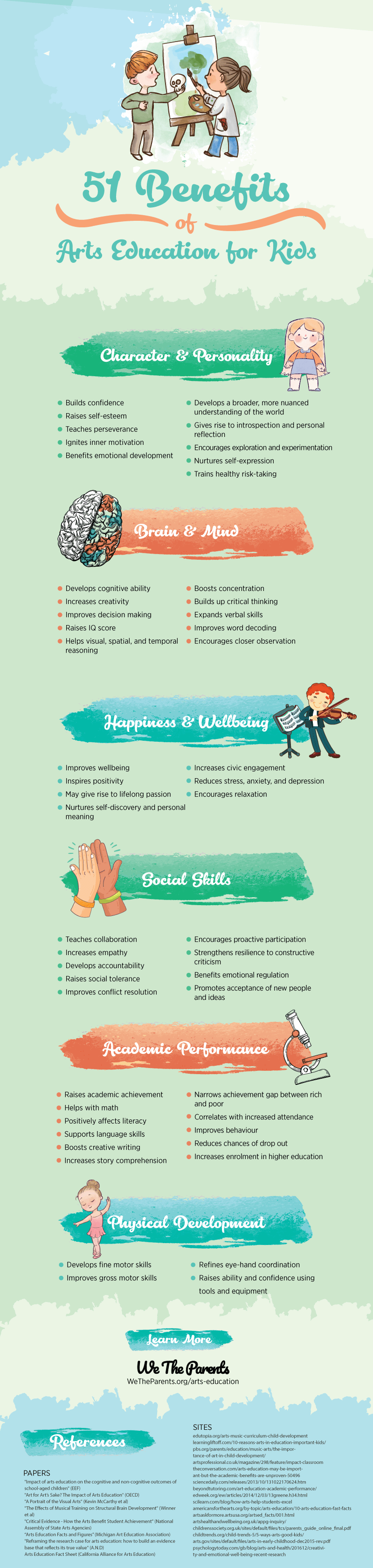
    For all children, learning arts cultivates cognitive abilities, nurtures positive character traits, and fosters critical thinking. It expands awareness, increases empathy, and develops an array of social skills. What’s more, the arts allow learning opportunities and expressive possibilities for students who don’t always fit the traditional academic mould. And that’s just the start! This visual guide highlights an incredible 51 powerful ways that learning arts reward children and young people.

    51 benefits of art educuation for kids

    Creating Space for Art in the Home

    A great idea is to designate a space for creativity and art in your home. This can be a whole room or a portion of one. The important thing is that it remains a permanent art zone where children have easy access to the tools and materials to create their mini masterpieces. A wipe-clean table is ideal and there must be plenty of storage to keep pencils, pens, and everything a creative mind may be inspired by. A devoted display area will also help kids to take pride in their work. It can be as simple as a string and pegs.

    Allowing Children to Do It for Themselves

    Avoid the impulse to continually step in as a disabled child first learns how to use and manipulate new art mediums. It is important that they are given space to explore and use their problem-solving skills as they get a feel for paints or clay or fabric or any myriad of different materials and tools. This will lead to greater learning and personal satisfaction as they create their art independently with minimal adult intervention.

    Visit We the Parents to discover more interesting articles on Neve’s blog.

  • Supporting Your Disabled Colleagues in the Workplace and During Covid-19

    Supporting Your Disabled Colleagues in the Workplace and During Covid-19

    Sponsored post sent to Disabled Living by Minton Morrill.

    This blog article will take you through some of the ways you can support your disabled colleagues in the workplace and through the current Covid-19 pandemic.

    Whether it be a congenital disability from birth, something that’s been brought on by a spinal injury, or a condition that’s developed over time, disabilities are important to learn about. Here are some tips for ways you can make your workplace more inclusive…

    Top Tips for Supporting Your Disabled Colleagues in the Workplace

    1. Educate Yourself

    First and foremost, educating yourself is key. This can come from trying to learn more about the condition your co-worker has. You could do this through online research, or simply by asking them questions.

    Just be mindful when doing so; I’m sure your disabled co-worker will be happy to answer your questions, but don’t fixate on it. Once you’ve asked your questions, move on to something you’d discuss with any other colleague.

    2. Explain Things That May Seem Obvious

    When it comes to co-workers with additional needs, like autism, it may take them a little longer to get to grips with their new surroundings. So, anything that may seem obvious to you, like where to put your lunch, or where to keep your mug, may not be clear to others. To tackle this, when giving the office tour, be sure to show your new colleague everything there is to see along the way.

    3. Speak Up for Your Colleague

    If you notice any discrimination within the workplace, including bullying or exclusion, making sure to speak up is so important. You should also report this to your line manager.

    4. Be Aware of the Language and Terminology You Use

    The language you use to interact with or discuss disabled people must be taken into consideration, to ensure inclusivity. Some important ways to talk about or address your disabled colleagues inside and out of work could include:

    • Mention the person first, and the disability second, e.g. Maria, who is blind.
    • Negative words should be avoided, for example ‘afflicted’, ‘ailment’, ‘bound’, and ‘confined’.
    • Talk about ‘disabled people’, not ‘the disabled’, as people with disabilities are individuals, and shouldn’t be lumped under this collective term.
    • Don’t patronise the individual.

    5. Don’t be Afraid to Offer Assistance

    If you can see your disabled co-worker struggling with something, be it work related or general accessibility, don’t be afraid to help. Just make sure to ask if they need your help in the first place, so you can make sure it isn’t unwanted. It may take them a little longer to do things, but that doesn’t mean they can’t do it. With this in mind, don’t rush your colleague with anything they do.

    6. Make Out of Hours Time Accessible

    Wanting to get everyone together to do an out-of-work activity? Then and try and ensure wherever you’re going is accessible. This is a thoughtful way to let your disabled colleagues know that you want them involved. By thinking that extra little bit about where you go for lunch, drinks, or activities after work, this is not only inclusive, but kind too.

    7. Communicate

    Open communication is the key to any relationship, and this is especially poignant with your disabled friends and colleagues. If you have any questions, ask them. If you’re wondering what’s holding them up with a certain piece of work, mention it.

    How Can You Provide Extra Support for Disabled Colleagues During COVID-19

    hand comforting a young woman

    Covid-19 has put a real spanner in the works for many people, especially for disabled people, who have been advised to remain housebound, just like the elderly. In many cases, your co-workers may also be your friends. With this in mind, we all want to do everything we can to support one another through these times. So, how can you go that extra mile for your disabled colleagues and friends?

    Physical Support for Disabled Co-Workers

    Disabled people can be more at risk than others, so may need more help around the house. What’s more, if their usual support network, for example parents, friends or carers, cannot leave their own homes, they may require a bit of extra support. Some great ways you could help your disabled co-workers during lockdown could include:

    • Offering to collect their groceries for them;
    • Seeing if they need any help with accessing medical care and/or medication;
    • Picking up protective equipment, like masks, soap, and hand sanitiser;

    In all these cases, it’s important that you make sure to follow government guidelines on social interaction. This always includes taking precautions to avoid contact with the person and remaining two metres apart. So, to tackle this, make sure to pass groceries, medication etc. without touching one another.

    Mental Support for Disabled Colleagues

    Supporting one another mentally should also be a priority, whether your friends and colleagues are disabled or not. As humans, we are so used to making social contact with people day in and day out. Ensuring to remain in contact with all your colleagues is so important. Whether it be by text message, email, or video chat, picking up the phone or laptop for a chat here and there certainly won’t go amiss.

    Do you have any tips and advice you’d like to share for supporting your disabled colleagues? Send your comments further below or follow.

  • Caring for a Child with Spastic Quadriplegia

    Caring for a Child with Spastic Quadriplegia

    This is a guest blog post written by Catherine Atkins for Disabled Living. Catherine and her son Jack are regular visitors at our Kidz to Adultz Middle event. Jack has spastic quadriplegia, a type of cerebral palsy that effects all four limbs.

    In 2010 I was delighted to find out that I was expecting my first child via sperm donor. I’m in a same sex relationship but had been desperate for children for years. The pregnancy was perfect, I thoroughly enjoyed getting bigger and showing that I was obviously pregnant. I loved all the extra attention I was getting and was over the moon when I got to feel the first kicks. The midwives were happy with how things were progressing and actively encouraged me to have a water birth at a midwifery run unit in Birmingham.

    Giving Birth to Jack

    I went into a natural labour 11 days after my due date and the water acted as a wonderful source of pain relief. Jack was born pretty easily in the water. However, he was a funny colour when he was pushed under the water to me and he was not breathing or moving at all. Jack had managed to get his umbilical cord wrapped around his neck twice and suffered a lack of oxygen for over 20 minutes. The next 9 hours were the most painful of my life.

    Jack was taken away to be resuscitated whilst my partner and I waited for news as to whether he would pull through. We were eventually called into a small side room to talk with the doctor. They confirmed that due to the lack of oxygen Jack had suffered, it was extremely unlikely that he would survive the night and if by some miracle he did, then the brain damage would be that great that he would have no quality of life.

    A Smile that Melts Hearts

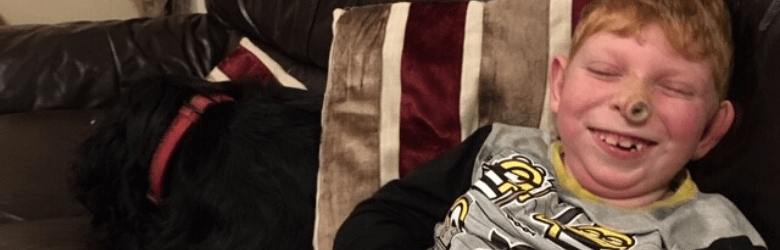
    Jack was transported to another hospital to receive cooling treatment for 72 hours, which is where his body temperature is kept at a lower than normal rate in order to prevent any further brain damage. Every morning we waited for the doctors to do their rounds and every morning it was touch and go whether Jack would survive the day. At one point it was looking likely that he had renal failure and we were told that would almost certainly mean the end to our precious bundle. Fortunately for us all, Jack is made of extremely strong stuff and he pulled through and has gone from strength to strength. His smile melts everybody’s hearts and his cheeky sense of humour is hilarious.

    Admittedly he is still classified as severely disabled as he is unable to walk or talk. He has spastic quadriplegia, a type of cerebral palsy that effects all four limbs. He has minimal head control and abnormal arm movements. His legs are extremely stiff and his feet are misshapen. Jack is fed purely through his PEG as he has a very poor swallow and no gag reflex which makes any attempt to eat or drink extremely dangerous. Jack also has a nasal pharyngeal airway (NPA) in permanent situ. This is because his tongue muscles are weak and his tongue will flop over his airway if it is not held back by the NPA.

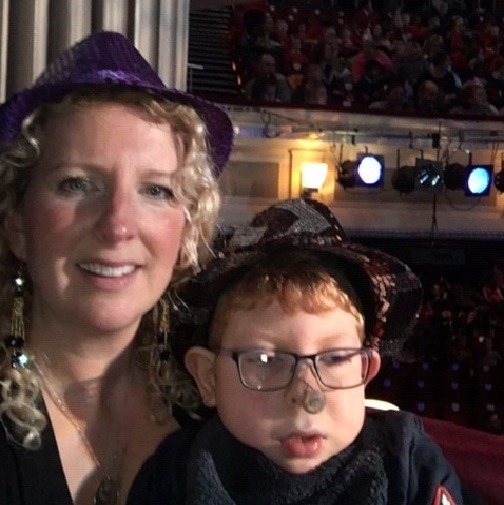
    Catherine and Jack

    Jack’s Epilepsy

    So yes he isn’t without problems. However the biggest challenge we have and are facing at this time is Jack’s epilepsy. The epilepsy began just before his third birthday. One night we were all asleep (Jack has always slept next to me as he requires regular suctioning throughout the day and night), I woke to find that Jack was having a full on tonic clonic seizure. Having never had any experience with seizures in the past, we weren’t really sure what was happening so we called an ambulance. The seizure lasted over 40 minutes and was terrifying but the doctors managed to stabilise him eventually and he was allowed home the following day.

    A Learning Curve

    Since then Jack has been in and out of hospital with various types of seizures. I learnt early on to ensure I knew the correct way of pronouncing the names of the cocktail of medications that Jack was taking in order to gain any kind of confidence from the number of doctors we met along our journey. The professionals I have met along the way have taught me so much. We were lucky enough to have a friend who is the best paediatric physio in the world (in my opinion anyway) and she has helped us immensely. Without her, I know we would not be where we are now so a huge thank you to Alison.

    I have often been asked if I have a medical background due to being able to spout out so much information about Jack’s condition and spastic quadriplegia. This couldn’t be further from the truth, I used to faint at the sight of needles or blood and couldn’t even watch casualty on the television! When you’re faced with such a situation you learn so much as you go along.

    I’ve watched Jack go through having 8 large needles of Botox injected into the backs of his legs twice a year in order to help with his spastic quadriplegia. I change Jack’s PEG every three months (although I admit I still feel rather queasy when faced with an unnatural gaping hole leading straight into his tummy but every time I change it I’m getting that bit better), I can change his NPA with my eyes shut and do things that no mother should ever have to do.

    The Most Rewarding Job

    I would have had to return to work if Jack had been born healthy. However, because of the situation, I gave up my job and became Jacks full time carer, the most rewarding and wonderful job ever. I’ve since gone on to have a beautiful daughter and a rather mischievous little boy. When my third child was born we arranged to have his stem cells collected from the placenta in the hope that one day Jack might be stable enough to travel to America to have stem cell treatment. There’s no guarantees but a stem cell treatment may help improve Jacks abilities.

    What I am trying to say is that you can do anything when you really put your mind to it. Whatever life throws at you there are always ways to turn negatives into positives. If ever I feel a bit down, Jack’s beautiful smile turns my frown upside down! I am one extremely lucky mummy!

Disabled Living