Tag: occupational therapist

  • What is Trusted Assessor Training?

    What is Trusted Assessor Training?

    This blog was written by Disabled Living’s Occupational Therapist, Jayne Watson.

    A lot of jobs require you to keep up to date with regular training. However, the type of training may differ depending on the organisation. Is E-learning the only approach that is expected of you to keep up to date with ongoing changes? Do you get great satisfaction from online learning or do you prefer to learn in the classroom? We all have different learning styles; I am a visual learner and learn through doing. Do you want to develop your skills by sharing knowledge with others, do you enjoy group interaction? Sharing experiences and ideas with other learners on a course can be invaluable, especially if the topic is an intricate one. During the Covid-19 outbreak, most organisations have adapted to doing online training. However, this does not suit everyone.

    Disabled Living offer a variety of training courses, one being the very popular Trusted Assessor course. If you work in health and social care, provide equipment to people or want to familiarise yourself with a specific type of equipment, this course may be suitable for you. It allows participants to learn knew skills which will both enhance their knowledge and support their service users.

    A Trusted Assessor is often someone who can keep an individual safe and independent at home, preventing or delaying hospital and care facility admission.

    Prescribing low level equipment can provide an individual, and the people caring for them, with a safe environment. Low level equipment can be prescribed by a knowledgeable Trusted Assessor, whilst Professional Occupational therapists can focus on more complex cases needing their time.

    Disabled Living have been delivering Trusted Assessor Courses for years, enabling professionals to gain insight to equipment and other services available, including funding, housing, education, employment and more.

    When delegates attend the course, the feedback has been very positive. Delegates have remained very focused. They have learned from each other about the different services within their own areas and worked well in their groups to encourage discussions and debates. This includes discussing what works and what does not work when supporting individuals.

    See what delegates have to say when previously attending the course below:

    Aisha

    As part of my role as a support worker for a hospital discharge service, we are always assessing individuals. The minor aids that we provide are beneficial to the individual as it promotes their independence and brings back some sort of control to their lives. Attending the trusted assessor course teaches you the variety of aids available and what aids are more beneficial to certain situations; you also learn how to fix equipment and how to measure aids correctly for each individual need which makes it person centred. The knowledge and experience of the trainers is phenomenal. The course is worthwhile attending not only to be fully trained in prescribing aids, but to also gain knowledge from the course. The course involves active participation and group work which makes it interesting and easy to learn. I personally have learnt a lot from this course.

    Michelle

    I attended the Trusted Assessor training course as I feel that it is relevant to my area of practice. Working within an inpatient mental health setting and specialising in dementia care, I feel that I have become deskilled around physical health interventions. The course has enabled me to revisit the provision and safe use of low-level equipment. I feel my practice as an occupational therapist will be enhanced and I am now greater equipped to consider physical health requirements when conducting home / environmental visits. Through the consideration and provision of equipment, we can ensure our service users capacity to retain independence is maximised and their ability to engage in meaningful occupation is enhanced.

    Who is the course for?

    • Handy People
    • Technicians
    • Retail Staff
    • Housing officers/assistants
    • Surveyors
    • Delivery Drivers
    • Social Workers
    • Managers
    • Product Specialist
    • Building Contractors

    If you are interested in booking onto one of our Trusted Assessor courses, please visit: https://www.disabledliving.co.uk/training/our-courses/trusted-assessor-courses/

    To view the other courses we offer, visit: https://www.disabledliving.co.uk/training/our-courses/

  • An Interview with Margaret Ellis on Accessible Toilets

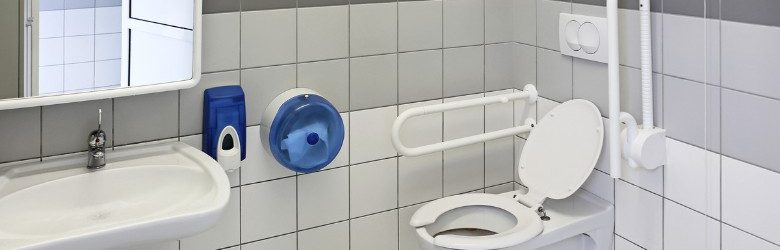
    An Interview with Margaret Ellis on Accessible Toilets

    Deborah Bell, Enablement Team Manager at Disabled Living recently interviewed Margaret Ellis. Maggie originally qualified with a Diploma and later graduating as an Occupational Therapist, working in a range of service provision including management of physical disability, mental health and learning disability services, sometimes combining NHS and Social Services.

    Margaret photo
    Can you tell us a bit about yourself?

    I qualified as an Occupational Therapist, working in a range of service provision including management of physical disability, mental health and learning disability services, sometimes combining NHS and Social Services. Now, I run an Independent OT practice, West Square Associates.

    I have been Chairman of the British OT Association (now RCOT) and of the European OT Committee and I have also been a member of several university and research boards.

    My membership of EU and ISO Technical Committee brought wider experience and the opportunity to link user needs with planners and policy makers, especially concerned with Appropriate Design and Practice for People with a Disability, including Accessible Transport.

    I am currently a Member of some ISO Technical Committees for similar topics and also Coordinate the European Group for eTechnology which started at LSE in 2010.

    Why are you interested in discussing accessible toilets?

    I am part of the Cross Party group for Disability in Holyrood and the All Party group in Westminster which have recently been looking at the need for accessible toilets. Part of this involves gathering facts about existing and lacking facilities.  Part of this information gathering has emphasised a well known fact that in some parts of the country there are open facilities for men and women while the ‘accessible’ facilities provided are in fact inaccessible because they are locked.

    In a remote village in Scotland, in the Highland Region, the ancient notice on the door of the “accessible toilet” tells potential users they can get the key to unlock the door from the Post Office. The Post Office is about a mile away and is only open for twenty Hours a week. When I wrote to all the members of the council concerned about this a disabled council member wrote back to me to tell me it was wonderful because he had purchased a key (costing about £5) so he could always use a loo whenever he needed. Should he have to buy a key to have a wee?

    The opportunity to visit Kidz to Adultz Wales & West presented itself and Disabled Living is one way we can get the message across that disabled access to toilets around the country is being looked at.

    You say Councils are failing to comply with Equality Law, why do you think this is?

    We discovered early on that Central Government does not force Local Government to provide Public toilets. In fact, in some parts of the country facilities are under threat as part of the general thrust for savings in our society.

    One thing we have determined is that the Equality Laws require that providers offer similar or even the same facilities to all users. If a council only offers locked facilities to accessible toilets it could be inferred that they are failing to comply with Equality Law.

    There is the misconception that Accessible Toilets are locked to prevent them being defaced. What is your response to this claim?

    So far the All Party Group and All Party group have only had one report of such action in Disabled Facilities although many of us are faced with vandalised public toilets. There is also the theory that anybody might use them. Fortunately there is now more awareness about hidden disabilities with some supermarket chains adding the excellent slogan ‘not all disabilities are visible’.

    What has happened so far?

    The convener of the Cross-Party Committee in Holyrood was so concerned about the locked facilities that he has managed to get the Planning Laws changed in Scotland so that planning permission will prohibit locked facilities. It’s a start but not the whole solution.

    Some work has been done about the development of Changing Places Toilets which offer a wider range of disabled facilities including hoists and changing plinths. The UK government has funded a £2 million review with the Multiple Sclerosis Society of some motorway Changing Places toilets.

    There are many instances where the toilet facilities are inadequate and inaccessible preventing people from living the independent life they want to. We must continue to highlight the issues and push for equality in accessing facilities which are fit for purpose. The more information people have the louder we can shout.

    We do now more greatly appreciate the requirements of the Equality Act – www.gov.uk/guidance/equality-act-2010-guidance. This requires that facilities should be equal for us all wherever they are provided. So no place should be locked against anybody.

    This post has been written by Margaret Ellis, Lead Academic and Co-ordinator EKTG, Enterprises, London School of Economics.

Disabled Living