Year: 2017

  • Disabled Living’s 120th AGM at the Yang Sing Cathay

    Disabled Living’s 120th AGM at the Yang Sing Cathay

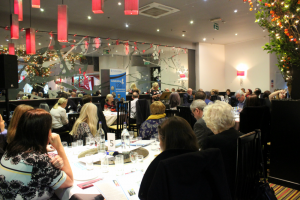
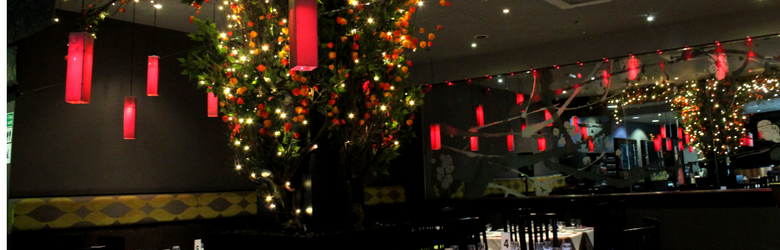
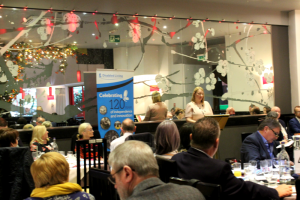
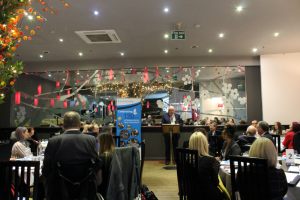
    Friday 13th is unlucky for some. However, this can’t be said for Disabled Living. The team put together a lot of plans and preparation to hold their 120th Annual General Meeting at the Yang Sing Cathay in the Trafford Centre. And it was a successful and enjoyable afternoon for all.

    Gerry Yeung OBE, owner of the Yang Sing, President of Disabled Living, and Higher Sheriff of Greater Manchester welcomed our guests and did his introductory speech.
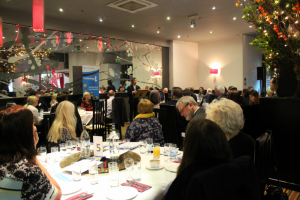
    Gerry Yeung speaking at Disabled Living's AGM
    Gerry Yeung opening Disabled Living’s AGM
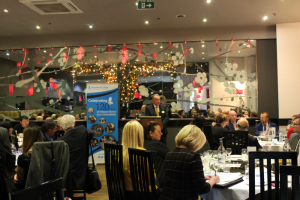
    Disabled Living's AGM
    Dean Styger, Chairman of Disabled Living
    CEO of Disabled Living speech
    Debra Evans, Chief Exexutive of Disabled Living, giving her speech

    This was followed by talks from our Chairman, Dean Styger, and Chief Executive, Debra Evans. A lot of information was provided to our guests, which guided them through key parts of our Annual Report for 2016/2017.

    Thank you to our speakers

    We were pleased to be joined by Joanne Beamish from Lloyd Piggott who spoke about Disabled Living’s annual accounts over the past 12 months and how we are in a stable financial position. The election of Honorary Officers and Council successfully took place followed by other business discussions.
    Lloyd Piggott speaker at Disabled Living's AGM
    Joanne Beamish from Lloyd Piggott
    Anthony O'Connor Manchester Cathedral speaker
    Anthony O’Connor, Director of Fundraising and Development at Manchester Cathedral

    It was wonderful to have our guest speaker, Anthony O’Connor, Director of Fundraising and Development at Manchester Cathedral. Many of us were impressed by the success of the cathedral and it was good to gain a bigger insight on it’s history. After the talks were complete, it was time for food. The part which many, if not all of us were looking forward to!

    For starters, we were served with pork spring rolls, spring onion pancakes (vegetarian option), chicken balls with satay sauce, and beef dumplings with ginger and spring onion. The lovely choices of dishes were followed by aromatic crispy duck with pancakes, leek, cucumber, and hoisin sauce. Finally, the main course was a choice of goujons of white fish with sweet and sour sauce, crispy chilli shredded fillet steak, mixed vegetables in Thai green curry, and boiled or egg fried rice.

    Yang Sing Cathay

    Natasha and Joanne’s first experience of Disabled Living’s AGM

    This AGM was Joanne and Natasha’s first one that they have attended. Both Joanne and Natasha thought the event ran smoothly and really enjoyed meeting everybody.

    Natasha, Marketing Coordinator & Content Writer at Disabled Living: It was an honour to be part of such an important event for Disabled Living, having only been in the team for a short period of time. I’m glad I was invited along. It was great to network and enjoy a variety of food at the same time.

    Joanne Mulligan, Team Leader, Kidz and Business Development: My first time at the AGM had lovely surroundings, ambience and food. It was great to hear Anthony’s talk on his role at the Cathedral and also to put faces to names.

    We would like to thank Gerry Yeung and all of his team at Yang Sing Cathay for their excellent customer service. They made sure our drinks were topped up and promptly served the courses of food.

  • A Quarter of the Public ‘Don’t Know What Cerebral Palsy Is’

    A Quarter of the Public ‘Don’t Know What Cerebral Palsy Is’

    This post has been written by JMW Solicitors. JMW Solicitors support families affected by cerebral palsy caused as a result of medical negligence. A team of expert solicitors ensure families receive the best possible care package and support to lead as normal life as possible. JMW fully support an initiative to raise awareness and highlight the importance of open discussions to support families.

    A new survey

    A new survey of 736 people has revealed a lack of understanding surrounding cerebral palsy in the UK. Conducted by the Clinical Negligence department at JMW Solicitors , the survey found that almost one-quarter (24%) of people do not know what cerebral palsy is.

    The research showed that despite almost one-quarter (24%) of respondents personally knowing someone with CP, a similar proportion said they do not know anything about the condition. More than four in ten (41%) of those questioned described their understanding of cerebral palsy as “poor”, while a further 15% described it as “very poor”. This compared to 38% with a “good” understanding of it and 6% with a “very good” understanding, highlighting the need for further awareness of the condition.

    cerebral palsy

    Just 22% know that roughly one in every 400 children is born with the condition. The other 78% believe cerebral palsy is less common; 21% answered one in every 800, 25% selected one in every 4,000 and 11% opted for one in every 8,000. Almost one-quarter (23%), meanwhile, concede that they are not aware cerebral palsy can vary in severity.

    Here’s what Eddie Jones has to say

    Eddie Jones, Partner and Head of Clinical Negligence at JMW, says: “Our findings highlight a real lack of knowledge among the general public regarding cerebral palsy. It is illuminating that almost one-quarter of the almost 750 people we asked confess to not knowing what the condition actually is. We believe that understanding cerebral palsy is an important step to helping both people with cerebral palsy and those closest to them and more can be done nationally to raise awareness.

    Many people freely admit they do not know much about cerebral palsy; indeed, the percentage of people claiming to have “very poor” or “poor” knowledge of the condition (a combined 56%) is significantly higher than those with a “very good” or “good” knowledge of it (a combined 44%).

    The survey also found that only 29% of respondents say they think £1 million or more is needed in compensation to adequately care for a child with cerebral palsy for the rest of their lives. The other 71% assume less compensation is required, including almost one-quarter (24%) selecting £500,000 to £1 million, and 3% choosing the lowest option; £1,000 to £10,000. Knowledge of the true extent of the care costs required to support children and adults with CP is limited.

    man holding child

    Eddie Jones added: “The majority of people not only don’t know how many children are born with cerebral palsy in the UK, they also believe prevalence of the condition is much lower than it actually is. As a law firm, JMW has helped many children and families to claim compensation that can run into the millions of pounds for a single case when the condition is caused by negligence at birth or in the newborn period. Every penny is essential for assisting that individual and their families, and it is alarming to see that so few people understand how much is needed.

    JMW Solicitors produced a guide to cerebral palsy diagnosis and more information is available on the NHS website.

    If you would like to submit a blog to us, please send an email to: info@disabledliving.co.uk

  • Looking After Your Back

    Looking After Your Back

    This year, Back Care Awareness Week is taking place during 2nd – 6th October. According to Backcare, 1 in 4 people suffer daily or regularly with back pain. Have you ever been one of these people? Our Supplier Directory could be of great assistance for you, with over 50 suppliers in our Chairs, Seating, and Postural Support category.

    When lifting loads of equipment at home or in the workplace, it’s important to remember what you learnt in your moving and handling training. Did you know that Disabled Living have a wide range of moving and handling courses available? This also includes an Advanced Moving & Handling  for Therapists.

    Some of us don’t realise how important our backs are. Think about the amount of times you haven’t sat up properly; haven’t lifted a heavy piece of equipment properly; or overdone it at the gym. We shouldn’t neglect looking after our backs. Here are 3 ways that you can look after your back.

    Maintain your posture

    2 people sitting down

    Conditions can affect people’s posture. That’s why it’s important to know what products are available to help them. If you’re someone who works at a desk, sit up right on your chair and try not to slouch. Part of maintaining good posture can also mean taking breaks to stretch the rest of your body.

    Reduce your stress levels

    man meditating

    Did you know that stress can cause backache? The NHS tells us that it can. Perhaps you want to try meditation techniques, yoga, or try some simple breathing techniques. These can all help to make you feel relaxed, therefore, causing less stress onto your back. Breathworks have a great video that can help.

    Have the right products for you

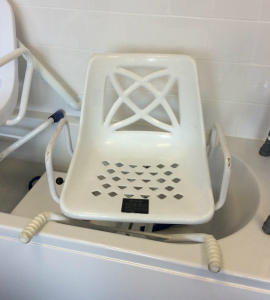
    bath seat redbank house

    Are you in need of specialist chairs, seating equipment, postural support, or sleep systems? Take a look at our Supplier Directory. Many of our great suppliers are in there including Felgains and Simple Stuff Works.


    The right care is available. There are many products for different areas of your home, workplace, and day-to-day routines that can assist you. Visit Disabled Living’s website or call 0161 214 4590 for further assistance on looking after your back.

  • Guidance on Choosing What to Keep in Your Archive

    Guidance on Choosing What to Keep in Your Archive

    This is the second blog from Heather Roberts (HerArchivist, archive consultant), explaining the process we undertook for appraising our photographs archive.

    Appraisal

    Appraisal is a term that archivists use a lot. It means “choosing what to keep”. Contrary to some beliefs, we are not “professional hoarders”. Well, most of us aren’t, I have my suspicions about some of us.

    An archive is:

    An archive is a collection of records (that are either physical or digital) that are the evidence of something or somebody in the past, which you keep so that others can remember it in the future.

    (HerArchivist, “Create your own archive” toolkit, p.5)

    Disabled Living photo archives

    When presented with loads of “stuff”, you therefore need to think about what fits the definition.

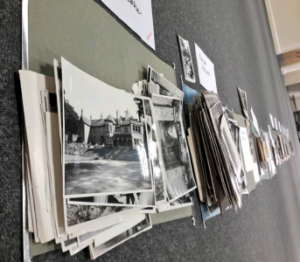
    Disabled Living’s Donkeys to Innovators project have hundreds of incredible photographs evidencing activities, staff, premises and so much more. We are not archiving them all. Many are duplicates and we don’t really need more than one of the same thing. We are going to appraise them.

    Here’s why…

    Duplicates

    Disabled Living photo archive Redbank House

    More than one of something is great. It beats having nothing. However, if you are keeping two or even three or more of something, you have to store it. A few hundred photographs take up enough space as it is. Add to that the special archive packaging and you’ve easily doubled the required space. If you have the space available then fab. Most organisations have to be very careful with storage space. The cost of it needs to be worth what you’re putting in it.

    Also, archival packaging isn’t cheap. Photography packaging in particular as it requires special materials to help preserve the photographs. It may not be financially sensible to spend money on more than packaging than you strictly need.

    The easiest way to reduce the volume of your archive and therefore space and money is to take out duplicates.

    Below are the two main things we have been considering when appraising duplicate photographs on the Donkeys to Innovators project.

    Information

    folders

    Two photographs may be the same. Same image, same angle, same size etc.

    If that’s the case, check the back. If one is blank and the other has a date, photographer’s stamp or scribble on the back which reveals some further information about where the photograph was took or who/what is in etc., that is the one you choose to keep.

    It’s frustrating when you have a great image but no information about it. Keep the one which has the most added information and you’ll have a richer archive.

    If both have the same information, then keep the one in the best condition.

    Condition

    Disabled Living photo archive

    Photographs are very delicate. They are the materials for which archivists insist on wearing cotton gloves, to protect the chemical surface of the image from the oils on people’s hands. Even freshly washed and thoroughly dried hands can easily damage a photograph.

    Photographs are also subject to light damage. This is when prolonged exposure to light has faded the photograph’s image and it is no longer as clear. Light damage is irreversible so if you have any photographs, be mindful of light exposure.

    Photographs can be torn, holes poked through where they’ve been pinned up, stained where Sellotape has held them in place and all sorts of similar damage.

    Choose the photograph that is in the best condition. Fewer stains, clearer image, least holes and tears etc.

    Information vs condition

    2b pencils

    Some decisions on the Donkeys to Innovators project have gone like this, “Well, this photograph is in the better condition, but this other photograph of the same image has more information on the back. Which do we keep?”

    The trick here is to choose the photograph which is in the best condition (and therefore easier to keep and use) and transfer the information from the other photograph onto this one. Either, write on the back of it with a soft pencil (2B or softer will do) or put it in a folder/envelope and write the information on that, again in a soft pencil.

    Soft pencils are the archivist’s weapon of choice because you don’t have to press very hard to a surface to write (hence reducing possible damage to the item) and because they are easy to rub out (in case of mistake), they don’t leak ink all over your invaluable archive either.

    We are looking forward to revealing some of our fabulous photographs to you on this project. We are certainly having an amazing time working with them.


    Heather’s free “Create your own archive” toolkit can be downloaded here.

  • A Rare Find: The Christmas Card Folio

    A Rare Find: The Christmas Card Folio

    Heather Roberts (HerArchivist, archive consultant), has put together this wonderful blog which discovers the meaning and significance of Disabled Living’s collection of heritage Christmas cards.

    The archive

    Disabled Living have a fascinating history stretching 120 years. It’s a vital but little-know part of Manchester’s amazing past and present. On the Donkeys to Innovators project, we are hoping to organise the evidence of their history into an archive and share their journey.

    Explore the timeline for some of the key points of the history.

    There are some gorgeous archive items in their collection. Hundreds of photographs, decades of annual reports, files of letters, ye old property deeds. Nice, core archive material through which you can learn so much.

    Disabled Living also has something else. It’s an absolute treat and so unique. Not only does it say so much about the organisation but it’s also aesthetically delightful.

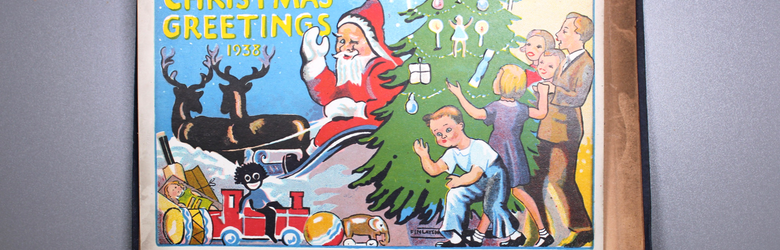
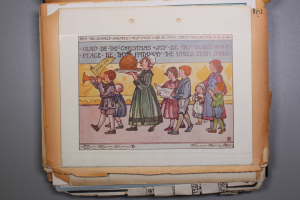
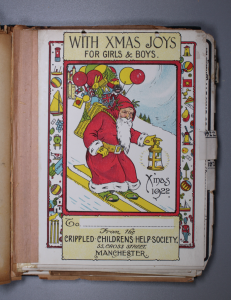
    Christmas card folio

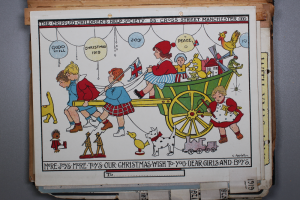
    Christmas card crippled children's help society

    Christmas card crippled children's help society

    It’s the kind of thing that when you look at it, it makes you sigh and wish for childhood and Christmas markets. It’s colourful, full of beautiful vintage designs and interesting stories to tell.

    The folio is an old crumbling hardback volume. Within it are pasted the Christmas cards that the society (back then called The Crippled Children’s Help Society) used to send to children at Christmas who were either disabled or otherwise housebound for the season (recovering from illness etc.).

    Each card is gorgeously designed and very of its time, charting the way through a good chunk of the first half of the 20th century. There’s hints of classic Arts and Crafts style borders, flowing into Art Nouveau lines all the way through to the vintage bright bold colours of Santas gone by.

    They must have been an absolute treat to receive in the post. Many were accompanied by Christmas hampers for the children as a small gift of added kindness for the season.

    How this helps research and understanding

    This folio is important not only for its beauty and rarity (much of the original archive was lost in a fire). It is also key in understanding what the society really did.

    Much of any organisation’s is written down, in minutes and letters and reports. These are all highly valuable. They chart the progress of an organisation, what it had to think about, how it managed challenges, what was planned etc.

    However, this only tells one side of the story. It can tell us on the top-level of the organisation what went on. This is the material that is therefore most likely to be kept. It’s rare that much of the ground-level activity is kept. It’s everyday stuff. It’s not discussed by the Board or debated over at Annual General Meetings.

    These simple heritage Christmas cards on the other hand, tell a story about the ground-level kindness and activism of the society. You can see it in front of your face. You can hold it in your hands. It’s a beautiful piece of Manchester’s history and we are so looking forward to sharing it with you.

    Take care of the pennies

    english coins

    The adage, “Take care of the pennies, the pounds will take care of themselves” might apply here. Important records, top-level records and core activities are usually kept because they shout of inherent value.

    The grass-roots, ground-level, every day activities and initiatives are what the organisation actually does, though. So spare a little effort in making sure that this is evidenced, remembered and celebrated.


    Heather’s free “Create your own archive” toolkit can be downloaded here.

  • Greta McMillan Exhibits Artwork at Porty Art Wall

    Greta McMillan Exhibits Artwork at Porty Art Wall

    For September, we would like to dedicate our Story of the Month to Greta McMillan. Greta is a 13-year-old girl who, earlier this month stunned members of the public with her artistic skills. As a wheelchair user with cerebral palsy who can’t use her hands or arms like other artists, Greta had her artwork exhibited at Porty Art Wall. This project is run by volunteers and ‘celebrates the public space and creativity of Portobello, Edinburgh’s Seaside.’

    When talking about the Porty Art Wall, Greta’s mum, Thea says:

    It has been quite wonderful. She didn’t have a way of expressing herself before – she’s always been good at doing yes blinks but that is dependent on us asking her the right question. So it’s still a learning curve. – Source: The London Economic (TLE). 

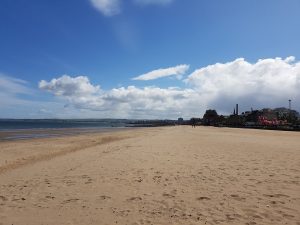
    portobello, edinburgh
    Portobello, Edinburgh

    Greta communicates by blinking with her eyes. And now her parents are very pleased that she finally has an ‘eye tracker’ computer to assist with her communication. The computer was funded by people in Edinburgh through a fundraising campaign. The money raised has given Greta a life-changing opportunity to do what she loves the most.

    Both mum and dad are very proud to see Greta be able to do something which she enjoys. Read more about how the computer helps Greta to create her art here.


    Did you see our guest post on art therapy about a man named Patrick Samuel with Asperger’s Syndrome?

    If you would like to feature your story on Disabled Living’s blog please send an email to: info@disabledliving.co.uk.

  • What Have We Learnt from Our Community Curation Training?

    What Have We Learnt from Our Community Curation Training?

    As many of you will already know, Disabled Living are celebrating 120 years of providing services. As part of our Heritage Lottery Funded project, Disabled Living has received training in different areas. An interesting section has included two community curation sessions delivered by Catherine O’Donnell from the People’s History Museum.

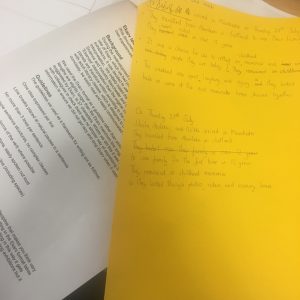
    We understand the importance of the planning process in our Donkeys To Innovators project. We have learnt many things including the Ekarv text style for an exhibition along with guidelines for handling objects. We had the opportunity to fill out a document for our archive material, which lists key information such as: object name, type, condition, creator etc. Learning about Ekarv writing was very interesting. It sounds easy enough to do but there’s more to it than you think.

    Ekarv writing style

    Imagine you’re writing a paragraph of text – with Ekarv you need to ensure that the lines of the sentences aren’t too long. It’s important to get your sentences straight to the point and include the key points.

    ekarv text

    I was advised that I took quite a journalistic approach to my wording at first. But once I repeated the writing with Catherine’s advice, she said that I created a good example. It actually felt like I was writing a piece of poetry due to the strict amount of points per line. – Natasha, Marketing Coordinator & Content Writer for Disabled Living

    The People’s History Museum advises the following:

    • One idea expressed per line
    • Line breaks placed at natural pauses in a sentence
    • No more than 3 lines per sentence
    • Simple sentence structures, no complex clauses
    • Use active forms of the verb where possible
    • Conversational rhythms, easily spoken out loud
    • Maximum 52 characters per line (including spaces)
    • Maximum 8 lines per paragraph

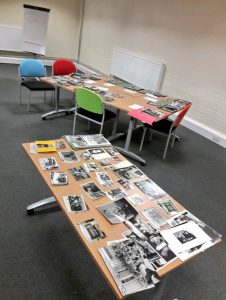
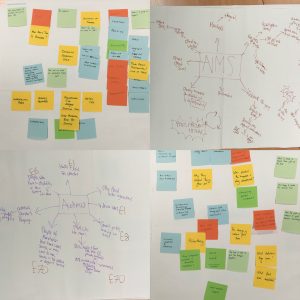
    Community Curation collage

    Themes and timelines

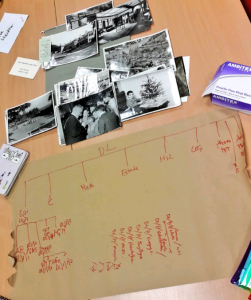
    We also created several mind maps in order to have an insight of the possible themes that could run through our project. With Catherine’s training techniques we were able to see the many ideas that can stem out from one theme alone. It was also useful to put these into a timeline of dates as well as arranging them thematically. This put us to the test of remembering key dates in our heritage!

    Catherine’s main message to us:

    Less is more and editing is key! Clarity and consistency is also key. Think about how you’re going to write dates and numbers.

    It’s essential for us to pick out the events and memories that people will be able to reflect on the most. We would like people to identify and perhaps familiarise themselves with our services.

    We now know the importance of getting people to try out the exhibition before it’s live. For example, having people of different heights look at the area where our exhibition will be presented. And of course, thinking about different disabilities and the best positioning to accommodate this. Seeing examples of other exhibitions has made us realise that we need to consider colours, fonts, and sizes to ensure these are readable by all of our audience. Relating to our key audience throughout the exhibiting is what it’s all about.

    Thank you to Catherine O’Donnell for your wonderful training. It’s been very insightful and we can’t wait to move things further.

    Would you like to be part of our Donkeys To Innovators project? See more information here.

  • Were You Involved with One of Manchester’s Oldest Charities?

    Were You Involved with One of Manchester’s Oldest Charities?

    Disabled Living, one of Manchester’s oldest charities, is calling for people to get in touch who have memories, materials and/or photographs about their links with the charity. Hundreds of thousands of people across the North West have been involved with the organisation in its 120 year history as service users, volunteers, staff and trustees.

    Alan Norton

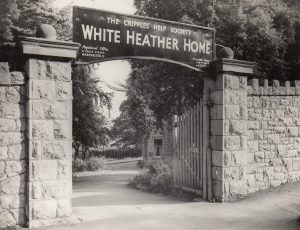
    White Heather
    For example, Alan Norton, one of Disabled Living’s current Trustees, went on a three week holiday as a child to Disabled Living’s White Heather holiday accommodation in North Wales and received one of the Christmas hampers that were donated to disabled children across Manchester and Salford.

    At the age of 7 I vaguely remember my mum sending me to a holiday home run by the ‘Cripples Help Society’ now known as Disabled Living Manchester, it was the first time I had been away from home and I had to dress myself which I had never done before. I remembered I had a fantastic time going on walks, playing various games especially enjoyed the swings at the local park. It was my first taste of independence and gave me the inspiration to do more for myself, which has led to me having a full and complete life,” states Alan.

    Since losing the majority of its records in 2009 due to a fire, the charity has been working towards rebuilding its heritage. As part of its birthday celebrations Disabled Living is delivering a project, From Donkeys to Innovators, supported by the Heritage Lottery Fund, that recognises the many services the charity provided and the people involved with the organisation.

    holiday

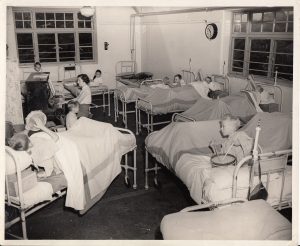
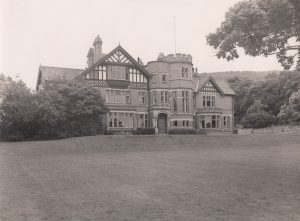
    Marple children's hospital

    Most importantly, the voices of disabled people will be recognised, preserved and celebrated, documenting unique stories about disability heritage. People’s contributions to the history of Disabled Living may be included in a permanent exhibition in the charity’s Redbank House in Cheetham Hill that launches in 2018, and all will be preserved in its new archive that will be safely maintained in Manchester Central Library’s Archives+.

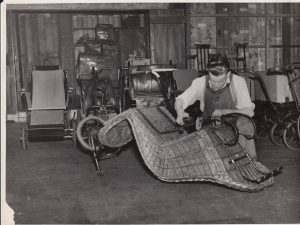
    Many people remain unaware that the activities they were involved with were part of the present day charity. These activities included the first wheelchair loans service in Greater Manchester; the establishment of the Children’s Orthopaedic Hospital in Marple; the provision of holidays for thousands of disabled children and adults to Blackpool, North Wales and overseas; a residential provision for disabled adults at Tan Y Bryn in Abergele, North Wales; advice and support about the use of innovative equipment to enable disabled people to live more independently; and a Style Centre providing advice and training for disabled teenagers and adults.

    Over the years, a myriad of organisations have also been involved with the charity from The Guardian and Manchester Evening News, the Disabled Drivers’ Association, Manchester Art Gallery, the Jewish Ex-Servicemen, Derbyshire Miners, Manchester United Football Club, the British Red Cross Society, and Greater Manchester Police, indicating the charity’s important place in the social history of Greater Manchester.

    Debra Evans, Disabled Living’s Chief Executive said:

    The history of Disabled Living are the stories of the people who were involved with the charity from the disabled people who used its services to the volunteers who packed the Christmas hampers and the nurses who worked at the Marple hospital. People’s memories are what bring the charity to life and we want to have a chance to celebrate and thank the individuals who helped to create the charity that we have today.

    disabled equipment

    People who are prepared to share their stories, or any photographs or materials they might have about Disabled Living’s heritage, are asked to contact Natasha Bolger at Disabled Living on 0161 214 5959 or email Natasha.bolger@disabledliving.co.uk. No stories or images will be included in any of the public materials without the express permission of the individual involved.

  • Understanding Parenting with a Disability

    Understanding Parenting with a Disability

    Thank you to Chris, our Disability Trainer and Advisor for writing this post about understanding parenting with a disability.

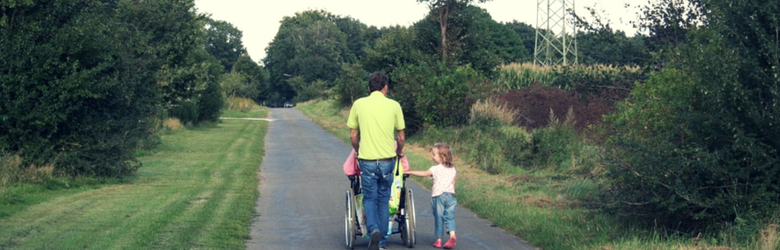
    I’m a wheelchair user who can’t walk at all and have been since I was 7-years-old when I caught polio. But very early on in adulthood I knew I wanted kids. I hadn’t thought it all through then but the thought was always there.

    I graduated and started to work (as a school teacher), and eventually got married.

    By this time I was very confident of what I could and couldn’t do in work, at home, around town, on holiday and so on. But the prospect of bringing up children was something else entirely.

    I had concerns in 3 areas:

    • Could I physically manage? Stairs, transport, carrying baby etc
    • What would other people think? “Is he able to manage?”
    • What came later – how would my growing kids view me? “All my friends Dads are playing football with them…”

    Well I can report that it all worked – not all plain sailing but an incredible journey. Looking back now over the last thirty five years I’m now at the grandparent stage – nine so far with every prospect of many more!

    Of course one short article can’t give you every practical piece of advice you might want.  And the advice is very specific to your disability anyway. I can give you everything you need to know if you’re a wheelchair user and I can give you my general observations on attitudes. This includes ideas for further research (see below). If you are worried there is a tremendous amount of top-quality, specific information out there.

    I think you’ll discover particular solutions that work for you. Disabled people are a very diverse group indeed – the variation across wheelchair users for instance is vast. What’s common though is problem solving and determination.

    close up of baby and parent touching hands

    Okay, so, I can’t walk at all. How do I carry a baby up and down the stairs?

    Why don’t I live in a bungalow you might ask? Well, when I became disabled I already lived in a house and I liked sleeping upstairs so I carried on. Sixty years later nothing has changed!

    I found that if you tightly wrapped up baby in a shawl you could carry him/her in your teeth. Good enough for lions and tigers so good enough for me. I did what I needed to do.

    How do I keep baby safe when I’m out and about if I’ve got my hands on the wheelchair most of the time?

    The standard child harness went over shoulders and clipped to my belt which worked perfectly, just the same as for everyone else.

    What if they run away, you can’t catch them?

    Well, they just didn’t. It’s as if they know you can’t chase so they don’t go running off too far. As they grew I would be trying to give them independence but always telling them not to go too far/too fast. They seemed to take this on board.

    Sometimes you see parents frantically running after their little loved ones and obviously getting really worried that they won’t catch up. But I’d say the child hasn’t been properly primed and that the child absolutely knows the parent will chase. So it’s all a bit of fun to them!

    What did other adults think?

    I’ve always said – most people, most of the time, do the right thing – and that applied here in abundance. There were lots of offers of help and total acceptance of the situation.

    I mentioned I was a schoolteacher. There were some initial reservations about whether I could command a class, deal with emergencies and exert discipline. But the children always responded. They might mess other teachers around but not me!

    I’d often transfer to sit on a higher bench so I could see the class easier leaving the wheelchair empty. The pupils would then argue about whose turn it was to sit in it for the lesson!

    wheelchair users playing basketball

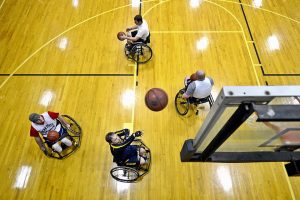
    So, my lads turned out to be very sporty but there were no issues at all around me being unable to participate. They watched me play wheelchair basketball and I watched them swimming, playing rugby and the rest. It all worked so well I found myself running the junior rugby club for years. Interestingly not a single questioning/negative comment ever from players, parents, visiting parents etc I was just decent at the job so they let me carry on.

    There’s lots of hard work but also so much to smile about.

    What’s still happening?

    I park up with one of my lads in the car. He gets out and gets my chair set up. If I’m fiddling with keys, gloves or bags he’ll sit in the wheelchair and scoot off round the car park for a minute. Lots of admiring faces because he’s very skilled (poor lad but doesn’t he do well?).

    He then races back and promptly stands up! Admiring faces change – they’ve been duped. But then I transfer into the chair. Oh, it’s dad and he really is disabled! Conflicted or what?

    Or this – I’m at home in my comfy armchair, wheelchair alongside. Grandchild asks if they can use the wheelchair and zooms off outside. “This is great; can I have one for Christmas?” “None of my friends has got one of these”. “Can I take it to school for “Show and tell?”

    brown wooden empty stair case

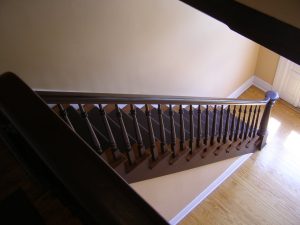
    Incidentally, when grandchildren stay over they all copy me on the stairs. If I sit on the top step and start to bump down then so do they!

    Of course I had to sort a lot of these things out as I went along – no computers, no mobiles at the beginning, but now there is a wealth of information out there. If you’d feel safer with more information, then there’s a lot to research relevant to your own specific issues. Just try to approach the situation with some confidence. People have been there before. Disability didn’t just start with the Paralympics. Parenthood will be so rewarding, and you’ll find there are lots of people in the same boat.

    Try these sources of information:

    • NHS Choices – discusses entitlement to support and your needs will be properly assessed.
    • You can also get in touch with other disabled parents via Netmums
    • Scope – where you will find all sorts of useful links
    • Disability Horizons – this website has hundreds of relevant articles and a blog
    • DPN (Disabled Parents Network) – again, endless links here.
    • Super Nanny – lots of useful links
    • Many relevant self-help groups, including specific to your disability
    • Many relevant chat-rooms
    • Lots of online support

    If you would like to share your experience on Disabled Living’s blog about parenting with a disability, send an email to: info@disabledliving.co.uk

  • Debra’s Visit To Facts & Fun Day in Marple

    Debra’s Visit To Facts & Fun Day in Marple

    On Sunday 3 September Debra, Chief Executive of Disabled Living, went along to The Roman Lakes and Mellor Mill for a Facts & Fun Day.

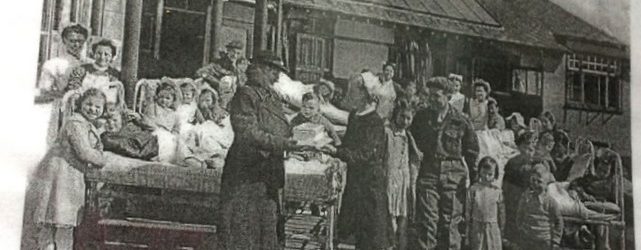
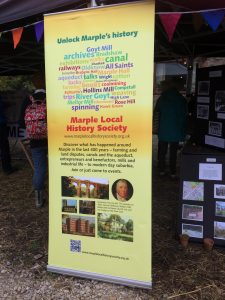
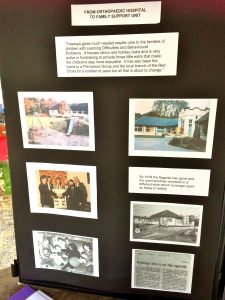
    This was a fundraising and awareness day for the Mellor Archaeological Trust and Friends of Our Valley. Marple Local History Society displayed photographs and archive material from the Children’s Orthopaedic Hospital and later the Hospital School.

    Debra spent around an hour and half exploring the location, displays, and meeting with other people. Debra was particularly happy to see that there were a lot of people coming to the stand who remembered the hospital. Ann Hearle and Hilary Atkinson were there, with Ann being in the immediate area of the display to interact with interested people.

    Debra would like to give a big thank you to Ann and Hilary:

    I want to thank Ann and Hilary and the rest of the members of Marple Local History Society for supporting Disabled Living (formerly The Cripples Help Society) to raise awareness of the work the charity undertook from the beginning of the 1900’s until well into the 1970’s. It was interesting listening to the local people who remembered the building as Treetops Child Development Centre but did not realise the history.

    The event took place from 11.00am until 5.00pm. There were a variety of activities taking place throughout the day including: Mellor Mill tours, historical lectures, guest talks, and workshops.

    Other attractions included:

    • A pop-up museum with a 3D model of Mellor Mill and its mechanics
    • Visual timeline of Our Valley through the centuries
    • Vintage finds and salvage stalls
    • Wet plate collodion photographer
    • Rural craft & opportunities to get involved
    • Plant sales & locally grown produce
    • Beer tent with locally crafted produce
    • Interactive display of Yoruba women’s headgear

    …and many more!

    We look forward to discovering more about Manchester’s heritage and learning more about any links to Disabled Living’s heritage too.

Disabled Living