Month: January 2018

  • Cooper’s Journey with Cerebral Palsy

    Cooper’s Journey with Cerebral Palsy

    January’s Story of the Month goes to, Kerrie Keen, 37 years old who talks about her son’s journey with cerebral palsy. Kerrie is married to her husband, Owen and is a proud mum to her 15 year old son and 4 year old identical twin boys, Cooper and Lucas. If you would like to catch up with our previous Story of the Month, please click here

    Owen and I discovered we were expecting twins in November 2012 at our first scan. Once we got our heads around the practicalities, we loved the thought of our twins always having each other, always having a play mate and sharing an incredible bond for life.

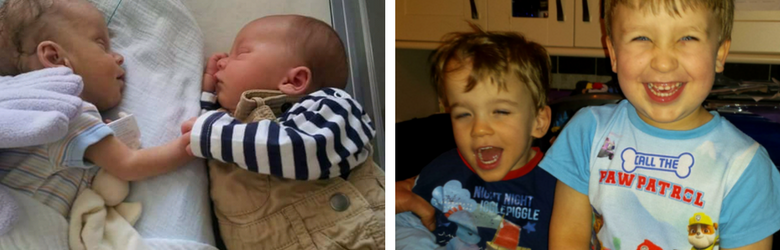
    April 2013, Cooper was born along with his twin brother Lucas. Cooper was the first born and weighed a little 4lbs 14oz and Lucas was born two minutes later weighing a big 7lbs 9oz. However, 5 hours after birth, Cooper was unusually sleepy and not feeding. After a pin prick blood test showed he had low blood sugar, he was taken to neonatal for the night.

    The seizures began
    Cooper young boy cerebral palsy

    Cooper began to have seizures and had dangerously low oxygen levels on the first night. He was then moved to intensive care and put on machines and a tube was put into his nose to enable feeding.  At 6 days old he was transferred to Glasgow Children’s Hospital for a MRI.  After the scan, a neurologist told us that Cooper had suffered grade 4 bleeding on the brain and would be severely disabled, if he survived.

    After transferring back to hospital, where the boys were born, Cooper began to fight back. His oxygen levels become steady and he stopped having seizures. However, the paediatric consultant told us they suspect Cooper has hydrocephalus. We had never heard of this! He told us Cooper might possibly need a shunt at some point.  We had never heard of a shunt but we decided to take each day as it came and see if we encounter this in the future.

    At 5 weeks old, Cooper left hospital.  He was finally well enough to come home. He was still being tube fed every 3 hours, day and night, which I found so difficult. The tiredness on top of trying to come to terms with Cooper being ill was such a trying time for us as a family.

    Having a VP shunt fitted
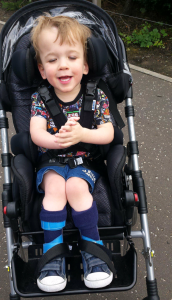
    Cooper young boy cerebral palsy

    November 2013, only 7 months old, Cooper was admitted to hospital in Glasgow to undergo his first brain surgery to fit a VP shunt. The aim of the shunt was to drain cerebral spinal fluid (CSF) from his brain down to his abdominal area where it would be absorbed. It was amazing to see the changes in Cooper only hours after this operation. A baby, who tightly clenched his right arm across his body, was now open handed trying to grab his milk bottle. This was an amazing day for us all. It was like we could start to see progress – a light at the end of a very dark tunnel. Cooper’s stability carried on and he became stronger and bigger over the next few months.

    June 2014, Cooper had another routine paediatrician appointment. The aim of this was to keep track of his development and physiotherapy which would help make him stronger. There was nothing unusual about this appointment, I gave an up to date account of what Cooper could do and what I felt he was struggling to do milestone wise. However, two weeks later, I received the summary letter of this appointment and my heart was broken. These letters always start the same, in bullet points, with the conditions which your child suffers.

    Coming to terms with a diagnosis of cerebral palsy 
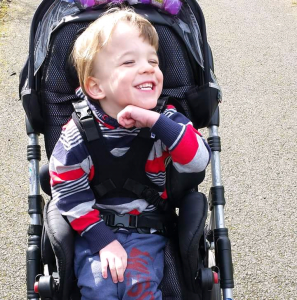
    Cooper young boy cerebral palsy

    I knew about Cooper’s grade 4 bleeds on the brain and I knew about his hydrocephalus and VP shunt. What I didn’t know was that Cooper had been diagnosed with cerebral palsy. This was mentioned months before by another paediatrician as a possibility for the future, but it wasn’t mentioned at all during the latest development appointment. I will always remember how I felt reading for the first time that my 1 year old son had cerebral palsy. I was distraught. Everything seems to hit you that bit harder when it’s on paper after re-reading the letter. I contacted the hospital and said I desperately needed to speak to this paediatrician. He apologised and said I should never have found out that way.

    Such a major diagnosis which will last my son a lifetime, this shock is something that will stay with me forever. Cooper’s cerebral palsy has since been defined as quadriplegic cerebral palsy with dystonia. He is a little boy who struggles with increasingly tight muscular spasms, mainly in his legs but in his arms too.

    We can’t take things for granted

    Since, he has mastered being able to roll both ways which is fantastic! He’s unable to walk but recently Cooper has learned to sit upright propping up with his arms. A truly inspiring day for us all! He has coped brilliantly with everything and he never complains.

    What I have learned from having a child with a severe disability is that, we can’t take things for granted. The world of disability is so up and down and we never truly know exactly what’s around the corner. Even the smallest expectations are not a given. One day things can be calm and you feel like you are making progress. Then the next day, you feel like you are back at the beginning. You feel scared, uncertain and angry at the thought of your child having to struggle with every area of their life.

    Also, the world of disability can be so isolated. I feel extra worries and pressure due to having one able bodied twin and one severely disabled twin. It is soul destroying seeing one child leaving behind their twin developmentally, physically and emotionally.

    I try to keep positive and remember that Cooper is alive, that is the most important outcome for us.


    Read more about Cooper’s journey by visiting Miracles and Me on Facebook.
  • University Doesn’t Have to be a Challenge…

    University Doesn’t Have to be a Challenge…

    The following is a guest blog by AskJules, who are exhibiting at our Kidz to Adultz Middle event this year in March. This blog post will discover facts that you may not have known about AskJules along with their advice for those with a disability who are starting a new term at university.  

    Whilst the excitement of Freshers’ Week may help to suppress the anxieties of living independently for the first time, as the party dies down and reality kicks in – the stresses of university life can also begin to sink in.

    But there’s no need to panic, help is at hand. Chris Benoit-Pool, co-founder of AskJules, offers some guidance and advice on adapting to these changes and the key decisions which can make the difference in ensuring a successful university experience.

    AskJules is a family business, created in 2008 when Chris’s mother Julie Pool helped his younger brother Oliver, who suffers from Spinal Muscular Atrophy, to leave home and go to University. With Julie’s support Oliver has achieved true independence and enjoyed the full student experience. He lived independently in a lively student area of Manchester and employed his own team of PAs, who provided his 24/7 care and student support. He has recently started a PHD in London, where he lives with his girlfriend and two children.

    To view the full post please visit our Kidz Exhibitions blog.

  • Life with Muscular Dystrophy

    Life with Muscular Dystrophy

    This is a guest feature with Carrie Aimes, founder of Life on the Slow Lane, lifestyle and disability blog. Carrie has lived with muscular dystrophy for 29 years (her whole life). And we took the opportunity to ask her a few questions. 

    Please can you tell us a little bit about your disability?

    I have the progressive neuromuscular condition – Ullrich congenital muscular dystrophy (UCMD). It is effective from birth, and causes the muscles throughout my body to deteriorate over time. I was able to walk short distances, with the aid of leg splints, until the age of ten. However, I am now completely non-ambulant and therefore use a powered wheelchair for mobility.

    I have an ‘S’ shaped curvature of the spine that has not been surgically corrected. This has a great impact on my respiratory function, which is my primary concern these days. Throughout my life, I have experienced multiple bouts of pneumonia, pleurisy and acute pneumothorax (a collapsed lung), resulting in prolonged hospital admissions.

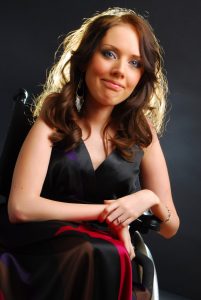
    Photo of Carrie Aimes

    What are your favourite hobbies?

    I’m a bit of a film buff and I listen to far too much music – if that is even possible? I’m very much an arty type – I love painting, drawing, crafts, and taking trips to the theatre. Here is where I’ll have to admit that, I’m a big Strictly Come Dancing fan!

    I also love to get out and explore. Sometimes it’s nice to just get in the car and drive, to nowhere in particular. I live rurally and so there are many winding, country lanes to investigate.

    If you could have any superpower in the world, what would it be?

    Wow, this is a tricky one. I think for me, it would have to be the ability to fly. I often feel restricted by the fact I am unable to get up and walk around, whenever and wherever I want. Being able to fly anywhere with ease would be so liberating.

    Overseas travel for me is quite a challenge! I would love to see much more of the world but I am very much put off by past experiences with air-travel. So, to simply fly myself to other countries would be pretty amazing!

    What’s the biggest obstacle you’ve faced with your disability?

    There have been many over the years – practical, social and emotional.  I think, for me, one of the main issues is trying to overcome societal preconceptions and attitudes towards people, like me, with disabilities. Even in this modern age, I would argue that I am in fact more disabled by society than my actual condition. By this I mean that, unnecessary limitations are inflicted on the disabled community through ignorance, a lack of accessibility, facilities and support. To overcome this, an increase in awareness, education and inclusivity is required.

    What inspires you most in the world?

    I’m inspired by certain people; their grit and determination. They need not necessarily be high-achieving academically, financially or career-wise. For some people, due to their circumstances, just getting out of bed or leaving the house is an overwhelming struggle, both physically and mentally.

    Life can be tough and sometimes you feel like you can’t catch a break. It’s easy to admit defeat and give in. But those who rise above adversity and face the challenges life throws at them, are the people who inspire me most.

    Thank you to Carrie for taking the time to complete this question and answer post. We’re sure you’ll continue to inspire others. To learn more about Carrie and Ullrich congenital muscular dystrophy, visit her blog: www.lifeontheslowlane.co.uk

    If you would like to feature on Disabled Living’s blog about your disability please send an email to: info@disabledliving.co.uk

  • Remap Are Changing Lives with Innovative Design

    Remap Are Changing Lives with Innovative Design

    This is a guest blog by Remap for Disabled Living.

    Remap is a charity that helps disabled people achieve independence and a better quality of life by designing and making equipment for their individual needs. Last year the charity helped over 3,500 people in this way and gave the equipment free of charge in every case. The charity has a network of skilled volunteers who design and make bespoke items to help people enjoy life more. 

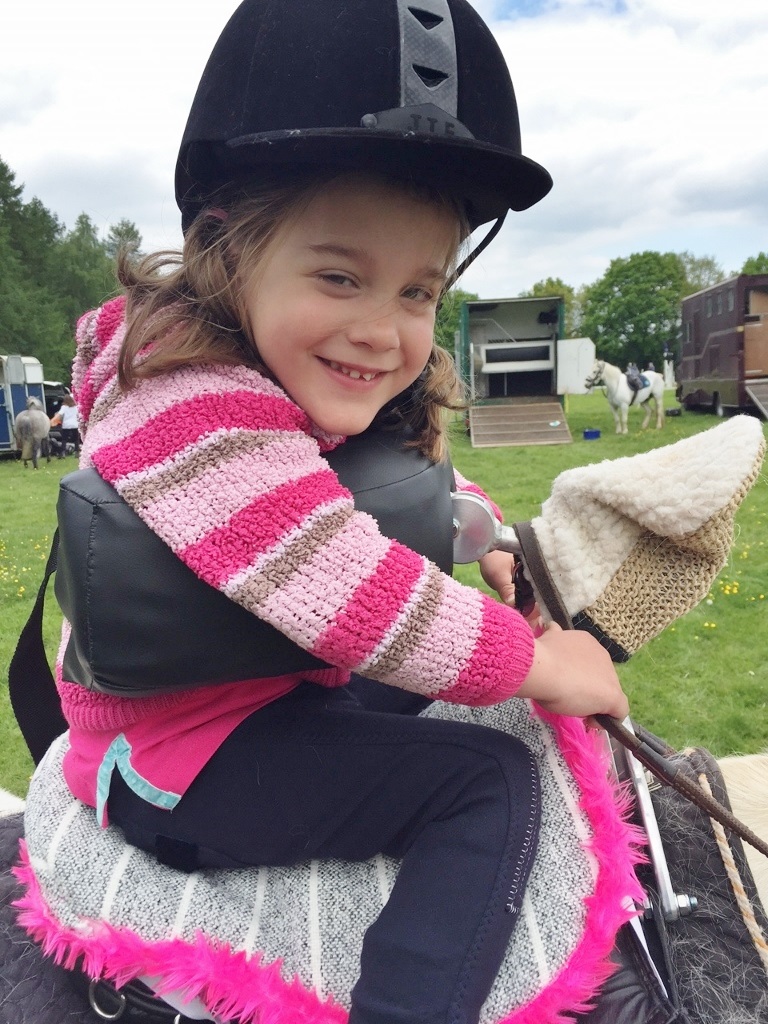
    Chloe, for example, is only four years old but already loves horse riding and wants to ride alongside her big sister. However Chloe has cerebral palsy and cannot walk. She needs to improve her core strength if she is to ever walk and horse riding is a good way of achieving this, but she needs somebody to walk with her supporting her while she rides.

    The challenge to help Chloe ride independently was taken up by Remap Coventry and Warwickshire. Volunteer Stephen Boulter came up with a piece of equipment based on a chest cuff that goes under her arms. She can now ride unassisted, getting safe and effective support which promotes the use of her core muscles. Chloe can be released quickly and easily and the support is weatherproof, easily cleaned and lightweight.

    Chloe now rides alone, with her sister and wants to enter competitions – she loves it!

    Piano aid

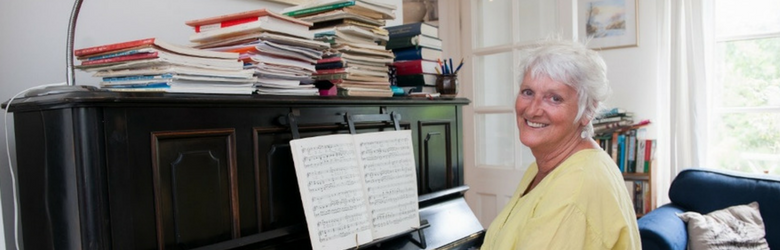
    Another innovative design helped Linda get back to doing what matters to her. Linda is an accomplished singer and pianist and teaches both, so she was deeply affected when treatment for breast cancer left her unable to support her left arm or move it sufficiently to play, although her fingers were unaffected. She was unable to work and was left feeling very frustrated.

    Remap volunteer Alan Blundell from the Bournemouth group met Linda along with her OT Heidi Grant to discuss possible solutions. They came up with the idea of fitting a rail to the edge of the piano, then adding a wheeled wrist support like a truck that would run silently up and down the rail.

    Alan set to work, fitting the supporting rail from underneath so as to have the minimum impact on the appearance of the piano. The wrist support which runs along the rail is shaped to support Linda’s wrist with expanded foam and chamois leather. On trying out the aid Linda was immediately able to play without any trouble. She was delighted and was able to resume giving music lessons and playing for her own pleasure.

    Further information

    You can read more about these and other examples of Remap’s work on their website and discover more about this remarkable charity. There’s a contact page on the website to help you find your nearest group – with over 75 groups across England and Wales there should be one near you.

    Remap is a charity that provides custom-made equipment for disabled people of all ages, free of charge. For over 50 years, this unassuming charity has been quietly helping thousands of disabled people to live more independently. It has a network of over 75 groups across England and Wales, so there is probably help near you.

  • 4 Reasons Why We Love Discovering Our Heritage

    4 Reasons Why We Love Discovering Our Heritage

    As it’s Heritage Treasures Day, we thought this would be a great opportunity to share the reasons as to why we love our heritage at Disabled Living. As you may already know, Disabled Living has had several name changes over the years and there have been many special memories shared.

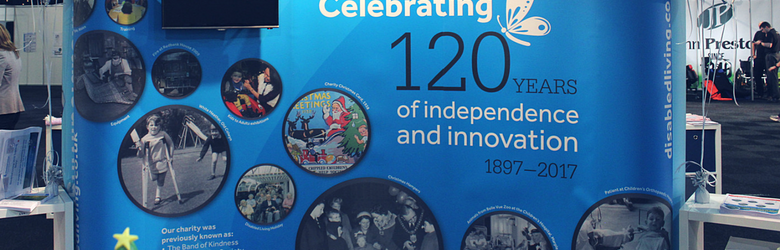
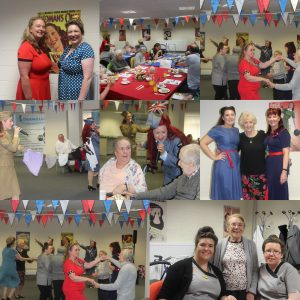
    Throughout 2017 we shared our wonderful celebrations and projects with you. We’re excited to continue these in 2018. So far we’ve had a 1940’s theme tea dance, lots of fun activities at Kidz to Adultz North, filming, community curation planning, oral history interviews, radio and television coverage, and much more. As our project, Donkeys to Innovators, funded by the Heritage Lottery Fund has developed in more ways than we ever imagined, we want to share what discovering our heritage means to us.

    There’s an endless amount of history to discover

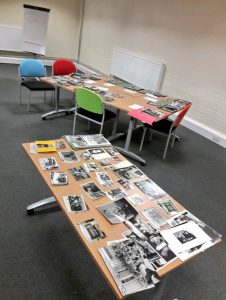
    Disabled Living heritage collections of photographs at Redbank House
    Just one of many tables we had when organising our archive into categories

    A date, a photo, a quote, and other small pieces of information can lead to a greater insight than you think. When we dig deeper into our research, we learn so much more about traditions and the context of a particular era. But the most important of all being that, we have had the chance to see the development of our services and products over 120 years. We have discovered some very talented artists, special achievements and milestones in our charity.

    It helps others to learn more about us

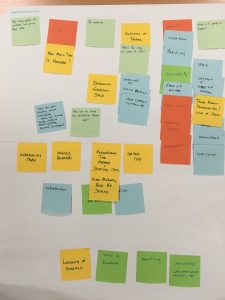
    community curation planning
    Community curation planning workshop

    We’ve had staff members, community curators, designers, printers, oral history experts, film makers, archivist, Heather Roberts, and creative cultural consultant, Claire Turner involved in the project. And we’ve also had members of the public, social media tweeters, and new volunteers that have been amazed by the facts we’ve discovered. Through our marketing, events, and word of mouth, we’ve really generated a lot of engagement with our history. And there’s still more to come!

    You can see a timeline of our history here.

    Debra Evans, Chief Executive of Disabled Living said: I’ve enjoyed meeting new people and hearing their stories. It’s amazing to see how one story leads onto another story. There’s so many fascinating facts I’ve come across throughout this project.

    You have more archive to work with than you originally thought

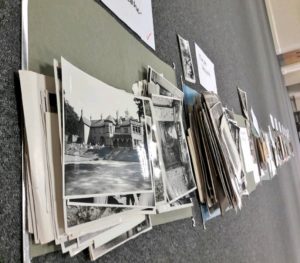
    Disabled Living archive
    Placing our archive into categories

    As a result of a major fire in 2009, Disabled Living lost all its older archived material. However, a totally unexpected phone call a couple of years ago changed all that. We were delighted to hear from the son of an ex employee who had worked for Disabled Living in the 1960’s. Unfortunately, his mother had recently passed away and while he was sorting out her house, he found a number of boxes in the attic of photographs and memorabilia relating to Disabled Living. We are very thankful to Mr Valentine who realised the importance of what he had discovered. Our heritage project wouldn’t have been possible without his mother.

    It’s really fun

    Disabled Living's Dementia Tea Dance
    Kick-start to our celebrations at our 1940’s tea dance

    Both the research and the practical side is so enjoyable. It’s always exciting when you discover or learn something new. Throughout our training in different elements of the project, we’ve been able to gain new knowledge whilst learning new skills at the same time. At first we didn’t know where to start, but once we had Claire on board with us, who is managing the project, we were introduced to new contacts and built new relationships along the way.

    There’s always something to love about discovering your heritage. What do you love about it? Tweet @HLFNorthWest with #HeritageTreasures and #LoveHeritage. Thank you to everybody who has made #DonkeysToInnovators a huge success.

  • The Story of Vicky and Paul’s Little Miracle with Angelman Syndrome

    The Story of Vicky and Paul’s Little Miracle with Angelman Syndrome

    This Story of the Month is based on a young boy called Sebastian, who attend our Kidz to Adultz North event in November 2017 with his parents. His mum (Vicky) gives her insight along with dad (Paul) about their journey of seeing their little boy grow up with Angelman syndrome.

    Please can you tell us a bit about you and your family?

    We have two sons, Sebastian who is 11-years-old and Harrison 8-years-old. Sebastian was born in 2006 after a very bumpy pregnancy with lots of hospital stays for hyperemesis. Once he was born he had feeding and sleeping problems. He suffered from reflux, which led to him being admitted into Royal Manchester Children’s Hospital at 6-weeks-old for feeding issues. They put a camera down his throat but it revealed nothing.

    However, they found he had sleep apnoea. We were scarily given training in baby resuscitation and Sebastian was placed on a monitor and under a paediatrician until 11-months-old. During this stressful time we had health visitors tell us we were ‘bad parents’ as he wasn’t gaining weight. They accused us of neglecting him because he wasn’t talking and at one point they tried to question family members about our parenting capacity. Sebastian has always been loved, cared for and protected.

    Can you tell us about Sebastian’s condition?

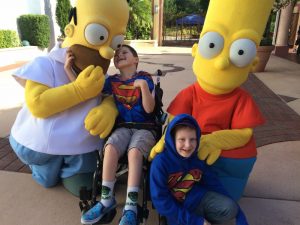
    Sebastian and Simpsons

    When we finally met the physiotherapist, little did we know that when she walked in she knew exactly what condition Sebastian condition was. She insisted we see another medical professional and referred us to a paediatrician in the community who assessed him. After the second appointment we agreed to a blood test. A month passed and we were told that it was something to do with Chromosome 15. It was very apparent that Sebastian had something called Angelman syndrome. We figured this from his delayed mile stones, his non existent language,  and his facial shape and sleep patterns (or lack of).

    We were absolutely heart broken

    But as a first time Mum and a woman who had historically been told she couldn’t have children, we didn’t see Sebastian as being any different. He was still the same little miracle they handed to us when he was born – a beautiful 18 month old who was bright, bubbly, and so very innocent, who had only just learnt to sit up although very wobbly.

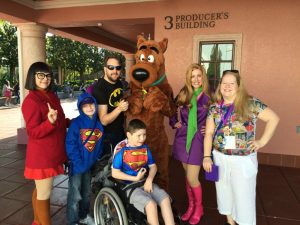
    Sebastian scooby doo group photo

    Another month had passed and we were sat in a paediatrician’s office awaiting confirmation it was Angelman syndrome. She confirmed it was Angelman syndrome, a rare condition caused by the gene UBE3A on Chromosome 15 where it’s either deleted, mutated or replaced by two copies from the paternal side (father) in the brain. We were relieved yet still very sad; someone was telling us that our perfect son wasn’t so perfect. She told us that Sebastian could have seizures, struggle to learn to walk and may never utter a recognisable word. We were also told that he may have absolutely no danger awareness.

    We had gone into the appointment with a support worker / portage worker to help us deal with the news. Her first comments were,

    You’ll never be able to go for a meal or do anything normal again.

    Needless to say, she wasn’t working with our little family long. From then onwards we decided that Sebastian would have every opportunity life had to give. At two-years-old Sebastian started with seizures which took years to control and on numerous occasions was in status epilepticus, a prolonged seizure where he was seizing both during being awake and  sleeping. He lost a lot of the skills he’d already learnt and had numerous hospital stays.

    9 years later

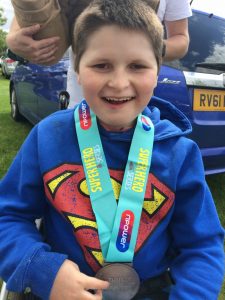
    Sebastian with triathlon medal

    Sebastian triathlon photo 2

    Fast forward 9 years, Sebastian has made lots of independent steps. His seizures have become more controlled, with 1:1 help Sebastian attended mainstream nursery and loved every minute being with his little friends. At 3-years-old, Sebastian became a big brother to Harrison, who Sebastian adores and loves to cuddle endlessly. He was a page boy at our wedding and with help walked down the isle.

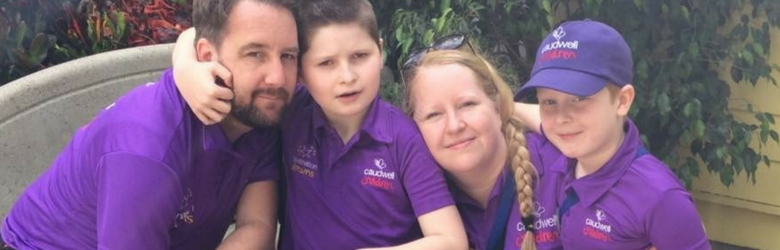
    Sebastian became a Beaver, a Cub, and now he’s now a Scout. He has been on a ‘wish’ holiday with Caudwell Children charity to Florida, a holiday we never thought Sebastian could cope with. And we plan to take him back one day.

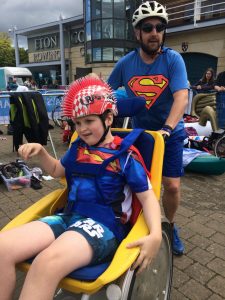
    More recently he took part in a super triathlon with his dad to raise money for Caudwell Children charity and Wheels for All. He has been home-schooled and now attends a special needs high school. He’s hardly seen in his wheelchair. There always seems to be something exciting going on there and he’s happy and healthy and loves all of his teachers. He has started using his iPod for communication (mainly for asking for chocolate and telling us he loves us but it’s a start!) And it was only recently that, he muttered that all very important word, ‘Mum’.

    An inspiring journey

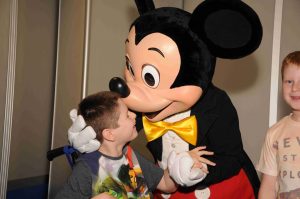
    Mickey Mouse and Sebastian

    Sebastian loves life and he loves being in the middle of everything, he has a naughty streak and a loving side. He loves his iPad, YouTube and everything all 11-year-olds love. He’s a typical boy doesn’t want to have a bath or doesn’t want to eat his greens! He sees no evil and has an energy that spurs you on. He makes you a better person and a better parent to help him be all he can.

    Life for us may not be normal but on our journey we have met the most astounding and inspiring people. We’ve lost friends who were scared and didn’t understand. But more importantly, we’ve made new life long friends who are travelling on that same ‘may not be normal life journey’. We thought we were alone but we weren’t.

    Nobody is alone, they just need to find the right support and discover people who are on that same journey.

    If you would like to feature your story on Disabled Living’s blog please get in touch with us via email: info@disabledliving.co.uk

    You might also like to read: ABA Therapy for Autism 

Disabled Living