Author: Daryl

  • 4 Reasons Why We Love Discovering Our Heritage

    4 Reasons Why We Love Discovering Our Heritage

    As it’s Heritage Treasures Day, we thought this would be a great opportunity to share the reasons as to why we love our heritage at Disabled Living. As you may already know, Disabled Living has had several name changes over the years and there have been many special memories shared.

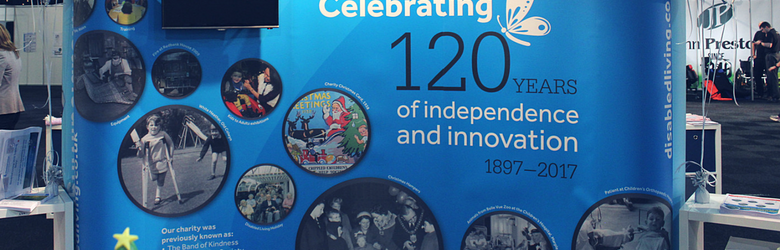
    Throughout 2017 we shared our wonderful celebrations and projects with you. We’re excited to continue these in 2018. So far we’ve had a 1940’s theme tea dance, lots of fun activities at Kidz to Adultz North, filming, community curation planning, oral history interviews, radio and television coverage, and much more. As our project, Donkeys to Innovators, funded by the Heritage Lottery Fund has developed in more ways than we ever imagined, we want to share what discovering our heritage means to us.

    There’s an endless amount of history to discover

    Disabled Living heritage collections of photographs at Redbank House
    Just one of many tables we had when organising our archive into categories

    A date, a photo, a quote, and other small pieces of information can lead to a greater insight than you think. When we dig deeper into our research, we learn so much more about traditions and the context of a particular era. But the most important of all being that, we have had the chance to see the development of our services and products over 120 years. We have discovered some very talented artists, special achievements and milestones in our charity.

    It helps others to learn more about us

    community curation planning
    Community curation planning workshop

    We’ve had staff members, community curators, designers, printers, oral history experts, film makers, archivist, Heather Roberts, and creative cultural consultant, Claire Turner involved in the project. And we’ve also had members of the public, social media tweeters, and new volunteers that have been amazed by the facts we’ve discovered. Through our marketing, events, and word of mouth, we’ve really generated a lot of engagement with our history. And there’s still more to come!

    You can see a timeline of our history here.

    Debra Evans, Chief Executive of Disabled Living said: I’ve enjoyed meeting new people and hearing their stories. It’s amazing to see how one story leads onto another story. There’s so many fascinating facts I’ve come across throughout this project.

    You have more archive to work with than you originally thought

    Disabled Living archive
    Placing our archive into categories

    As a result of a major fire in 2009, Disabled Living lost all its older archived material. However, a totally unexpected phone call a couple of years ago changed all that. We were delighted to hear from the son of an ex employee who had worked for Disabled Living in the 1960’s. Unfortunately, his mother had recently passed away and while he was sorting out her house, he found a number of boxes in the attic of photographs and memorabilia relating to Disabled Living. We are very thankful to Mr Valentine who realised the importance of what he had discovered. Our heritage project wouldn’t have been possible without his mother.

    It’s really fun

    Disabled Living's Dementia Tea Dance
    Kick-start to our celebrations at our 1940’s tea dance

    Both the research and the practical side is so enjoyable. It’s always exciting when you discover or learn something new. Throughout our training in different elements of the project, we’ve been able to gain new knowledge whilst learning new skills at the same time. At first we didn’t know where to start, but once we had Claire on board with us, who is managing the project, we were introduced to new contacts and built new relationships along the way.

    There’s always something to love about discovering your heritage. What do you love about it? Tweet @HLFNorthWest with #HeritageTreasures and #LoveHeritage. Thank you to everybody who has made #DonkeysToInnovators a huge success.

  • The Story of Vicky and Paul’s Little Miracle with Angelman Syndrome

    The Story of Vicky and Paul’s Little Miracle with Angelman Syndrome

    This Story of the Month is based on a young boy called Sebastian, who attend our Kidz to Adultz North event in November 2017 with his parents. His mum (Vicky) gives her insight along with dad (Paul) about their journey of seeing their little boy grow up with Angelman syndrome.

    Please can you tell us a bit about you and your family?

    We have two sons, Sebastian who is 11-years-old and Harrison 8-years-old. Sebastian was born in 2006 after a very bumpy pregnancy with lots of hospital stays for hyperemesis. Once he was born he had feeding and sleeping problems. He suffered from reflux, which led to him being admitted into Royal Manchester Children’s Hospital at 6-weeks-old for feeding issues. They put a camera down his throat but it revealed nothing.

    However, they found he had sleep apnoea. We were scarily given training in baby resuscitation and Sebastian was placed on a monitor and under a paediatrician until 11-months-old. During this stressful time we had health visitors tell us we were ‘bad parents’ as he wasn’t gaining weight. They accused us of neglecting him because he wasn’t talking and at one point they tried to question family members about our parenting capacity. Sebastian has always been loved, cared for and protected.

    Can you tell us about Sebastian’s condition?

    Sebastian and Simpsons

    When we finally met the physiotherapist, little did we know that when she walked in she knew exactly what condition Sebastian condition was. She insisted we see another medical professional and referred us to a paediatrician in the community who assessed him. After the second appointment we agreed to a blood test. A month passed and we were told that it was something to do with Chromosome 15. It was very apparent that Sebastian had something called Angelman syndrome. We figured this from his delayed mile stones, his non existent language,  and his facial shape and sleep patterns (or lack of).

    We were absolutely heart broken

    But as a first time Mum and a woman who had historically been told she couldn’t have children, we didn’t see Sebastian as being any different. He was still the same little miracle they handed to us when he was born – a beautiful 18 month old who was bright, bubbly, and so very innocent, who had only just learnt to sit up although very wobbly.

    Sebastian scooby doo group photo

    Another month had passed and we were sat in a paediatrician’s office awaiting confirmation it was Angelman syndrome. She confirmed it was Angelman syndrome, a rare condition caused by the gene UBE3A on Chromosome 15 where it’s either deleted, mutated or replaced by two copies from the paternal side (father) in the brain. We were relieved yet still very sad; someone was telling us that our perfect son wasn’t so perfect. She told us that Sebastian could have seizures, struggle to learn to walk and may never utter a recognisable word. We were also told that he may have absolutely no danger awareness.

    We had gone into the appointment with a support worker / portage worker to help us deal with the news. Her first comments were,

    You’ll never be able to go for a meal or do anything normal again.

    Needless to say, she wasn’t working with our little family long. From then onwards we decided that Sebastian would have every opportunity life had to give. At two-years-old Sebastian started with seizures which took years to control and on numerous occasions was in status epilepticus, a prolonged seizure where he was seizing both during being awake and  sleeping. He lost a lot of the skills he’d already learnt and had numerous hospital stays.

    9 years later

    Sebastian with triathlon medal

    Sebastian triathlon photo 2

    Fast forward 9 years, Sebastian has made lots of independent steps. His seizures have become more controlled, with 1:1 help Sebastian attended mainstream nursery and loved every minute being with his little friends. At 3-years-old, Sebastian became a big brother to Harrison, who Sebastian adores and loves to cuddle endlessly. He was a page boy at our wedding and with help walked down the isle.

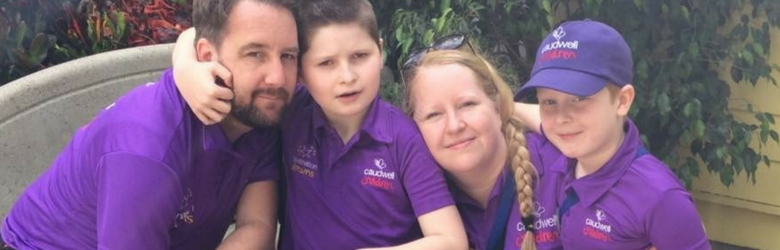
    Sebastian became a Beaver, a Cub, and now he’s now a Scout. He has been on a ‘wish’ holiday with Caudwell Children charity to Florida, a holiday we never thought Sebastian could cope with. And we plan to take him back one day.

    More recently he took part in a super triathlon with his dad to raise money for Caudwell Children charity and Wheels for All. He has been home-schooled and now attends a special needs high school. He’s hardly seen in his wheelchair. There always seems to be something exciting going on there and he’s happy and healthy and loves all of his teachers. He has started using his iPod for communication (mainly for asking for chocolate and telling us he loves us but it’s a start!) And it was only recently that, he muttered that all very important word, ‘Mum’.

    An inspiring journey

    Mickey Mouse and Sebastian

    Sebastian loves life and he loves being in the middle of everything, he has a naughty streak and a loving side. He loves his iPad, YouTube and everything all 11-year-olds love. He’s a typical boy doesn’t want to have a bath or doesn’t want to eat his greens! He sees no evil and has an energy that spurs you on. He makes you a better person and a better parent to help him be all he can.

    Life for us may not be normal but on our journey we have met the most astounding and inspiring people. We’ve lost friends who were scared and didn’t understand. But more importantly, we’ve made new life long friends who are travelling on that same ‘may not be normal life journey’. We thought we were alone but we weren’t.

    Nobody is alone, they just need to find the right support and discover people who are on that same journey.

    If you would like to feature your story on Disabled Living’s blog please get in touch with us via email: info@disabledliving.co.uk

    You might also like to read: ABA Therapy for Autism 

  • What Have Disabled Living Been up to in December?

    What Have Disabled Living Been up to in December?

    December is a time to be feeling festive and prepare for Christmas. We have got a lot of news for you to catch up on this month. There have been several events at Redbank House and Disabled Living giving us that Christmassy feeling. We put our Christmas trees up at the beginning of the month and our elves have been getting up to a lot of mischief, which you can see for yourself here

    Film-making workshop for HLF project

    film-making workshop

    On Monday 4th December members of the Disabled Living team attended a film-making workshop with Sue and Jim, who are working on our heritage project with us. They wanted to give us an insight to the different types of camera angles, interviewing and film-making techniques, along with a short introduction to editing your footage. We all thought this workshop was very useful and we look forward to using these exciting new skills in the new year.

    Coleman’s Christmas Crackers

    Christmas cracker

    Every Friday in December, Billy Coleman from our Kidz Exhibitions team, gave us his very best ‘Coleman’s Christmas Crackers’ jokes.  Here’s a few of the ones we’ve shared over the last few weeks:

    What’s the best Christmas present ever?

    A broken drum; you can’t beat it!

    Why are Christmas trees very bad at knitting?

    Because they always drop their needles!

    What do you call an elf who sings?

    A wrapper!

    Visiting Isabelle – Our Christmas card winner

    Isabelle Christmas card winner
    Isabelle Peacock, Christmas card winner from Kidz to Adultz North 2017

    Debra and Natasha visited the winner of our Christmas card competition to reward her with a lovely hamper. The competition took place at this year’s Kidz to Adultz North event at EventCity in November. This relates back to our heritage when the charity (know then as the Band of Kindness), organised the delivery of Christmas hampers for 300 children every December. Debra and Natasha felt that it was very heart-warming to see the smile on Isabelle and her mum’s face.

    Christmas Jumper Day (and week)

    Collage of Christmas Jumper Week at Redbank House

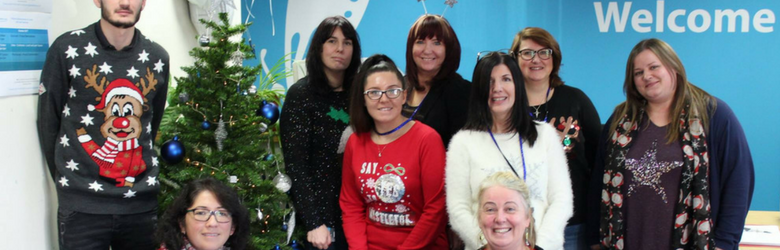
    Monday 11th – Friday 15th December was Christmas Jumper Week at Redbank House. A lot of our service users got into the festive spirit and wore their Christmas jumpers as they attended Sensurround. Amanda, Janice, Sharon and Debbie loved taking part. The team at Burrows House also took part in Christmas Jumper Day. They also enjoyed getting into the Christmas spirit And as you can see above, Elfie helped to raise money for Save the Children at our Redbank House reception.

    Christmas Extravaganza

    Disabled Living stand at Christmas Extravaganza

    On Saturday 16th December our CEO, Debra Evans, attended the Christmas Extravaganza at Manchester’s Central Library. Disabled Living’s stand gave people the chance to learn all about us and have the opportunity to see our wonderful Christmas card archive collection. There was a live choir and band along with mince pies to get everyone feeling in the Christmas mood!

    Christmas Work’s Doo

    Christmas table

    On Saturday 16th December we had our Christmas work’s doo in the evening. This year, we went to the Village Hotel in Bury. We enjoyed a Christmas dinner and listened to a live band and DJ playing both old and new songs. It was a fantastic evening and great for the whole team to be together.

    Company Christmas Open Day

    Christmas reps day 2017

    On Wednesday 20th December, members of Disabled Living staff welcomed representatives who have been involved with projects across our departments in 2017. Everyone enjoyed a mince pie, tea/coffee, and were given the opportunity to meet new members of staff, discuss our service developments for 2018 and explore ways in which we could help them to increase their company and equipment profile.


    Another wonderful year for Disabled Living. We would like to thank you who’s supported us this year. As a charity we value all of our customers, service users, trustees, staff, volunteers, and anyone who has worked with us to help make a difference. Share your memories with us on Twitter.

    We would like to wish you a Merry Christmas and a happy New Year.

  • Manchester People First Are Celebrating 25 Years of Self Advocacy

    Manchester People First Are Celebrating 25 Years of Self Advocacy

    We recently received a ‘Speak Up’ newsletter from Manchester People First (MPF) and felt inspired to write a blog about what they do.

    From 1992 to 2017, MPF have given training and support to disabled adults and professionals, with the aim to campaign for disabled people’s rights. This year, they were awarded with ‘Best Service User Involvement Organisation in Manchester’ by the Spirit of Manchester Awards. What an incredible and well deserved achievement that is. They have recently circulated their 2017 Annual Report, which is available here.

    About MPF

    The team is made up of learning disabled adults and their office is based in Cheetham Hill, Manchester. They’re located close by to our office in the area. They offer staff training and also training and workshops to let members know about the different issues that affect them. They have organised some fantastic social events including. MPF’s Talent Show and several television tours.

    MPF newsletter 2017

    I am a person, not a label.

    MPF have worked with many groups and organisations over the years for different causes. These have included Greater Manchester Police, Healthwatch and Ambition for Ageing. A big project they’ve worked on this year is their ‘Hidden Histories’ exhibition, which was held at Central Library last month in November. Attending conferences and having stands at events helps MPF to promote their message of the importance of support for disabled people.

    Congratulations on winning your Spirit of Manchester award. You’ve accomplished many things this year that the whole team should be very proud of. We’re looking forward to seeing all of the great things that you’ll achieve in 2018.

    Follow MPF on social media

    Twitter
    Facebook
    YouTube

    Or you can visit their website to learn more about them here.

  • Success at Peacefield Handicrafts

    Success at Peacefield Handicrafts

    This is a guest blog by Heather Roberts, who you might have seen featured in our other blog posts.

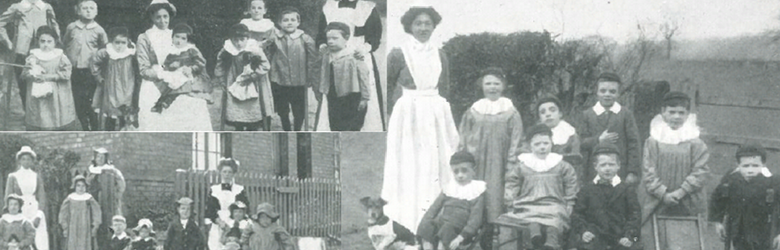
    It’s not just in Manchester and Salford that Disabled Living has operated. Way back in the late 1800s The Band of Kindness, as it was known back them, was implementing novel ideas all over the country. As well as organising the delivery of Christmas hampers for 300 children every December, it operated a sort of convalescent home for children who needed time away from the “dirty old town” to recover from illness or injury, or receive other treatment.

    This was called “Peacefield” and was situated on Cross Lane in Marple. The bottom of Cross Lane is now called Peacefield.

    Peacefield newspaper cutting

    Peacefield newspaper cutting

    An article in Disabled Living’s archive, kept in an absolutely stunning newspaper scrapbook, recognises that it is difficult enough to “struggle along in the slums of the city with health and limb” without having the added difficulty of illness or disability.

    An added need was that the Band of Kindness has so much work to do for children that a separate operation was needed to deliver the required help. The Crippled Children’s Help Society was therefore formed and founded Peacefield.

    First days at peacefield

    The convalescent home didn’t just treat illness, but taught children skills. An ethos that has run through Disabled Living for over a century is that of opportunity for independent living. Back then, this was manifested in teaching children under its care handicrafts. It’s praised as being “eminently useful”. This isn’t only due to benefits to mental health. But that if, disabled children learned a skill then they could earn some money and live independently.

    Women and basket weaving

    Initially women would come and teach basket weaving. But mind quickly turned to more effective crafts and expert craftspeople were consulted to:

    …extend the teaching of crafts more satisfactory, and to a larger extent more remunerative.

    Peacefield 1904

    Success stories were quick to come with two young women from Peacefield. They found a place in the Crippled Girls’ Industrial Home in London. Here, they were taught “the art of artificial flower making, and thus be enabled to earn their own living.”

    The article ends triumphantly stating that “this beneficent work speaks loudly for itself.”

    I love this story of success, attention, care and triumph and can’t wait to share more insights into the archive with Disabled Living’s “Donkeys To Innovators” archive and heritage project.

  • The Importance of an Active Lifestyle for Disabled People

    The Importance of an Active Lifestyle for Disabled People

    At the end of October we introduced Ben Andrews to you and told you why we thought he was deserving of our Story of the Month. Since then, Ben has started a whole new project which involves his series of videos, ‘Breaking Barriers’. These look at topics such as, transport as a barrier to an active lifestyle for disabled people and supporting disabled people with exercise. We thought this would be a worthwhile opportunity for Disabled Living to talk to Ben about his story and what it means to help disabled adapt a more active lifestyle.

    Can you tell us about Empower’s story?

    I started working on Empower when I was 17-years-old. I gained my Level 2 Gym Instructor qualification and started supporting family members with visual impairments at the local gym. I often thought that, there’s got to be more people in this position with a disability who could benefit from increasing their fitness but might need some support to do so.

    So I started volunteering around Salford, delivering health lifestyle sessions for people with a range of disabilities; wheelchair users, people with learning disabilities, deaf people and people with hearing impairments and got a real feel, and buzz, for adapting sessions to meets people’s needs. I also assessed what was available for disabled people to keep active and found there to be a real lack of opportunities.

    library bookshelf

    I tried to put a report together at about 19-years-old to state a case for a disability specific gym instructor. I’d never written a report. It had no rationale, no evidence base, and I wasn’t really sure what to do with it so unsurprisingly it didn’t go anywhere. But I knew what I wanted to do and why, so I didn’t give up on it.

    Knowing I’d need more knowledge and experience to make this work I approached Salford University and explained my plans and was granted access onto an Exercise and Health Sciences degree. I used my time at Salford University to research my field, with a particular emphasis on disability, exercise and the heightened prevalence of long term conditions for this demographic.

    By the time I left University I was able to articulate a clear case as to the importance of disabled people leading healthy, active lifestyles. Luckily enough, NHS Salford CCG had just released an Innovation fund to pilot new ideas to improve the health of Salford residents with one of there target groups disabled people. Being right up my street, I compiled all of my personal and professional experience along with my academic learning into a bid and submitted it. Since 2015 NHS Salford CCG has funded the Empower project, with the aim to support disabled people to lead more active lifestyles.

    Gordon - Empower Health

    What does working for Empower Health mean to you?

    Even though I’ve only been contracted to deliver it over the last 2 years, it’s been a massive part of my life for coming up to 9 years now. So it means a lot to be able to do something I’ve wanted to do for so long and worked so hard towards. This is something I’m passionate about; I couldn’t imagine doing anything that doesn’t support disabled people to lead healthier lifestyles in some way so I’m very grateful for the opportunity.

    I’m grateful that NHS Salford CCG has been innovative enough to see the benefits of this type of initiative and that Unlimited Potential have supported the project through incubation to allow me to secure funding and deliver Empower whilst ensuring that the project grows and develops in the way that it should.

    What inspired you to get into this area of work?

    I suppose first off growing up around disability has given me a bit of a different mindset and perspective on what disability is and the barrier society presents. It’s something that families have always overcome and I’d hope to support others to do so.

    Mike and Ben - Empower Health

    Secondly, I don’t think its right that anybody should be at any worse odds health wise based on something they have no control over. Disabled people face massive health inequalities and in many cases it’s not down to the actual disability but due to the barriers disabled people face when trying to manage their health. For example, there is no physiological reason that people who are blind should be overweight or obese, but they are at increased risk of being, due to the lack of opportunities they have to maintain a healthy weight through activity.

    Finally, and from my point of view the most important, I hope to change perceptions from both non-disabled people and disabled people. From my experience, both in many cases don’t acknowledge that disabled people can keep active and lead healthy lifestyles. It feels like there’s an expectation that disabled people cannot be healthy or active, so there’s no planning in place for them to do so. I’d hope that by creating a platform to showcase disabled people keeping active and exposing both groups to this, that over time, this perception will change and it’ll no longer be an afterthought.

    What advice do you have for people with disabilities that want to get more active?

    I’d say look for local opportunities, not always disability specific, mainstream integrated groups, activities and venues. Services have a duty to make reasonable adjustments to accommodate your needs and it’s important that you exercise this to support a healthy lifestyles.

    There are loads of barriers, which will affect this which I’m happy to talk about and give my tips and experience on overcoming these.


    Contact Ben

    Email: ben.andrews@unlimitedpotentail.org.uk

    Twitter
    Instagram
    Facebook

  • Edward Gosling: An Inspiring Disabled Artist

    Edward Gosling: An Inspiring Disabled Artist

    We are so excited to share this little bit of hidden history with you! As we’ve mentioned before, this month is Disability History Month and its focus is the arts in disabled histories. On our #DonkeysToInnovators archive and heritage project, we are obsessed with our beautiful Christmas card collection. Read about the stories behind them on this blog for more information. But for now, we want to introduce you a wonderful young man, Edward Gosling.

    A disabled artist

    Edward Gosling Christmas card

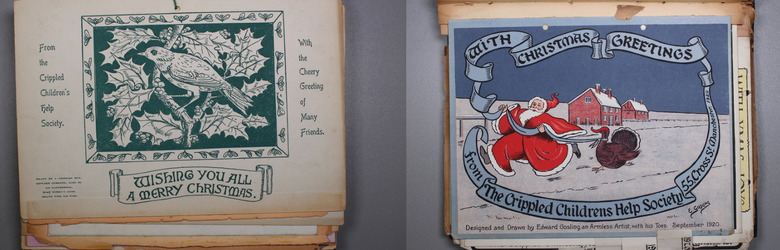
    Gosling was an artist who designed a number of our Christmas cards back in 1910 when he was just 15 and again in 1920. Not many artists are fully credited on the cards but the lovely dedication to Gosling is fascinating. On his gorgeous winter bird and holly design, it reads,

    Drawn by a crippled boy, Edward Gosling, aged 15 (of Manchester), boy without arms, drawn with his toes.

    It is likely that, due to his age, he was a member of the society or otherwise accessed its services. Disabled Living, or the Crippled Children’s Help Society as we were known then, not only supported children and young people living with disability but encouraged crafts, arts and skills in its service users.

    1920’s colours

    Edward Gosling Christmas card

    The change in design between 1910 and 1920 are quite striking. 1910 sees a mono-coloured traditional design, almost Victorian in its simplicity and humbleness. The 1920 design, in contrast, sees bold and bright colours, vitality and humour.

    Perhaps in 1910 we see a developing artist, a 15 year old boy finding his style and wanting to keep his commission simple and pleasing. Then in 1920, this 25-year-old man is a talented artist, playing with themes and confidently expressing style. Could it also be that the vitality of post-war 1920 is bursting through, still being shared with the young children who will receive this card along with their hamper?

    This card is even signed by Gosling in gorgeous stylised script.

    The artist

    Sadly, we don’t know much more about him. He is credited to a beautifully warm painting of The Ruskin School in Lynn, Norfolk. Perhaps he moved down there? Perhaps he visited and painted? Perhaps he was commissioned? Unfortunately we don’t know.

    If you have any information about this disabled artist, we would love to hear from you. Send us a message on Facebook or Twitter.

    Thank you to Heather Roberts for writing this post. You can find her blog here.

  • We’re Proud to be Celebrating International Volunteers Day

    We’re Proud to be Celebrating International Volunteers Day

    Today, Tuesday 5th December, celebrates a whole day dedicated to International Volunteer Day. For this day we would like to show recognition to our volunteers who have been supporting us on our #DonkeysToInnovators project so far. 

    Throughout our From Donkeys to Innovators project funded by the Heritage Lottery Fund, we’ve had volunteers help us with community curation, attending oral history workshops, participating in archiving and digitisation processes, plus contributing to blog posts. We spoke to two of these volunteers who have been over at Redbank House. They have been working with Archivist, Heather Roberts, and Claire Turner  who is managing our project.

    One of our longstanding volunteer, Avril

    Disabled Living archive
    Just a small amount of our photo archive

    We asked Avril what she enjoys about volunteering with Disabled Living. Avril is one of our longstanding volunteers, and has attended a number of workshops for our #DonkeysToInnovators heritage project.

    I came to the archiving project through my interest in many years of volunteering with the Kidz team. I have enjoyed the volunteering which supports giving people with physical problems the opportunity to be more equal. The archiving project is important for me. It shows the beginnings of the organisation and how far it has come today but still keeping the core ethos. Since I have the time it also allows me the opportunity to develop more skills and be hands on in a situation that needs more hands! I also enjoy the camaraderie of like-minded people.

    One of our new volunteers, Kezi

    Kezi working alongside Heather
    Kezi working alongside Heather

    Kezi has been involved in our archiving and selection process for what photos represent Disabled Living’s history the best. Straight from the get-go Kezi wanted to get involved and that’s exactly what she did on her first visit at Redbank House. We asked her what she enjoyed about her first experience volunteering with us.

    I loved helping out with Disabled Living’s archive. It gave me a really great chance to have some hands on experience with cataloging an archive for the first time. This is an area I would like to work in eventually. I loved looking through the photograph collection, which shows a wonderful range of day to day life at Disabled Living and how they have helped to enrich the lives of many different people over the years.

    Thank you to all of our volunteers. You’ve made us so proud and we wouldn’t have been able to get this far in the project without you.

    How are you celebrating Volunteers Day? Tell us on Twitter @disabledliving or Facebook.

  • Talking About Our Christmas Crafts for Disability History Month

    Talking About Our Christmas Crafts for Disability History Month

    For Disability History Month this year, the theme is the arts. Disabled Living is proud of its history which is steeped in arts and crafts. This month, we would love to share some of these stories from our #DonkeysToInnovators archive and heritage project with you. Thank you to Heather Roberts for writing this blog post. 

    Christmas card crafts

    Befitting the season is more from our astounding Christmas card collection. Following on from our sneak peek before we wanted to delve in a little deeper.

    For this blog, we would like to share with you the first famous designer we know to have illustrated our cards.

    1907, Garth Jones

    The first Christmas card that we know to have been designed by a recognised artist is the gorgeous 1907 print of Santa. Garth Jones (1872-1955) was a Mancunian illustrator and art teacher, notable for his designs in fairy tale and folklore volumes. He studied at what would become the Royal College of Art in London and later in Paris.

    I absolutely love this item!  You can definitely see a little fairy tale in the Christmas card. The cheeky little cherubim hauling a wayfarer troubadour Santa along with his wicker basket, reminds me of the English fables book my Nana would have by her chair (with ginger biscuits at the ready of course).

    Garth Jones Christmas card 1907

    The poem

    The lovely little poem is attributed to an M.K. It is highly likely this is Marianne Kirlew, Honorary Secretary for The Band of Kindness and Children’s Help Society (which was Disabled Living back in the day).

    Our aches and pains all fly away, when hampers come on Christmas day.

    The pretty verse refers to the Christmas hampers which were given out to children either living with disability or otherwise home bound for Christmas due to illness. The Christmas card accompanied the hamper and would have surely brightened any child’s day.

    As an archive

    One of my favourite things about this card is how archive-y it is. Can you see what looks like a very precise tea stain on the card and some ghostly scribbled up top?

    The outline shows where the card has been pressed against another item in the folio. It has remained there for so long that it has sort of protected the natural yellowing of the card. The scribbles are where ink has bleached and protected just that bit of card which it was pressed against. If you look closely, you can see that the writing is backwards, referring to the 1907 Christmas card.

    The craft

    This beautiful little design shows how the arts, illustration and poetry have been valued by Disabled Living for over a century.

    We look forward to sharing more of these stories with you soon!

  • Yang Sing Cathay Launch New Christmas Dish

    Yang Sing Cathay Launch New Christmas Dish

    For November’s Story of the Month, we would like to do something that’s a little different. Usually, we dedicate this post to a person to recognise their potential or amazing achievements. However, this month we would like to dedicate this blog to the hardworking spirit of more than one person, which is the whole team at Yang Sing Cathay in the Trafford Centre. Disabled Living are interested in what’s on in Manchester and we thought this would be the perfect opportunity to share Yang Sing Cathay’s new Christmas dish with you.

    This year Yang Sing Cathay has created a special Christmas dish! We spoke to Louise, Marketing Executive at Yang Sing Cathay as she shared her thoughts:

    It was quite challenging to find a balance between a traditional British turkey dinner and a Chinese dish.

    Louise suggested that Yang Sing create a Christmas dish and insisted that they serve turkey breast. She felt that turkey is the essence of Christmas and the blackcurrant sauce goes so well with it. She described it as giving the dish ‘a real Christmassy taste’ as well as a Chinese taste.

    On Monday 27th November, the new dish was available for customers to try

    plum and hoi sin sauce yang sing cathay
    Plum and hoi sin sauce
    blackcurrant sauce yang sing cathay
    Blackcurrant sauce

    They were offered offered them three different sauces, a sweet chilli sauce, which only a few people liked, along with Plum and Hoi Sin sauce and a fruity blackcurrant sauce. Most people enjoyed the Plum and Hoi Sin sauce and blackcurrant sauce the most.

    One customer said:

    The deep fried turkey works really well, the fruity sauce is delicious.

    With the help from Gerry Yeung, the Head Chef and Louise the decision has been made! Turkey breast goujons, served with either Plum and Hoi Sin sauce or Blackcurrant sauce and sesame seeds. The coating is made from self raising flour and potato starch.

    The team are very much looking forward to Christmas. Julie the restaurant manager said:

    It’s nice that we are serving a turkey dish with a Chinese twist.

    gerry yeung yang sing cathay

    Another member of the Yang Sing Cathay team, Kong a senior waiter who has been working for Yang Sing Cathay for more than 10 years said:

    Our Christmas tree has been up since October we are very much in the Christmas spirit.

    Thanks to the Trafford Centre who also put their Christmas decorations up and began to showcase their Christmas lights display on 2nd November.

    The special Christmas turkey goujons will be served in Yang Sing Cathay from Monday 4th December. To find out more about Yang Sing Cathay, please visit their website. Or you can follow them on Facebook, Twitter, and Instagram.

Disabled Living