Author: Daryl

  • How an Occupational Therapist Helped in a Kenyan Sanctuary

    How an Occupational Therapist Helped in a Kenyan Sanctuary

    This Story of the Month has been written by Gareth Brown, Development Manager at AAT GB Ltd for Disabled Living.

    In October 2017, we received a video clip from an OT from Northern Ireland. She was making an enquiry about buying a Chillibean. This is one of our Stabilo vacuum posture cushions. Nothing unusual in that, it is a very popular and versatile piece of equipment after all. However, that’s where normal ended and an adventure began!

    Jolene Allen is a missionary Occupational Therapist working out in Kenya. She runs a centre called the Metropolitan Sanctuary for Children with Disability in Nyeri. In her video, she described a country where approximately 70% of the population of children with a disability live below the poverty line. Free healthcare is extremely limited to children under 5-years-old for rehab. Physio and government hospitals are overwhelmed with huge queues and limited resources. Assistive devices such as Orthotics, prosthetics and wheelchairs sadly aren’t free. Also, there aren’t affordable to most people or are impractical.

    Having a child with a disability can be stigmatised and is believed to be a curse to many families.

    The sad results of this are that, many mums are left to cope with children with disabilities on their own with little or no social support. Often, mothers themselves buckle under the pressure of stigma and self blame. They run away, deserting the child. Many get raised by grandmothers. Many get abandoned. Tragically, in some tribes, they are not allowed to live. The reality of this is that many children spend their lives lying on a bed looking at the ceiling, and are often left all day. Sometimes, they’re tied to the bed, while the mum has to go out and work just to be able to support the family and survive.

    Sadly, there aren’t support systems for feeding or supportive seating. So, deformities go unchecked and many of these children don’t survive into adulthood.

    It’s a pretty gloomy picture for such a fast developing African country. Though the government and charitable organisations are endeavouring to develop health services, progress is slow. Particularly in the area of custom made adaptive seating, which still remains out of reach for the vast majority who would benefit from it. Should a child be fortunate enough to have rehabilitation services, it’s common that staff who ought be prescribing equipment, are largely accustomed to disregarding positioning altogether.

    So what’s Jolene up to?

    She’s been at the Sanctuary for over seven years now, overseeing the rehab services including therapy services, medical reviews, medicine, day care, counselling, support and even residential services for the most disadvantaged children. She established a social enterprise hub, which involves employing mothers of children with disability to make paper with recycled materials and create beautiful hand crafted art.

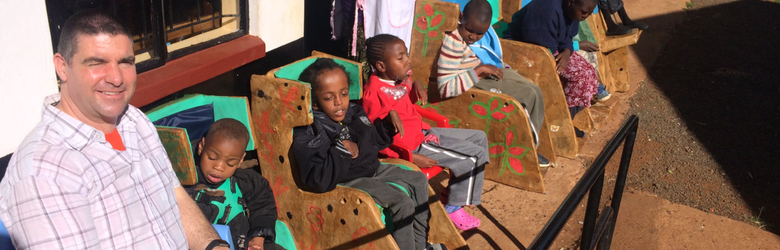
    The really amazing part is what they’re making for the children. Jolene has mastered the art of using recycled cardboard and paper to make custom postural seating and equipment. Each child is assessed and measured and has a perfectly matched cardboard chair (or standing frame, or combination of the two) made for them. This allows them to be able to sit up and be part of family life. It helps their posture, breathing, swallowing and digestion and raises their quality of life to unprecedented levels. Families are also gently educated in the importance of this when they are given the equipment as well.

    sanctuary helping child

    Not resting on her laurels, Jolene has been tackling ever more challenging seating for the children. She uses extremely complex shapes, vacuum bags, vacuum cleaner and polystyrene beads to create moulded patterns. And then making papier-maché seating systems mounted into cardboard bases. This has proven quite a difficult undertaking with such basic but ingenious equipment, which triggered her call for help to us.

    We were so inspired by her amazing creativity and achievements. AAT donated a Stabilo Grande mattress to the Sanctuary to use for creating the moulded seats. This proved to be a very useful tool for making more accurate moulds and is now used to form plaster of Paris body templates of each child so a custom seat can be made. I also offered to help with advice. And after many, quite technical conversations, it was clear that talking about it just wasn’t good enough.

    An inspirational adventure

    An adventure was long overdue for me. So, mid February found me on a plane heading out to Nairobi on my first ever trip to Kenya. What a week it was! I had a very busy time. First, coaching everyone on how to get the best out of the Stabilo cushion. Then we experimented with the various techniques used in the UK for creating custom moulded seating but adapted them to using only the resources available locally. It was such a rewarding experience and a privilege to work with Jolene and her team of dedicated staff. We had great fun problem solving on such a practical level where every tiny improvement would make such a huge difference. I could easily have stayed for a month and still had so much more to do.

    So, what next?

    team at work

    A return trip is certainly on my to-do list! They are currently raising the funds to build the next part of the Sanctuary, a three storey building to house children during extended intensive therapy visits, accommodation and training facilities for OTs, physios and families. There’s still a long way to go but the ground has already been excavated and the giant retaining wall has been built by hand over the last 9 months.

    The Cardboard seating is moving on to a next generation of more adjustable, longer lasting seats with improved shaping, cushioning and harnessing. Moulded seating is still in development while materials are being sourced locally, hopefully including liquid Polyurethane foams from BASF chemicals for foam in place seating.

    My next project has already started, building a foam carving duplicator machine so a copy can be cut straight from the Stabilo cast of the child’s shape, saving a lot of time and cost. This would mean the plaster of Paris body print would not be needed and a child can be test fitted while still at the clinic, potentially saving the family many hours of uncomfortable additional travelling.

    Grateful for any assistance

    Jolene and her team would be grateful for any assistance from professionals in all areas of rehabilitation services. This includes: PTs, OTs, SLTs, Orthopaedic Technicians, or people with experience in wheelchair or seating services. They’re always keen for people to buy and sell their paper products. And they have a £100 box challenge every Christmas where you retail £100 of their products to family and friends. For further information visit Sanctuary Artists website.

    To find out more about the wonderful work going on at the sanctuary please click here.

  • 4 Amazing Years in the Kidz to Adultz Team at Disabled Living

    4 Amazing Years in the Kidz to Adultz Team at Disabled Living

    This post has been written by Billy Coleman. Well, where to begin about telling you all about my 4 amazing years at Disabled Living and being a member of the Kidz to Adultz Team? It all began when I certainly couldn’t grow the beard I can today!

    Below are a few reasons why I love working at Disabled Living.

      • Organising the Kidz to Adultz Events
      • The hype you get when travelling down on the train, setting up the events and waiting for the doors to open for the children, general public and health care professionals.
      • Seeing the Children smiling and taking part in the activity areas, craft area and expressing their ideas in the innovation hub
      • The work memories you take from travelling to the events e.g. Jo picking up the wrong case on the train, myself nearly ending up in Newcastle instead of coming back to Manchester.
      • Finally getting a pitch view room after the 4th year of visiting the Ricoh Arena.
        That little rewarding nap I enjoy on the train home after knowing you and your team have organised another successful event!
      • The progression and skills I have been taught and progressed within the years of working here.
        • Working hard to get the best possible prizes for each event. The excitement I get when receiving the prizes for the events and ringing the successful winners.
        • Working with all the members of staff here at Disabled Living and exhibitors at the events.
        • Entertaining everyone in work with my hilarious jokes and lovely singing.
        • Dressing up as John Travolta in Grease at the 1950’s Disabled Living Tea Dance.
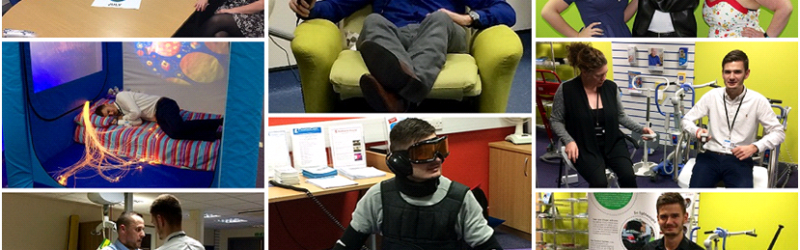
        • Being the Product Demo model every Wednesday. My favourite being wearing an aged suit and looking like RoboCop.

    Here’s to the future

    I am now off on new adventures! I’ll be coaching/goalkeeping coaching in New England, America for 8 months which was too much of a great opportunity to possibly turn down.

    Finally, I just want to thank everyone at Disabled Living for giving me this fantastic opportunity. I wish everyone all the very best and I’ll be sure to stay in touch! My work here is complete… (drop the mic).

    Thank you to Billy for being part of our Kidz to Adultz team over the last 4 years. We wish you the best of luck in your future.

  • Would Your Staff Really Embrace Single Handed Care?

    Would Your Staff Really Embrace Single Handed Care?

    Could you answer all their objections by the time you have finished reading this article? How do you get your staff to embrace a new way of working? Bringing about changes at work isn’t an easy thing to do. Some staff will embrace any changes you introduce; they trust you and know that you will support them. Others will be more difficult to persuade. It’s just a fact of life. We can’t dictate how and what we want. We need to have reason and honesty in order to get colleagues on board.

    Good leadership and management will help to bring in changes effectively but you will still be asked many questions about what is happening before people will start to think differently.

    Let’s not run away from the questions, by answering them honestly we can help to dispel myths and reassure our staff about the safety and introduce reasonable means to make the changes as in obtrusive as possible. By being honest and open with our colleagues we can hopefully work together to introduce changes like bringing in Single Handed Care.

    At Disabled Living we have introduced a general moving and handling day which has a slant towards single handed care , it’ s not suitable for everyone but I hope we can help you to feel confident about facing the questions people have. Single Handed Care is being bandied about like a new hot topic. Everybody is looking to save money and thinking this may be the best way to go, are you? Bringing about change is never easy and introducing single handed care is no exception.

    What is Single Handed Care?

    Quite simply it’s the practice of one person delivering care to the client as opposed to double handed care which is two people. It’s not rocket science and it’s not new. I am sure there are more than a few people reading this who will agree we have been looking after people on our own forever. So, what’s new?

    More pressure at work, less staff available, an ageing population so more clients to look after to name but a few.

    Why do we need Single Handed Care?

    turn no into yes

    The answer to this can be found in just a few of the features and benefits of Single Handed Care.

    Families and clients can build trust with one person, bonding improves, everyone more relaxed, and client feels less invaded. All leads to fewer complaints.

    It may be that you are facing the prospect of more carers because you are growing or becoming more dependent, Single handed care may still be an option with the right risk assessment and attitude.

    Less people in your home have got to be the best option, more privacy, more dignity, ore control over your life.

    Confident, well trained employees, who feel valued, are less likely to leave the job. Your good reputation improves even more which leads to more work. Staff  would be able to develop great bonds with the client, leads to better risk assessments, better compliance, preventative measures more likely to have an effect.

    How we can help you

    At Disabled Living we can help you to understand and articulate your responses to common objections. We can help to train you and your staff how to be safe and innovative at the same time.

    Come to our seminar at Kidz to Adultz Middle at the Ricoh Arena on Thursday 15th March and listen to the answers to some common objections to Single Handed Care. Have a go at some techniques with just one person. By having the correct equipment you could save yourself some time, energy and money. It’s a win win for the right person. Have a chat with us about how we could help you  reduce carers in your home.

    If you have any questions email Deborah.bell@disabledliving.co.uk or give me a call on: 0161 607 8211.  I hope to see you at Kidz to Adultz Middle.

    Other useful links for home safety

    Locksmith London
    Blocked Drain Bristol
    Locksmith Bristol
    Plumber Bristol

  • Disabled Living Host 1950’s Tea Dance and Jive The Afternoon Away

    Disabled Living Host 1950’s Tea Dance and Jive The Afternoon Away

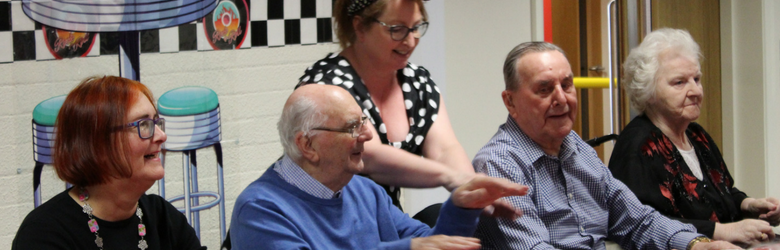
    This Story of the Month ties in with our 1950’s tea dance that we held for people with dementia and their carers. This was the second tea dance that we have hosted since July and we are pleased to say it was another enjoyable day for all.  On Tuesday 27th February, we were joined by our wonderful volunteers from the League of Jewish Women, guests from Future Directions (service users at Redbank House’s multi-sensory rooms), tenants from Bourke Gardens, and other people with dementia and their carers. 

    The room was full of 1950’s decor including neon food and drink signs, a diner girl and chequered pattern wall, small plastic vinyl discs hanging from the ceiling and much more. Once again, we provided our guests with lots of sandwiches, cake, tea, coffee, and juice. This must be where they got their energy from to sing and dance away! Thanks again to Le Mange Tout for your lovely catering service.

    Marylin Snyder recently resigned as a Trustee at Disabled Living after 25 years. She attended our tea dance to support with hospitality, along with her colleagues from the League of Jewish Women.

    marilyn smiling disabled living
    Marylin with her flowers from Disabled Living

    On behalf of the League of Jewish Women I would like to thank you for an amazing Tuesday afternoon. Walking back to our cars some of  the comments made were:-

    • I feel guilty, I went to help and ended up having a brilliant time.
    • I had more fun this afternoon than I had over the weekend!
    • All the staff made you feel so welcome.
    • Anytime Disabled Living would like a volunteer, let me know because I would love to help out again.
    • What gorgeous food and fabulous entertainment.

    All I can add to that is if the guests enjoyed themselves only half as much as the volunteers it would have still been a roaring success. Talking to the guests and seeing the looks on their faces how much they were enjoying themselves, you could see that, all your efforts were worthwhile and very much appreciated by them all.

    We’re absolutely delighted to have received further positive feedback on our tea dance.

    Diane Knowles

    Thank you so much for yesterday we had a wonderful time. You all go to so much trouble to make it lovely for us all.  The pictures are great and I will show dad them to help him remember. Many thanks, to you all.

    Jacqui Woodall

    I wanted to thank you and staff/volunteers for a fabulous afternoon and for making us feel so welcome! Myself and our customers really enjoyed ourselves. Your hospitality was second to none and  the entertainment girls were brilliant too.

    Seeing everybody smile made our day. We look forward to seeing you all again at our 1960’s themed tea dance.

  • Celebrate Chinese New Year with Yang Sing Cathay

    Celebrate Chinese New Year with Yang Sing Cathay

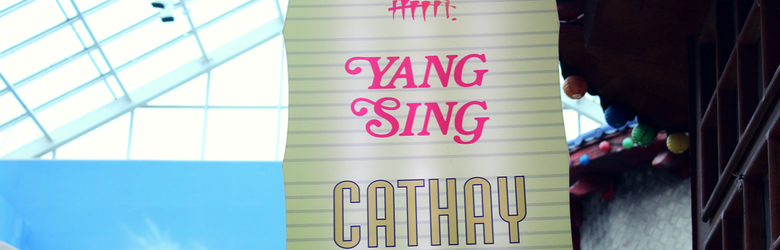
    Would you like to win a portion of spring rolls to enjoy at Yang Sing Cathay in the Trafford Centre? As Chinese New Year commences on Friday 16th February, we wanted to let you know of something very exciting! Yang Sing Cathay are teaming up with the Trafford Centre for this annual tradition. They are giving away 150 vouchers for a free portion of spring rolls. These are placed in lucky red envelopes and hidden around the shopping centre. You have three days to be in with the chance of winning. Will you be one of the lucky people who get your hands on the delicious treat?

    The meaning of Chinese New Year

    chinese new year dragon

    Managing Director of Yang Sing Cathay, Kui Man Gerry Yeung OBE, shared his thoughts on Chinese New Year with us:

    Chinese New Year, to me, means family. It’s a time for families to share together.

    And we completely agree with Gerry. There’s nothing better than a family run restaurant who want to bring families together to enjoy the celebration. Especially with staff who offer a vibrant atmosphere for you to enjoy Chinese food. There’s no better way to celebrate Chinese New Year than to head over to the restaurant yourself and try out their tasty dishes.

    We’re extremely proud of Gerry’s achievements and are honoured to have him as our President of Disabled Living and High Sheriff of Greater Manchester.

    A successful adventure of 20 years

    yang sing cathay dining

    This year Yang Sing Cathay are celebrating an amazing 20 years. Over these years, the restaurant has become an integral part of the Trafford Centre.

    1998 wasn’t the beginning of their success. The Yang Sing group commenced business in 1977 in Manchester’s famous China Town. Their first restaurant on Princess Street celebrated their 40th birthday last year.

    From sizzling steak dishes to vegetarian and vegan courses, there’s something for everyone. Take a look at the full menu. Whether you attend for a casual lunch, relaxed dinner, or group party, the modern oriental atmosphere will leave you wanting to return for more food!

    Fun fact: This year is the ‘Year of the Dog’. If you were born in 1958 or 2018, you are known as the Earth Dog. This means, you are usually recognised for being communicative, serious, and responsible in the workplace. View source here.

    T&Cs for the red envelopes

    red envelope chinese new year

    1. The vouchers are valid on 15th – 17th February 2018 only
    2. If the free portion of spring rolls is to be claimed without any additional purchase, it will be served as a bar snack
    3. A choice of Pork or Vegetable Spring Rolls is available
    4. Portion size is two spring rolls

    More information about Chinese New Year celebrations can be found by visiting the Trafford Centre’s website.

    Follow Yang Sing Cathay on Facebook, Twitter, and Instagram to see more of their success and offers we’re sure you’ll be tempted to enjoy.

  • Kath’s Experience of Almost 4 Years Working on a NICE Guideline

    Kath’s Experience of Almost 4 Years Working on a NICE Guideline

    This post explores Kath’s experience of working on a National Institute for Health and Care Excellence (NICE) Guideline. Her journey began almost 4 years ago. This is when Kath became a Lay Committee Member on transitions from hospital to home for people with social care needs.

    It was very interesting to see that despite us all coming from such different backgrounds (professionally and personally), we all agreed that things needed to change, and the person always needed to be at the centre of the decisions made about their lives.

    As well as my own experiences of having multiple impairments and high support needs, I believe my work as an advocate for people with complex impairment related difficulties stood me in very good stead. i was able to make practical, common sense suggestions of possible ways to resolve difficult issues. The work was very rewarding, as I could raise issues that may not have been considered had I not been there. I was also able to suggest ways that would strongly benefit the individual and their caregivers, whilst ensuring that staff were supported to carry out their work in an integrated and coordinated way, and without unnecessary delays.

    It is challenging but ‘well worth the final result’

    NICE kath photo

    I have to admit the work on a guideline committee is exceptionally challenging, simply due to the amount of papers that need to be reviewed. But, it is well worth the final result! The production of essential guidelines and standards for health and social care, which is substantially strengthened by the voice of lay members (including disabled people, people with long term health conditions and carers) is priceless.

    In fact, I found the work so rewarding that I went on to join my second NICE Guideline Committee, which focused on Intermediate Care including Reablement. Again, this was something close to my heart as effective intermediate care services ensure that people are supported to learn safe strategies to regain their confidence in performing daily living tasks. In this way, they can remain in their own homes, if they wish to do so. This is vital when it prevents unwanted placements in residential homes and could be responsible to keeping people in hospital unnecessarily. And most importantly, it is far less distressing and disempowering for the individual and their families.

    Gaining a better understanding of practical ways

    I believe that I benefited personally from the work on the guidelines, as I gained a much better understanding of the practical ways in which health and social care systems worked.  However, I have also been able to support many people to gain access to appropriate and timely intermediate care services, which has made a massive difference to the quality of their lives and the long-term impact of their impairment.

    I was therefore delighted to be asked to assist in the shaping the Quick Guide for the guideline. It provides you with plain English information about the types of service available, the stages of intermediate care and the professionals who may be involved in providing care. It is designed to give anyone who may need to access intermediate care services the information they need to make an informed decision about whether intermediate care is right for them. In this way, more people know about the value of intermediate care services and how to access them appropriately.

    And as intermediate care can make a massive difference to people’s lives, if it is implemented in a co-produced way with the individual, why wouldn’t you want to know about it?

    Learn more about Public Involvement at NICE and follow NICEGetInvolved on Twitter.

  • Cooper’s Journey with Cerebral Palsy

    Cooper’s Journey with Cerebral Palsy

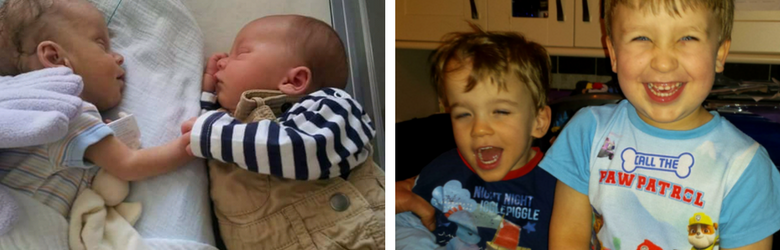
    January’s Story of the Month goes to, Kerrie Keen, 37 years old who talks about her son’s journey with cerebral palsy. Kerrie is married to her husband, Owen and is a proud mum to her 15 year old son and 4 year old identical twin boys, Cooper and Lucas. If you would like to catch up with our previous Story of the Month, please click here

    Owen and I discovered we were expecting twins in November 2012 at our first scan. Once we got our heads around the practicalities, we loved the thought of our twins always having each other, always having a play mate and sharing an incredible bond for life.

    April 2013, Cooper was born along with his twin brother Lucas. Cooper was the first born and weighed a little 4lbs 14oz and Lucas was born two minutes later weighing a big 7lbs 9oz. However, 5 hours after birth, Cooper was unusually sleepy and not feeding. After a pin prick blood test showed he had low blood sugar, he was taken to neonatal for the night.

    The seizures began

    Cooper young boy cerebral palsy

    Cooper began to have seizures and had dangerously low oxygen levels on the first night. He was then moved to intensive care and put on machines and a tube was put into his nose to enable feeding.  At 6 days old he was transferred to Glasgow Children’s Hospital for a MRI.  After the scan, a neurologist told us that Cooper had suffered grade 4 bleeding on the brain and would be severely disabled, if he survived.

    After transferring back to hospital, where the boys were born, Cooper began to fight back. His oxygen levels become steady and he stopped having seizures. However, the paediatric consultant told us they suspect Cooper has hydrocephalus. We had never heard of this! He told us Cooper might possibly need a shunt at some point.  We had never heard of a shunt but we decided to take each day as it came and see if we encounter this in the future.

    At 5 weeks old, Cooper left hospital.  He was finally well enough to come home. He was still being tube fed every 3 hours, day and night, which I found so difficult. The tiredness on top of trying to come to terms with Cooper being ill was such a trying time for us as a family.

    Having a VP shunt fitted

    Cooper young boy cerebral palsy

    November 2013, only 7 months old, Cooper was admitted to hospital in Glasgow to undergo his first brain surgery to fit a VP shunt. The aim of the shunt was to drain cerebral spinal fluid (CSF) from his brain down to his abdominal area where it would be absorbed. It was amazing to see the changes in Cooper only hours after this operation. A baby, who tightly clenched his right arm across his body, was now open handed trying to grab his milk bottle. This was an amazing day for us all. It was like we could start to see progress – a light at the end of a very dark tunnel. Cooper’s stability carried on and he became stronger and bigger over the next few months.

    June 2014, Cooper had another routine paediatrician appointment. The aim of this was to keep track of his development and physiotherapy which would help make him stronger. There was nothing unusual about this appointment, I gave an up to date account of what Cooper could do and what I felt he was struggling to do milestone wise. However, two weeks later, I received the summary letter of this appointment and my heart was broken. These letters always start the same, in bullet points, with the conditions which your child suffers.

    Coming to terms with a diagnosis of cerebral palsy 

    Cooper young boy cerebral palsy

    I knew about Cooper’s grade 4 bleeds on the brain and I knew about his hydrocephalus and VP shunt. What I didn’t know was that Cooper had been diagnosed with cerebral palsy. This was mentioned months before by another paediatrician as a possibility for the future, but it wasn’t mentioned at all during the latest development appointment. I will always remember how I felt reading for the first time that my 1 year old son had cerebral palsy. I was distraught. Everything seems to hit you that bit harder when it’s on paper after re-reading the letter. I contacted the hospital and said I desperately needed to speak to this paediatrician. He apologised and said I should never have found out that way.

    Such a major diagnosis which will last my son a lifetime, this shock is something that will stay with me forever. Cooper’s cerebral palsy has since been defined as quadriplegic cerebral palsy with dystonia. He is a little boy who struggles with increasingly tight muscular spasms, mainly in his legs but in his arms too.

    We can’t take things for granted

    Since, he has mastered being able to roll both ways which is fantastic! He’s unable to walk but recently Cooper has learned to sit upright propping up with his arms. A truly inspiring day for us all! He has coped brilliantly with everything and he never complains.

    What I have learned from having a child with a severe disability is that, we can’t take things for granted. The world of disability is so up and down and we never truly know exactly what’s around the corner. Even the smallest expectations are not a given. One day things can be calm and you feel like you are making progress. Then the next day, you feel like you are back at the beginning. You feel scared, uncertain and angry at the thought of your child having to struggle with every area of their life.

    Also, the world of disability can be so isolated. I feel extra worries and pressure due to having one able bodied twin and one severely disabled twin. It is soul destroying seeing one child leaving behind their twin developmentally, physically and emotionally.

    I try to keep positive and remember that Cooper is alive, that is the most important outcome for us.


    Read more about Cooper’s journey by visiting Miracles and Me on Facebook.

  • University Doesn’t Have to be a Challenge…

    University Doesn’t Have to be a Challenge…

    The following is a guest blog by AskJules, who are exhibiting at our Kidz to Adultz Middle event this year in March. This blog post will discover facts that you may not have known about AskJules along with their advice for those with a disability who are starting a new term at university.  

    Whilst the excitement of Freshers’ Week may help to suppress the anxieties of living independently for the first time, as the party dies down and reality kicks in – the stresses of university life can also begin to sink in.

    But there’s no need to panic, help is at hand. Chris Benoit-Pool, co-founder of AskJules, offers some guidance and advice on adapting to these changes and the key decisions which can make the difference in ensuring a successful university experience.

    AskJules is a family business, created in 2008 when Chris’s mother Julie Pool helped his younger brother Oliver, who suffers from Spinal Muscular Atrophy, to leave home and go to University. With Julie’s support Oliver has achieved true independence and enjoyed the full student experience. He lived independently in a lively student area of Manchester and employed his own team of PAs, who provided his 24/7 care and student support. He has recently started a PHD in London, where he lives with his girlfriend and two children.

    To view the full post please visit our Kidz Exhibitions blog.

  • Life with Muscular Dystrophy

    Life with Muscular Dystrophy

    This is a guest feature with Carrie Aimes, founder of Life on the Slow Lane, lifestyle and disability blog. Carrie has lived with muscular dystrophy for 29 years (her whole life). And we took the opportunity to ask her a few questions. 

    Please can you tell us a little bit about your disability?

    I have the progressive neuromuscular condition – Ullrich congenital muscular dystrophy (UCMD). It is effective from birth, and causes the muscles throughout my body to deteriorate over time. I was able to walk short distances, with the aid of leg splints, until the age of ten. However, I am now completely non-ambulant and therefore use a powered wheelchair for mobility.

    I have an ‘S’ shaped curvature of the spine that has not been surgically corrected. This has a great impact on my respiratory function, which is my primary concern these days. Throughout my life, I have experienced multiple bouts of pneumonia, pleurisy and acute pneumothorax (a collapsed lung), resulting in prolonged hospital admissions.

    Photo of Carrie Aimes

    What are your favourite hobbies?

    I’m a bit of a film buff and I listen to far too much music – if that is even possible? I’m very much an arty type – I love painting, drawing, crafts, and taking trips to the theatre. Here is where I’ll have to admit that, I’m a big Strictly Come Dancing fan!

    I also love to get out and explore. Sometimes it’s nice to just get in the car and drive, to nowhere in particular. I live rurally and so there are many winding, country lanes to investigate.

    If you could have any superpower in the world, what would it be?

    Wow, this is a tricky one. I think for me, it would have to be the ability to fly. I often feel restricted by the fact I am unable to get up and walk around, whenever and wherever I want. Being able to fly anywhere with ease would be so liberating.

    Overseas travel for me is quite a challenge! I would love to see much more of the world but I am very much put off by past experiences with air-travel. So, to simply fly myself to other countries would be pretty amazing!

    What’s the biggest obstacle you’ve faced with your disability?

    There have been many over the years – practical, social and emotional.  I think, for me, one of the main issues is trying to overcome societal preconceptions and attitudes towards people, like me, with disabilities. Even in this modern age, I would argue that I am in fact more disabled by society than my actual condition. By this I mean that, unnecessary limitations are inflicted on the disabled community through ignorance, a lack of accessibility, facilities and support. To overcome this, an increase in awareness, education and inclusivity is required.

    What inspires you most in the world?

    I’m inspired by certain people; their grit and determination. They need not necessarily be high-achieving academically, financially or career-wise. For some people, due to their circumstances, just getting out of bed or leaving the house is an overwhelming struggle, both physically and mentally.

    Life can be tough and sometimes you feel like you can’t catch a break. It’s easy to admit defeat and give in. But those who rise above adversity and face the challenges life throws at them, are the people who inspire me most.

    Thank you to Carrie for taking the time to complete this question and answer post. We’re sure you’ll continue to inspire others. To learn more about Carrie and Ullrich congenital muscular dystrophy, visit her blog: www.lifeontheslowlane.co.uk

    If you would like to feature on Disabled Living’s blog about your disability please send an email to: info@disabledliving.co.uk

  • Remap Are Changing Lives with Innovative Design

    Remap Are Changing Lives with Innovative Design

    This is a guest blog by Remap for Disabled Living.

    Remap is a charity that helps disabled people achieve independence and a better quality of life by designing and making equipment for their individual needs. Last year the charity helped over 3,500 people in this way and gave the equipment free of charge in every case. The charity has a network of skilled volunteers who design and make bespoke items to help people enjoy life more. 

    Chloe, for example, is only four years old but already loves horse riding and wants to ride alongside her big sister. However Chloe has cerebral palsy and cannot walk. She needs to improve her core strength if she is to ever walk and horse riding is a good way of achieving this, but she needs somebody to walk with her supporting her while she rides.

    The challenge to help Chloe ride independently was taken up by Remap Coventry and Warwickshire. Volunteer Stephen Boulter came up with a piece of equipment based on a chest cuff that goes under her arms. She can now ride unassisted, getting safe and effective support which promotes the use of her core muscles. Chloe can be released quickly and easily and the support is weatherproof, easily cleaned and lightweight.

    Chloe now rides alone, with her sister and wants to enter competitions – she loves it!

    Piano aid

    Another innovative design helped Linda get back to doing what matters to her. Linda is an accomplished singer and pianist and teaches both, so she was deeply affected when treatment for breast cancer left her unable to support her left arm or move it sufficiently to play, although her fingers were unaffected. She was unable to work and was left feeling very frustrated.

    Remap volunteer Alan Blundell from the Bournemouth group met Linda along with her OT Heidi Grant to discuss possible solutions. They came up with the idea of fitting a rail to the edge of the piano, then adding a wheeled wrist support like a truck that would run silently up and down the rail.

    Alan set to work, fitting the supporting rail from underneath so as to have the minimum impact on the appearance of the piano. The wrist support which runs along the rail is shaped to support Linda’s wrist with expanded foam and chamois leather. On trying out the aid Linda was immediately able to play without any trouble. She was delighted and was able to resume giving music lessons and playing for her own pleasure.

    Further information

    You can read more about these and other examples of Remap’s work on their website and discover more about this remarkable charity. There’s a contact page on the website to help you find your nearest group – with over 75 groups across England and Wales there should be one near you.

    Remap is a charity that provides custom-made equipment for disabled people of all ages, free of charge. For over 50 years, this unassuming charity has been quietly helping thousands of disabled people to live more independently. It has a network of over 75 groups across England and Wales, so there is probably help near you.

Disabled Living