Category: General

  • How Writing Poetry Changed Nicholas’ Life

    How Writing Poetry Changed Nicholas’ Life

    This is a guest blog by Lois Letchford for Disabled Living’s blog discussing how writing poetry has changed her son’s life. Lois’ dyslexia came to light at the age of 39, when she faced teaching her seven-year-old non-reading son, Nicholas. Examining her reading failure caused her to adapted and change lessons for her son. The results were dramatic. Lois qualified as a reading specialist to use her non-traditional background, multi-continental experience, and passion to assist other failing students. Her teaching and learning have equipped her with a unique skillset and perspective. As a teacher, she considers herself a “literacy problem-solver.”

    Living in Brisbane, Australia, my six-year-old son, Nicholas, failed first grade. The effects of going to school showed themselves through his quietness, his bitten fingernails, and the daily wetting of his pants. His teacher shouted at him for his slowness, his withdrawal, and his inability to follow the “simplest instructions.” Testing revealed he could read ten words, displayed no strengths, and above all, he had a low IQ. The prognosis was dire.

    An unusual opportunity arose. My husband was offered a study leave in Oxford, UK.

    Taking this opportunity to work with Nicholas in a one-to-one setting, I set myself up with a series of books titled, “Success for All.”

    They were an abject failure, and I was no better than his first-grade teacher.

    Faced with a blank slate, and no excuses, I thought about Nicholas’ strengths. I knew he could rhyme words and see patterns. With only these known skills, I thought about writing simple poems based around the consonant-vowel-consonant word patterns. I chose words which rhyme with bug, such as mug, lug, tug, and rug.

    The transformation in our little classroom was instant- no longer did I expect Nicholas to read anything. I read to him. Together we talked about the meaning of the poem, found the rhyming words, and finally illustrated the poem. Using coloured paper as a ladybug’s wings, and folded paper (with embellishments) for the rug, our enjoyment for learning intensified.

    One success led to another. And another. Every Nicholas was excited to read and play with yet another rhyme. We recited our poems as we walked his brothers to and from school. Each day we worked to retrieve those rhymes. His brain was being lined with language, also making the connection between words and pictures. Using poetry appeared to cocoon the sounds and help him with all aspects of learning to read.

    Every day, a new poem helped Nicholas make tiny steps forward in learning…

    After completing many poems using the short vowel sounds, the oo sounds as in cook, look, and book captured my imagination. My focus turned to Captain Cook, the last of the great explorers with the poem:

    Captain Cook had a notion,

    There was a gap in the map in the great big ocean.

    three sons
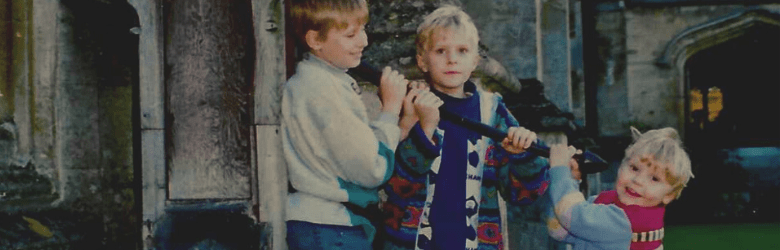
    Photo taken in Abingdon. Left to right: Isaac (age 3), Nicholas (middle age 7), Nathanael (age 10)

    He took a look, without the help of any book

    Hoping to find a quiet little nook.

    Captain Cook had a notion,

    There was a gap in the map in the great big ocean.

    He took a look and filled a whole book

    That caused the whole world to look.

    Living in Oxford and visiting museums, we encountered maps from the 1550s.

    “Look, Nicholas,” I said, “there’s a gap in the map. There is no Australia.”

    Our learning took a turn from writing simple poems to writing poetry for an inquiry project.

    I read the books and turned my learning into poems for Nicholas. I found this was the best way for him to access information, and poetry made for easy repetition, for questioning and tapping into his curiosity. Together we began to question – what knowledge did Captain Cook have when he left England?

    “Who came before Captain Cook?” Nicholas asked one day.

    “That’s easy,” I replied. “That was Christopher Columbus.”

    “And who came before Columbus?” he questioned.

    I stopped. I was stunned.

    nicholas and lois
    Nicholas and Lois in 2018

    Such a question had never entered my imagination, and for the first time, I knew my son did not have a “low IQ.” His questions told me he was “thinking.”

    Being in Oxford, with the world of libraries and maps at our fingertips, we searched for answers. Viewing maps in the local map shops aided our search. Discovering that Columbus’s travels were based on the maps of Ptolemy, led us to visit the Bodleian Library, hunting for more answers.

    Our investigation began in the gift shop, where a lady eager awaited our questions.

    “Do you know where we could find a Ptolemy map?” I questioned, with an anxious Nicholas by my side.

    The lady turned away from us, leaned against the counter, and scratched her head. Her eyes scanned the bookshelf. Finally, she bent down and retrieved one, large, blue-covered book.

    “This is a new book in our collection,” she said as she carefully placed it on the counter. “It’s a book of Ptolemy maps and only recently printed. Does this work for you?”

    Nicholas and I gaped.

    “Yes,” I replied as Nicholas grinned and nodded.

    Adding positive, enriching experience to our learning enhanced Nicholas’s curiosity.

    Our time in Oxford was completed with a memorable visit to the British Museum to see Captain Cook’s original maps and concluded our epic inquiry project.

    Returning home, Nicholas once again attended our local school. I was feeling on edge when I again met with the school counsellor.

    “Nicholas learned so much! I wrote poetry and he was so excited by our learning,” I gushed.

    “Well,” she replied, “he’s the worst child I’ve seen in twenty years of teaching!”

    Shocked, I left the room with my tail between my legs.

    This was not the end of the story, just the beginning of a new chapter.

    Advice for parents whose children are like Nicholas:

    Write for your children – write about their everyday experiences – what they see, hear, eat, or watch on YouTube.

    Write where you are with what you have

    Create books about their life

    Place the child as the central character of their story

    Take pictures to complement your writing

    Write in short sentences or poetry format

    Read and re-read to and with your child

    Recite the sentences or poems

    Record their reciting and sent it to relatives – if possible, ask relatives to respond

    If a child has a challenge recalling a particular sound, find words and objects which include it.

    Write about them in short sentences or rhymes.

    Write and read every day

    Remember:

    Learning is emotional, as well as cognitive.

    When learning is painful, sadly, that’s what children learn.

    When children are laughing, learning happens with ease.

    Once the process begins, one never knows where it ends…

    Grab a copy of Reversed: A Memoir to read the full story at https://amzn.to/3d2cNg5

  • Is Sport Really So Important?

    Is Sport Really So Important?

    Deborah Bell, Enablement Manager at Disabled Living talks about the importance of sport and how it can help you to stay active during the Covid-19 lockdown.

    Yes, sport really is so important because it can develop from exercise! Having been in lockdown for the last few weeks, with one of the few reasons we can venture out, being for exercise, Deborah Bell, Disabled Living’s Enablement Team Manager, has reflected on her involvement in sport as a child, and that of her now adult children.

    Sports England’s Active Lives Research

    According to Sports England, Active Lives Children and Young People provides a world-leading approach to gathering data on how children engage with sport and physical activity. The aim is to enable “children and young people to feel more motivated, confident and able to get active”.

    I thought about my attitude towards sport as a child, my bike was my life, every day in the holidays and after school I could be found freewheeling down the steepest hill I could find, with the scars to prove it. I wasn’t very competitive at school although I was on the hockey team as I was a fast runner.

    As an adult running was my choice of sport, I could lose myself for hours running miles around the town I lived in. It all stopped when I developed an injury as a direct result of my running. I now do no sport and am feeling the consequences. But enough about me. How would I have felt as a child if I couldn’t ride my bike because there wasn’t one adapted for my disability?

    There is an abundance of research proving the various benefits of sport on physical, and emotional health, social value and economic benefits. See the Sports England Active Lives survey: https://www.sportengland.org/research/active-lives-survey/active-lives-children-and-young-people/

    What I am interested in is how we can help to motivate children who are disabled to become more active, it needn’t be a classical sport, it could be gardening or playing outside in the garden. Disabled children often have additional challenges when it comes to things the rest of us take for granted and whilst the range of disability sports has improved massively it can still prove difficult if you have a physical or psychological disability to find the right activity for you.

    How Can We Encourage Our Children to Get Involved With Others Playing Sport?

    We can involve them in what we are doing. We did things as a family so they could learn what motivated us, if we were going somewhere, we talked about it, we read about it. We invited friends so the kids were with their peers.

    When my children were young, I tended to lean towards the things I was interested in, I remember the moans as I made them walk up Ben Nevis one summer. It is only now they are grown up that I hear the pride in their voices if they are talking about it.

    I don’t think it matters particularly what your children are interested in doing, it may not be what you are interested in, but we should encourage and support them as much as possible. I wanted both my children to choose what they wanted to do. My son showed an interest in rugby as a young lad so I rang the local club and duly turned up on a cold Sunday morning so he could run about an extremely muddy field with lads just like him. It caused much amusement for the parents that they were all more interested in the ladybirds under a log at one end of the field than they were in the rugby ball, but hey ho.

    My son likes routines, A LOT so we turned up come rain or shine for the next 7 years, we went in convoy to play neighbouring teams and ate enough bacon butties to feed an army. My son hardly ever touched the ball but that didn’t matter, to him or to me. I encouraged him every game.  He kept all his teeth intact and more importantly built a group of friends he still has today. The teamwork and camaraderie did wonders for his self-confidence, having to stand up for himself in a group of peers was immensely influential  to him becoming a rounded confident adult. He developed a habit of wanting to be fit, now he goes to the gym and boxes, (his teeth are yet again in danger).

    My daughter watched a lot of rugby games, kudos to her for putting up with the rain and snow every week, she was more interested in music than sport but the habits of the family and our attitude to being healthy has impacted on her keep fit routines as an adult, she goes walking , sometimes in the hills and sometimes around the shops  but she is very active.

    A number of Disabled Living’s blogs have concentrated in young disabled people who have overcome whatever challenges they have faced to do a sport they love. You may find a tip on how to motivate your child (or yourself). Sports activities and companies who exhibit at our Kidz to Adultz exhibitions have some great ideas and solutions for you to help your child become involved in sport.

    Have a look at the sensory section of our Supplier Directory for companies who provide toys and outside play equipment. The charities on our Supplier Directory can link you up to organisations in your area who can support you and your child with sport.

    Good luck in your endeavours to introducing sport to your family life, no matter how small it will only be a good thing.

    Get in Touch with Disabled Living

    Our helpline is open if you need to contact us on 0161 214 4590 or email: info@disabledliving.co.uk. You can also join our #DisabledLivingAgainstCorona campaign on Facebook and Twitter.

  • Abbie’s Story About Running a Business With Cerebral Palsy

    Abbie’s Story About Running a Business With Cerebral Palsy

    This is a guest blog by Abbie Hills, 24 year old from Hampshire. She talks about her experience of running a business with cerebral palsy. 

    About Abbie Hills

    I was born with cerebral palsy (mild), which is something I never understood growing up as I found myself being placed in a grey area of being almost able. Throughout my childhood and early teens I would notice that I got tired much quicker than others, and had persistent pains and could not understand why. When I got my first part time job, I noticed that even working a small shift in a tiny hair salon trying to sweep the floor was a challenge.

    I had never been particularly physical (shying away from sports days and other activities in school) but I always had a love for film and tv. Wishing to pursue a career in one of the most fast paced and physically demanding industries there was, I started acting in short films and doing work in small television roles. While this fulfilled a small part of my dreams, it would often leave me wiped out and fatigued for days after.

    Continuing my studies through university (BA Film) I realised I also had a passion for writing. This allowed me to create scripts and stories out of my ideas and watch them come to life – but I still wondered, how did people with disabilities manage a career in Film and TV?

    Fast Forward

    While I was proud of myself for finishing my degree and making a few short films during it, I was worried about what would come next. I knew working in a production role full time would not have been manageable for me, and moving away from my hometown was not an option, so I decided to further my knowledge of the Arts so that I could be in a position to start my own business (MA Arts Management).

    I had always had a thought in the back of my mind that the industry I planned to go into was not yet inclusive, so I wondered what I could do to change that, and throughout my course I picked up business skills and then took the plunge – launching my own Talent Agency and Production Company The Dazey Hills Company. With the experience I had gathered over the years in front and behind the camera I felt that I was in a good position to help others get into the industry.

    portrait picture of abbie hills

    The ethos behind my company is ‘Real People. Real Talent’ and I take pride in offering opportunities to people of all abilities and experience levels, as someone with cerebral palsy this has always been something close to my heart and something that I will continue to believe in throughout my career.

    I have secured paid industry work for people with no prior experience, and continuously look for people with passion in what they do. The nature of my job fortunately means that I can work from home which allows me the chance to have ‘off days.’ All of my clients have an understanding of what cerebral palsy is and alongside finding them work I am happy that I have been able to raise awareness for CP.

    Running my own business has given me a lot of help with recognising my own strengths and weaknesses, while also giving me an understanding of how to manage my condition as a young adult. I still get pains and fatigue regularly, but working on gentle yoga (although my balance isn’t great) between working has really helped.

    As I still act and make films alongside what I do, I have developed strategies in how to help myself while on set. Often the hours can be long, and there can be a lot of waiting around but I will always take simple measures such as making sure I have somewhere to sit and making sure that I keep myself hydrated (sometimes I take hot water bottles or heat patches to set to help with leg cramps). Where possible, I like to make sure I can plan a rest day after a day or two of shooting.

    Looks Towards the Future

    In the future I hope to broaden my client base, while also working with other disabled artists, performers or writers to build a support network and also assist them with securing work in their field. I am proud of myself for how far I have come, and how I have adapted to build my dream job, and I look forward to what the future holds for me and The Dazey Hills Company.


    If you would like to share your story with Disabled Living, please email info@disabledliving.co.uk and a member of our marketing team will be in touch.

  • World Art Day – Celebrating the Power of Art for All Children

    World Art Day – Celebrating the Power of Art for All Children

    Neve Spicer from We the Parents is one of our new guest contributors on Disabled Living’s blog. Neve is a passionate advocate for art, play and creative learning. She talks about the benefits of learning art to coincide with this year’s World Art Day.

    Today, on Leonardo da Vinci’s birthday, people around the globe are celebrating World Art Day. It’s a perfect time to acknowledge and appreciate the power of art and arts education in all our lives.

    Art: A Field of Equals

    All children learn differently. For some disabled children, these learning differences can make it more challenging to engage in and enjoy the same activities as their peers. But when it comes to art and creative expression, each child is on a level playing field.

    The essence of art is self-expression. For as long humans have been around, they have used it to communicate feelings and ideas, the very nature of which are personal and subjective. Like all others, disabled children have a deep well of personal experience and imagination to draw upon. They are at no disadvantage. And, what’s more, there isn’t the pressure to conform or do things in the same way as everyone else.

    The Benefits of Arts Education

    For all children, learning arts cultivates cognitive abilities, nurtures positive character traits, and fosters critical thinking. It expands awareness, increases empathy, and develops an array of social skills. What’s more, the arts allow learning opportunities and expressive possibilities for students who don’t always fit the traditional academic mould. And that’s just the start! This visual guide highlights an incredible 51 powerful ways that learning arts reward children and young people.

    51 benefits of art educuation for kids

    Creating Space for Art in the Home

    A great idea is to designate a space for creativity and art in your home. This can be a whole room or a portion of one. The important thing is that it remains a permanent art zone where children have easy access to the tools and materials to create their mini masterpieces. A wipe-clean table is ideal and there must be plenty of storage to keep pencils, pens, and everything a creative mind may be inspired by. A devoted display area will also help kids to take pride in their work. It can be as simple as a string and pegs.

    Allowing Children to Do It for Themselves

    Avoid the impulse to continually step in as a disabled child first learns how to use and manipulate new art mediums. It is important that they are given space to explore and use their problem-solving skills as they get a feel for paints or clay or fabric or any myriad of different materials and tools. This will lead to greater learning and personal satisfaction as they create their art independently with minimal adult intervention.

    Visit We the Parents to discover more interesting articles on Neve’s blog.

  • Supporting Your Disabled Colleagues in the Workplace and During Covid-19

    Supporting Your Disabled Colleagues in the Workplace and During Covid-19

    Sponsored post sent to Disabled Living by Minton Morrill.

    This blog article will take you through some of the ways you can support your disabled colleagues in the workplace and through the current Covid-19 pandemic.

    Whether it be a congenital disability from birth, something that’s been brought on by a spinal injury, or a condition that’s developed over time, disabilities are important to learn about. Here are some tips for ways you can make your workplace more inclusive…

    Top Tips for Supporting Your Disabled Colleagues in the Workplace

    1. Educate Yourself

    First and foremost, educating yourself is key. This can come from trying to learn more about the condition your co-worker has. You could do this through online research, or simply by asking them questions.

    Just be mindful when doing so; I’m sure your disabled co-worker will be happy to answer your questions, but don’t fixate on it. Once you’ve asked your questions, move on to something you’d discuss with any other colleague.

    2. Explain Things That May Seem Obvious

    When it comes to co-workers with additional needs, like autism, it may take them a little longer to get to grips with their new surroundings. So, anything that may seem obvious to you, like where to put your lunch, or where to keep your mug, may not be clear to others. To tackle this, when giving the office tour, be sure to show your new colleague everything there is to see along the way.

    3. Speak Up for Your Colleague

    If you notice any discrimination within the workplace, including bullying or exclusion, making sure to speak up is so important. You should also report this to your line manager.

    4. Be Aware of the Language and Terminology You Use

    The language you use to interact with or discuss disabled people must be taken into consideration, to ensure inclusivity. Some important ways to talk about or address your disabled colleagues inside and out of work could include:

    • Mention the person first, and the disability second, e.g. Maria, who is blind.
    • Negative words should be avoided, for example ‘afflicted’, ‘ailment’, ‘bound’, and ‘confined’.
    • Talk about ‘disabled people’, not ‘the disabled’, as people with disabilities are individuals, and shouldn’t be lumped under this collective term.
    • Don’t patronise the individual.

    5. Don’t be Afraid to Offer Assistance

    If you can see your disabled co-worker struggling with something, be it work related or general accessibility, don’t be afraid to help. Just make sure to ask if they need your help in the first place, so you can make sure it isn’t unwanted. It may take them a little longer to do things, but that doesn’t mean they can’t do it. With this in mind, don’t rush your colleague with anything they do.

    6. Make Out of Hours Time Accessible

    Wanting to get everyone together to do an out-of-work activity? Then and try and ensure wherever you’re going is accessible. This is a thoughtful way to let your disabled colleagues know that you want them involved. By thinking that extra little bit about where you go for lunch, drinks, or activities after work, this is not only inclusive, but kind too.

    7. Communicate

    Open communication is the key to any relationship, and this is especially poignant with your disabled friends and colleagues. If you have any questions, ask them. If you’re wondering what’s holding them up with a certain piece of work, mention it.

    How Can You Provide Extra Support for Disabled Colleagues During COVID-19

    hand comforting a young woman

    Covid-19 has put a real spanner in the works for many people, especially for disabled people, who have been advised to remain housebound, just like the elderly. In many cases, your co-workers may also be your friends. With this in mind, we all want to do everything we can to support one another through these times. So, how can you go that extra mile for your disabled colleagues and friends?

    Physical Support for Disabled Co-Workers

    Disabled people can be more at risk than others, so may need more help around the house. What’s more, if their usual support network, for example parents, friends or carers, cannot leave their own homes, they may require a bit of extra support. Some great ways you could help your disabled co-workers during lockdown could include:

    • Offering to collect their groceries for them;
    • Seeing if they need any help with accessing medical care and/or medication;
    • Picking up protective equipment, like masks, soap, and hand sanitiser;

    In all these cases, it’s important that you make sure to follow government guidelines on social interaction. This always includes taking precautions to avoid contact with the person and remaining two metres apart. So, to tackle this, make sure to pass groceries, medication etc. without touching one another.

    Mental Support for Disabled Colleagues

    Supporting one another mentally should also be a priority, whether your friends and colleagues are disabled or not. As humans, we are so used to making social contact with people day in and day out. Ensuring to remain in contact with all your colleagues is so important. Whether it be by text message, email, or video chat, picking up the phone or laptop for a chat here and there certainly won’t go amiss.

    Do you have any tips and advice you’d like to share for supporting your disabled colleagues? Send your comments further below or follow.

  • Caring for a Child with Spastic Quadriplegia

    Caring for a Child with Spastic Quadriplegia

    This is a guest blog post written by Catherine Atkins for Disabled Living. Catherine and her son Jack are regular visitors at our Kidz to Adultz Middle event. Jack has spastic quadriplegia, a type of cerebral palsy that effects all four limbs.

    In 2010 I was delighted to find out that I was expecting my first child via sperm donor. I’m in a same sex relationship but had been desperate for children for years. The pregnancy was perfect, I thoroughly enjoyed getting bigger and showing that I was obviously pregnant. I loved all the extra attention I was getting and was over the moon when I got to feel the first kicks. The midwives were happy with how things were progressing and actively encouraged me to have a water birth at a midwifery run unit in Birmingham.

    Giving Birth to Jack

    I went into a natural labour 11 days after my due date and the water acted as a wonderful source of pain relief. Jack was born pretty easily in the water. However, he was a funny colour when he was pushed under the water to me and he was not breathing or moving at all. Jack had managed to get his umbilical cord wrapped around his neck twice and suffered a lack of oxygen for over 20 minutes. The next 9 hours were the most painful of my life.

    Jack was taken away to be resuscitated whilst my partner and I waited for news as to whether he would pull through. We were eventually called into a small side room to talk with the doctor. They confirmed that due to the lack of oxygen Jack had suffered, it was extremely unlikely that he would survive the night and if by some miracle he did, then the brain damage would be that great that he would have no quality of life.

    A Smile that Melts Hearts

    Jack was transported to another hospital to receive cooling treatment for 72 hours, which is where his body temperature is kept at a lower than normal rate in order to prevent any further brain damage. Every morning we waited for the doctors to do their rounds and every morning it was touch and go whether Jack would survive the day. At one point it was looking likely that he had renal failure and we were told that would almost certainly mean the end to our precious bundle. Fortunately for us all, Jack is made of extremely strong stuff and he pulled through and has gone from strength to strength. His smile melts everybody’s hearts and his cheeky sense of humour is hilarious.

    Admittedly he is still classified as severely disabled as he is unable to walk or talk. He has spastic quadriplegia, a type of cerebral palsy that effects all four limbs. He has minimal head control and abnormal arm movements. His legs are extremely stiff and his feet are misshapen. Jack is fed purely through his PEG as he has a very poor swallow and no gag reflex which makes any attempt to eat or drink extremely dangerous. Jack also has a nasal pharyngeal airway (NPA) in permanent situ. This is because his tongue muscles are weak and his tongue will flop over his airway if it is not held back by the NPA.

    Catherine and Jack

    Jack’s Epilepsy

    So yes he isn’t without problems. However the biggest challenge we have and are facing at this time is Jack’s epilepsy. The epilepsy began just before his third birthday. One night we were all asleep (Jack has always slept next to me as he requires regular suctioning throughout the day and night), I woke to find that Jack was having a full on tonic clonic seizure. Having never had any experience with seizures in the past, we weren’t really sure what was happening so we called an ambulance. The seizure lasted over 40 minutes and was terrifying but the doctors managed to stabilise him eventually and he was allowed home the following day.

    A Learning Curve

    Since then Jack has been in and out of hospital with various types of seizures. I learnt early on to ensure I knew the correct way of pronouncing the names of the cocktail of medications that Jack was taking in order to gain any kind of confidence from the number of doctors we met along our journey. The professionals I have met along the way have taught me so much. We were lucky enough to have a friend who is the best paediatric physio in the world (in my opinion anyway) and she has helped us immensely. Without her, I know we would not be where we are now so a huge thank you to Alison.

    I have often been asked if I have a medical background due to being able to spout out so much information about Jack’s condition and spastic quadriplegia. This couldn’t be further from the truth, I used to faint at the sight of needles or blood and couldn’t even watch casualty on the television! When you’re faced with such a situation you learn so much as you go along.

    I’ve watched Jack go through having 8 large needles of Botox injected into the backs of his legs twice a year in order to help with his spastic quadriplegia. I change Jack’s PEG every three months (although I admit I still feel rather queasy when faced with an unnatural gaping hole leading straight into his tummy but every time I change it I’m getting that bit better), I can change his NPA with my eyes shut and do things that no mother should ever have to do.

    The Most Rewarding Job

    I would have had to return to work if Jack had been born healthy. However, because of the situation, I gave up my job and became Jacks full time carer, the most rewarding and wonderful job ever. I’ve since gone on to have a beautiful daughter and a rather mischievous little boy. When my third child was born we arranged to have his stem cells collected from the placenta in the hope that one day Jack might be stable enough to travel to America to have stem cell treatment. There’s no guarantees but a stem cell treatment may help improve Jacks abilities.

    What I am trying to say is that you can do anything when you really put your mind to it. Whatever life throws at you there are always ways to turn negatives into positives. If ever I feel a bit down, Jack’s beautiful smile turns my frown upside down! I am one extremely lucky mummy!

  • Best Accessible Days Out in Greater Manchester

    Best Accessible Days Out in Greater Manchester

    This is a guest blog for Disabled Living, written by Patricia McCartney.

    Are you looking to find accessible days out for you and your family? Supportability have got you covered! Whether you’re looking to keep the kids busy over the summer holidays or just want to make the most of the weekend. 

    This blog post starts with detailing some of the best accessible days in Greater Manchester. Further into the blog post there is information going to look some accessible days out across the rest of the UK.

    Best Accessible Days Out in Manchester

    iFLY Indoor Skydiving, Manchester

    If you’re looking for an adrenaline pumping activity try visiting iFLY Manchester. The staff are experienced in dealing with disabled people using their facilities, and encourage visitors with physical disabilities to try indoor skydiving.

    The best idea is to contact the centre in advance so they are aware you are coming so they can make sure to allocate the time and attention needed. With this in mind if you can book on weekdays when the centre is less busy, we would recommend doing so.

    In terms of parking you have three Blue Badge Spaces in the car park that are near the entrance. The building itself is fully accessible, all levels are connected with good size lifts, with three accessible toilets available.

    When it comes to the activity itself one carer is allowed to enter the flying zone free of charge. However, in the flight chamber itself only the instructor will be with you at all times.

    Museum of Science and Industry, Manchester

    If you’re looking for a more relaxed and educational day out the Science and Industry Museum is a great option.

    The museum is spread out over five nineteenth-century buildings, which may initially put you off. However, the whole site is wheelchair accessible with smooth paths connecting the different areas.  There is also step-free access to all floors of their multi-level buildings.

    Wheelchairs can be borrowed (£20 deposit required) and the staff are very willing to help. All multi-level buildings are served by lifts, and most buildings have disabled toilets.

    The museum always has something on, and regularly provides special exhibits and events during half term weeks. So, it could be a great option for the kids.

    If you’re thinking of going check out https://www.scienceandindustrymuseum.org.uk/visit/facilities-accessibility so you can familiarise yourself with the museum and its facilities.

    The museum also offers free personal assistant/carer tickets for paid events and exhibitions. These are available to book online, by phone on 0333 241 4000 or in person on the day of your visit.

    Disability Cycling with Supportability, Stockport

    Supportability Wheelers project offers weekly cycling opportunities throughout the year for disabled and able-bodied adults, children & young people. The Project has a variety of adapted cycles to enable individuals of all abilities to experience and enjoy cycling.

    Over the past few years the project has supported nearly 400 disabled adults and 125 disabled children at Woodbank Park in Stockport. This is where UK Para-cycling Champion Katie Toft who has Cerebral Palsy started her cycling days.

    Many of the disabled children and adults who use the project have complex needs. The cycles are specially adapted, so everyone can join in and have fun, whilst getting some healthy exercise!

    Carers and parents can also drop in at Wheelers Café during the disability cycling sessions to meet and socialise

    Royal Exchange Theatre, Manchester

    Another laid back but fun night out is on the cards here at the Royal Exchange Theatre. The building itself is one of the most unusual theatre designs in the country, but this doesn’t stop it being accessible.

    The theatre has wheelchair spaces offering excellent, unimpeded views of the action, plus a lift providing level access to all floors.

    You can check out all the accessible performances at: https://www.royalexchange.co.uk/access

    Chill Factore, Manchester

    Chill Factore is actually home to Disability Snowsport UK. They provide adaptive skiing for individuals with any disability. By using adaptive equipment and specialist instruction and support they are able to cater for even those with very limited mobility.

    The entrance is approx. 10m-20m from the accessible parking spaces. The path leading to the main entrance is approx. 8m wide and made from levelled concrete. There is free on-site car parking available for all guests.

    There are 9 toilet blocks with each one having a disabled access toilet with non-slip flooring.

    You can find all the information you need on the link: https://www.chillfactore.com/plan-visit/accessibility/

    National Football Museum, Manchester

    If you’re planning a day out for some football fans, then the National Football Museum could be the perfect pick.

    The museum offers great accessibility to all disabled visitors. Lifts, ramps, and accessible toilets are common throughout the building.

    There’s seven levels of football heritage and memorabilia to be explored here. You can even listen to the historic commentary on some of the greatest moments in football.

    Visit the accessibility page of the National Football Museum for more information.

    Rest of the UK

    If you’re looking to travel a bit further there are some great days out you can have throughout the rest of the UK. These are our favourite picks.

    Cadbury World

    Perfect for those with a sweet tooth! During your visits you’ll learn about the history of Cadburys, watch the makers at work and, of course, eat chocolate!

    The disabled facilities are suitable for people with all needs. There are low-level desks, ramps, lifts, disabled toilets, tactile surface level indicators, large print guides and an infrared system for hearing aid users.

    You can find out more information on the Cadbury World website.

    Avon Tyrell

    All of the activities at Avon Tyrell have additional equipment to support those that need it.

    The hoists and adapted equipment used on site means that you can zip wire across the lake, climb our climbing wall, take part in tree climbing, shoot an arrow in Archery or canoe/kayak across the water.

    They offer over 40 activities to choose from. They even offer accessible adventures you can get involved with.

    You can find more information on the link below

    https://www.avontyrrell.org.uk/accessibility.html

    Other ideas

    Festivals

    confetti in the air at a concert

    If you’re looking something epic to do over the summer holidays a festival could be your answer. Some of the biggest festivals in the UK provide great access options.

    Checkout the ones below:

    Edinburgh Fringe festival accessibility

    Latitude festival accessibility

    Bluedot festival accessibility

    Greenbelt festival accessibility

    Zoos

    three lions in safari

    Days out at the zoo never disappoint. There are approximately 54 zoos and wildlife parks in the UK.

    The top 3 are worth checking out are:

    Whipsnade Zoo

    London Zoo

    Longleat Safari Park.

    Other wildlife parks that have been positively praised by disabled visitors include the Five Sister Zoo near Livingston, Yorkshire Wildlife Park.

    What are your favourite accessible days out in Manchester and the rest of the UK? Tell us on Twitter or Facebook.

  • 6 Accessible Travel Hacks for Wheelchair Users

    6 Accessible Travel Hacks for Wheelchair Users

    This blog post has been written by Stuart on behalf of My Baggage for Disabled Living.

    Finding accessible travel options as a wheelchair user can sometimes be frustrating and difficult. It’s impossible to prepare for every situation. All you can do is try and prepare as much as possible and give yourself a break, this is your holiday after all! We’ve put together six accessible travel tips to help ensure your trip goes as smoothly as possible.

    Before you book your flight

    It’s important to ensure that the airline you are travelling with has comprehensive information for passengers who are wheelchair users. Each airline policy will differ and if you are flying outside the EU you may not be covered by disability laws. Some airlines will have restrictions on the size of electric wheelchairs, so when in doubt always contact their customer services.

    If you need assistance both on and off the aircraft when you are booking your flight, tick the airport assistance checkbox. Every airport will have this service available, but the service will differ. When choosing your seat, some wheelchair users prefer the window seat to the aisle, as anyone requesting special assistance is boarded first onto the plane. Remember that this also means you will be the last to leave the plane as you will have to wait for airport assistance. This is important if you have an onward flight to catch, so always allow for this delay when booking long-haul or connecting flights.

    Avoiding wheelchair damage

    Your wheelchair is an important part of your mobility and the last thing you want is to discover it has been damaged in transit. One way to try and protect your wheelchair is to include written instructions attached to it, explaining how to break it down and how the chair lifts and tilts. A fragile sticker also goes a long way. Before you hand your wheelchair over, remember to remove any parts that can be removed such as the seat pad, footrest or wheels. You will be able to carry these items on board the plane and they will not count towards your hand luggage.

    To always protect yourself, take photographs of your wheelchair prior to handing it over to airport staff. This way, in the rare occasion that your chair is damaged, you have before images. If the worst does happen and your wheelchair is damaged, take images immediately and include them, alongside the before journey images and contact your airline’s customer service team as soon as possible.

    Accessible bathroom issues

    This is a real problem for wheelchair users when flying. Most domestic, short-haul flights will not have an accessible toilet available or an aisle wide enough to accommodate a wheelchair. Before booking a flight, confirm whether they have an on-board wheelchair or an accessible bathroom. This will usually only be available on long-haul flights or on bigger aircraft, but every airline will have its own policy. It’s important to remember that air stewards will not assist in transferring you into the bathroom but will be able to push your wheelchair. When in doubt confirm with your airline or with special assistance at the airport prior to departure. Accessing accessible bathrooms is a real struggle for wheelchair users no matter what mode of transport. To learn more about this, there is a great blog called Wheelchair Travel, which outlines what airlines cater to wheelchair users.

    Luggage shipping

    Travelling through the terminal with your luggage whilst in your wheelchair can be incredibly stressful. A popular way to combat this is through shipping your luggage directly to your destination. This will mean you will not have to navigate the airport with your suitcase in tow or worry about making it in time to the arrival’s carousel. Luggage shipping is very easy, all you have to do is arrange for a courier company to collect your items from your home and ship it to your forwarding address where you will spend your holiday, leaving you one less thing to worry about. One concern is the cost, but luggage shipping can often work out cheaper than the cost to store your luggage in the hold.

    Finding accessible accommodation

    Finding accessible accommodation has gotten a lot easier thanks to many hotel comparison sites like booking.com and hotels.com. These websites give wheelchair users the option to search for a place that is wheelchair friendly. Enable this option so you can ensure that the room you pick is entirely accessible. When in doubt you can contact the hotel directly or when booking via a comparison website, you can add this request in the booking requests option.

    Accessible activities

    Once you arrive at your destination and check into your accessible hotel, the next hurdle can be finding accessible activities to enjoy. Many destinations will have a dedicated tourist website which will cover facilities and tourist sites that are fully accessible. They will also provide information on accessible transport to reach these sites and any further information you may require to put your mind at ease. Websites like VisitEngland and Accessible Travel Netherlands offer advice and information for wheelchair users.

    If you don’t want to go on an independent holiday, there are plenty of tours, cruises and package holidays that cater and provide accessible activities. An example is a Responsible Travel, who offer responsible adventure holidays which are also accessible. You can go on a trip to explore the wonders of Ancient Egypt, enjoy an island resort stay on the luxurious Maldives or even go in search of mountain gorillas in Rwanda. The world is your oyster and there are many destinations and tour operators out there who will cater to a variety of needs and ensure you have the holiday of your dreams.

    Destinations that are wheelchair accessible

    When deciding where to go, you might wonder what destination will even be able to cater for you and your wheelchair. To help inspire you, the following destinations are wheelchair accessible; Lisbon, Amsterdam, Krakow, Israel, Ecuador, Morocco, South Africa, Slovenia, Barbados and Dubai.

    Although there may currently be extra travel restrictions due to COVID-19, travelling is still possible. Make sure to check how to travel responsibly before you set off in Love Holidays’ COVID-19 Tourism Travel Guide.

  • A Tribute to Fred Booth – Longstanding Trustee of Disabled Living

    A Tribute to Fred Booth – Longstanding Trustee of Disabled Living

    It was with great sadness I learnt of the passing of Fred Booth.

    Fred was one of the longest serving Trustees of Disabled Living and had joined the Board when the future of the charity looked very bleak. In the early days he was instrumental in raising funds through a number of events he helped to organise. His efforts certainly meant Disabled Living could survive those difficult times and become the strong organisation it is today.

    When I joined, Fred had already been involved with Disabled Living for probably 2 years and I always found him someone who was always willing to help solve a problem, whatever is was and in whatever area of life. I was trying to organise a football legends evening for the company I worked for. A quick chat with Fred, a meeting with Gary Owen, who is now a trustee too, and the event went from a vague concept to one of the best evenings our customers had. None of it would have been possible without Fred’s involvement.

    Not long after that, I remember Fred coming to a Disabled Living meeting, saying he was going to be a pop star and would have a number one record. He was involved in producing a record for the 2014 world cup, shot in The Printworks, involving a number of Manchester celebrities. In keeping with his caring attitude for others less fortunate, any profits the record made would go to charity. I honestly don’t know if it got to Number 1, but I am sure it raised a lot of money. I have even managed to find a link – see below.

    We will never be able to replace Fred on the Board, he was a one off, great character, considerate and fun loving, always able to offer sound, intelligent advice.

    I have no doubt he has managed to get the best seat in the house to watch his beloved Manchester City from above.

    Fred, thank you. You will be missed.

    Dean Styger
    Chairman, Disabled Living

    It was both an honour and a pleasure to work with Fred, both as a fellow trustee of Disabled Living and as a proud Mancunian.

    One of my fondest memories was during my time as High Sheriff of Greater Manchester, when my wife Joanne and I were invited to visit Volition, a charity which was launched by Manchester Cathedral.

    group photo with fred and gerry
    Group photo for Volition launch

    Volition believes that volunteering can play a huge role in tackling poverty and  social exclusion, ultimately reducing unemployment. They upskill, retrain and move their volunteers on to bigger and better things, with the support of an extensive and award winning Employer Partnership.

    Fred, as director, had allowed Volition to create a roof garden at The Printworks where volunteers grow all sorts of luscious vegetables.

    He proudly showed us huge cabbages and cherry tomatoes grown by hydroponics (in a watery solution of mineral nutrients instead of soil). There were also four hives full of hardworking Manchester bees.

    scenery of Manchester
    View of roof garden

    It was such a beautiful and restful place, with bees, butterflies and lots of delicious looking vegetables and fruits. A little oasis in the centre of the city.

    It is also Fred to a tee, always looking for a way to help people and to give something back to Manchester.

    He was a very generous and special man, who will be sorely missed.

    Gerry Yeung OBE, DL
    President, Disabled Living

    Fred was approached to head up a Fundraising Committee for Disabled Living called the Big Hitters in 2002 and attend Trustee meetings and subsequently joined the charity as a Trustee in 2005.

    Fred had the most amazing ‘little black book’ of contacts due to his business and network connections around Manchester. Over the years there had been challenging times for Disabled Living and Fred was always very generous with his time to help us find solutions. We had a major fire at our premises Redbank House, Cheetham in 2009 and Fred was able to guide me in very unfamiliar territory with contractors, insurance people and anything that could and did crop up. As Disabled Living went from strength to strength Fred was always available to offer a guiding hand as we embarked on new projects.

    Fred was a very kind man, with a big heart and will be sadly missed.

    Debra Evans
    Chief Executive, Disabled Living

    The Printworks are raising £30,000 to purchase new Dialysis machines

    Fred’s colleagues at The Printworks have set up a donation page on behalf of Fred’s family in hope to raise enough funds to purchase a new Dialysis machine for the hospitals that tended to Fred. If people would like to contribute it would be greatly appreciated.

    To make a donation visit: https://www.justgiving.com/crowdfunding/dialysismachinecalledfred

  • 7 Sports Activities for People with Disabilities

    7 Sports Activities for People with Disabilities

    This is a guest blog for Disabled Living by Heidi Jones, who outlines 7 sports activities for people with disabilities. 

    Over the past couple of years, sports accessibility has increased for those with disabilities. Since the first official Paralympic Games in Rome 1960, more avenues have opened up for disabled people to showcase their talents. As a result, decorated careers have been made from the Paralympic Games and other disability-based championships.

    Aside from the Paralympic Games there are hundreds of different sports and workout routines that a disabled person can experiment with to ensure they stay in top shape, physically and mentally. Read on to discover more about these activities.

    a disabled person in a wheelchair

    Image Source

    The State of Disability and Sport

    According to recent statistics, around 17% of adults with long-term disability or illness participate in weekly sports activities.

    However, the question isn’t about their unwillingness to engage in physical fitness and sports activities. Instead, it has a lot to do with poorly-equipped gyms, inadequate disability-based competitions, and a few other limiting factors. As a matter of fact, a poll that was conducted by Parallel London revealed that up to 83% of disabled people long to participate in more physical activity than they currently do.

    Top 7 Disability-friendly Sports and Fitness Activities

    1.Sit to Stand

    Sit to Stand is a workout that’s suitable for people with a disability that weakens their lower bodies, hence the need to improve the strength around those areas. Examples of such conditions include multiple sclerosis (MS), rheumatoid arthritis, motor neuron disorder, obesity, peripheral neuropathy, Parkinson’s disease and fibromyalgia.

    Procedure:

    1. Perch your bottom on a chair near the front edge, while ensuring your feet rest flat on the ground and behind your knees.
    2. Gently tilt the upper portion of your body forward and make as if to push yourself up into a standing position.
    3. Return your body to the seated position that you started in.

    You may find it difficult to perform this exercise using your arms, especially when it comes to the part where you have to push yourself up. In that case, your knees might come in handy. Just place your hands on top of the knees and try to push yourself up.

    Also, if the disability has severely compromised your legs such that they can’t lift your body at all, you can always make use of a support. Think of a worktop, a crossbar, or a grab rail. Using these support frames, you can now exert as much force as possible on your leg and pull your body as high as you can, before letting it down gently back to the chair.

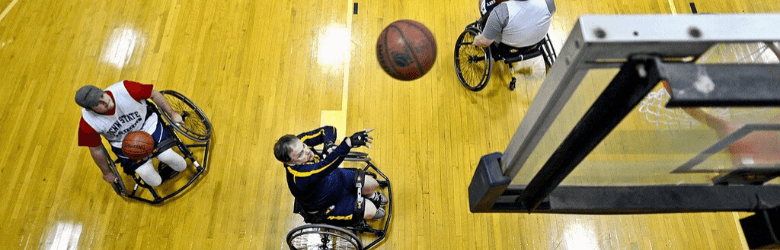
    2. Wheelchair Basketball

    Wheelchair Basketball is suitable for people with varying physical disabilities, especially those that affect their lower extremities. Examples of these disabilities include amputations, spina bifida, cerebral palsy, and disabilities resulting from accidents. To play this sport, you need to have full control of your upper body, including your shoulders, forearm, abdomen, and chest muscles.

    Procedure:

    If you’re pursuing wheelchair basketball professionally, the basketball hoop retains the 10-foot measurement and the court is of standard dimensions. However, if you’re playing the game for leisure, there could be a few modifications suited to the needs of the players.

    Your main intention of engaging in wheelchair basketball is to strengthen your lower extremities. So, when scoring, try as much as you can to lift your body off the seat by pressing your feet against the floor. However, monitor the height that your body rises to, to ensure you have a soft landing.

    two disabled persons playing basketball

    Image Source

    3. Seated Knee Raise

    Seated-knee-raises are excellent for people that are seeking to strengthen their hip flexors. Hip flexors are the muscles located around the hip section that aid movement in that area.

    People with weakened hip muscles often experience difficulties bending or walking. Seated-knee-raises are also best for people who have a degree of control over their lower bodies.

    Procedure:

    1. From a sitting position, raise one of your knees up till your foot is some inches above the ground.
    2. Lower the knee gently to the position where you began.
    3. Repeat the process as many times as possible with one leg, then do the same for the other leg.

    You may experience problems lifting your feet completely off the ground, depending on the level of control you have over them. In that case, you can leverage your calf muscles to help flex the ankle. Better yet, you could take it a notch higher by experimenting with power scooters. Just ensure you purchase your scooters from a reliable supplier.

    4. Seated Tricep Dips

    Seated-tricep-dips are ideal for people with significant strength in and control over their upper bodies. The exercise is intended to boost the strength of your triceps, chest muscles, and the muscles in front of the shoulders.

    If you use a wheelchair, this exercise will greatly help you to maneuver through difficult terrains and when you’re transferring from the wheelchair.

    Procedure:

    1. In a sitting position, rest your hands on your wheelchair’s armrests or another support nearby.
    2. Place the hands such that they’re positioned directly below your shoulders.
    3. Raise your body to a position where the arms are now fully extended.
    4. Lower your body to the original seated position.

    You can always complement the efforts of your arms using your legs, especially if you have more strength in your foot than you have in your hands. However, do much of the lifting using the arms.

    5. Seated Shoulder Press

    This is an exercise that’s perfect for those looking to boost the strength of their shoulder muscles, which translates to improved strength on the arms.

    If your disability doesn’t affect your grip strength, then this is the exercise for you.

    Procedure:

    1. Take weights into each hand, then sit down with your body upright.
    2. Raise the weights to a position above your shoulder line and hold them there for a few seconds, ensuring your palms are facing forward.
    3. With your palms still facing forward, push the weights over your head such that they somewhat meet around the middle.
    4. Lower them gently to the position that you began.

    The convention is to begin with no weight, then proceed to a lighter weight as you work your way up. You could also experiment with a resistance band in the place of weights.

    6. Reverse Crunches

    Reverse Crunches are recommended for people with a disability that doesn’t affect their abdominal muscles. This exercise is suitable for those who want to improve the strength of their abdominal muscles but are unable to perform crunches or sit-ups.

    Procedure:

    1. Sit on the floor and bend your knees at an angle of 90 degrees.
    2. Gradually push your upper body backward till the body rests flat on the ground but facing up.
    3. Gently return to the seated position that you started with, in whichever way that you can.
    4. Lower your body once again, this time rolling your spine and ensuring that your vertebrae touch the floor one after another.

    The secret to excelling in this exercise lies in focusing deeply as you lower your body and roll your spine. You don’t want to suffer a muscle sprain in the process.

    7. Resistance Band Leg Press

    This exercise is appropriate for people with disabilities that allow them a degree of control over their lower bodies. It’s the easier alternative to sit-to-stand, with a couple of more bonuses. This exercise is good for strengthening your thigh muscles and glutes.

    Procedure:

    1. Begin in a seated position and hold a resistance band such that each of your hands holds either end of that band.
    2. Keep the middle section of the band looped beneath one foot.
    3. Exert enough tension on the resistance-band such that your leg now appears bent, and your knee faces your chin.
    4. Maintain that tension for a few seconds and straighten your foot by pushing it towards the ground. That will ensure the band stretches even further.
    5. Now, let the resistance-band draw your leg back to its initial bent position.

    One expert advice while performing this exercise is to vary the intensity of slack in your resistance band, or the tension you exert on it.

    There are several workouts and sports activities that someone with a disability can perform to help stay active. We hope you found these workouts and sports activities helpful.

Disabled Living