Tag: Cerebral palsy

  • Abbie’s Story About Running a Business With Cerebral Palsy

    Abbie’s Story About Running a Business With Cerebral Palsy

    This is a guest blog by Abbie Hills, 24 year old from Hampshire. She talks about her experience of running a business with cerebral palsy. 

    About Abbie Hills

    I was born with cerebral palsy (mild), which is something I never understood growing up as I found myself being placed in a grey area of being almost able. Throughout my childhood and early teens I would notice that I got tired much quicker than others, and had persistent pains and could not understand why. When I got my first part time job, I noticed that even working a small shift in a tiny hair salon trying to sweep the floor was a challenge.

    I had never been particularly physical (shying away from sports days and other activities in school) but I always had a love for film and tv. Wishing to pursue a career in one of the most fast paced and physically demanding industries there was, I started acting in short films and doing work in small television roles. While this fulfilled a small part of my dreams, it would often leave me wiped out and fatigued for days after.

    Continuing my studies through university (BA Film) I realised I also had a passion for writing. This allowed me to create scripts and stories out of my ideas and watch them come to life – but I still wondered, how did people with disabilities manage a career in Film and TV?

    Fast Forward

    While I was proud of myself for finishing my degree and making a few short films during it, I was worried about what would come next. I knew working in a production role full time would not have been manageable for me, and moving away from my hometown was not an option, so I decided to further my knowledge of the Arts so that I could be in a position to start my own business (MA Arts Management).

    I had always had a thought in the back of my mind that the industry I planned to go into was not yet inclusive, so I wondered what I could do to change that, and throughout my course I picked up business skills and then took the plunge – launching my own Talent Agency and Production Company The Dazey Hills Company. With the experience I had gathered over the years in front and behind the camera I felt that I was in a good position to help others get into the industry.

    portrait picture of abbie hills

    The ethos behind my company is ‘Real People. Real Talent’ and I take pride in offering opportunities to people of all abilities and experience levels, as someone with cerebral palsy this has always been something close to my heart and something that I will continue to believe in throughout my career.

    I have secured paid industry work for people with no prior experience, and continuously look for people with passion in what they do. The nature of my job fortunately means that I can work from home which allows me the chance to have ‘off days.’ All of my clients have an understanding of what cerebral palsy is and alongside finding them work I am happy that I have been able to raise awareness for CP.

    Running my own business has given me a lot of help with recognising my own strengths and weaknesses, while also giving me an understanding of how to manage my condition as a young adult. I still get pains and fatigue regularly, but working on gentle yoga (although my balance isn’t great) between working has really helped.

    As I still act and make films alongside what I do, I have developed strategies in how to help myself while on set. Often the hours can be long, and there can be a lot of waiting around but I will always take simple measures such as making sure I have somewhere to sit and making sure that I keep myself hydrated (sometimes I take hot water bottles or heat patches to set to help with leg cramps). Where possible, I like to make sure I can plan a rest day after a day or two of shooting.

    Looks Towards the Future

    In the future I hope to broaden my client base, while also working with other disabled artists, performers or writers to build a support network and also assist them with securing work in their field. I am proud of myself for how far I have come, and how I have adapted to build my dream job, and I look forward to what the future holds for me and The Dazey Hills Company.


    If you would like to share your story with Disabled Living, please email info@disabledliving.co.uk and a member of our marketing team will be in touch.

  • Caring for a Child with Spastic Quadriplegia

    Caring for a Child with Spastic Quadriplegia

    This is a guest blog post written by Catherine Atkins for Disabled Living. Catherine and her son Jack are regular visitors at our Kidz to Adultz Middle event. Jack has spastic quadriplegia, a type of cerebral palsy that effects all four limbs.

    In 2010 I was delighted to find out that I was expecting my first child via sperm donor. I’m in a same sex relationship but had been desperate for children for years. The pregnancy was perfect, I thoroughly enjoyed getting bigger and showing that I was obviously pregnant. I loved all the extra attention I was getting and was over the moon when I got to feel the first kicks. The midwives were happy with how things were progressing and actively encouraged me to have a water birth at a midwifery run unit in Birmingham.

    Giving Birth to Jack

    I went into a natural labour 11 days after my due date and the water acted as a wonderful source of pain relief. Jack was born pretty easily in the water. However, he was a funny colour when he was pushed under the water to me and he was not breathing or moving at all. Jack had managed to get his umbilical cord wrapped around his neck twice and suffered a lack of oxygen for over 20 minutes. The next 9 hours were the most painful of my life.

    Jack was taken away to be resuscitated whilst my partner and I waited for news as to whether he would pull through. We were eventually called into a small side room to talk with the doctor. They confirmed that due to the lack of oxygen Jack had suffered, it was extremely unlikely that he would survive the night and if by some miracle he did, then the brain damage would be that great that he would have no quality of life.

    A Smile that Melts Hearts

    Jack was transported to another hospital to receive cooling treatment for 72 hours, which is where his body temperature is kept at a lower than normal rate in order to prevent any further brain damage. Every morning we waited for the doctors to do their rounds and every morning it was touch and go whether Jack would survive the day. At one point it was looking likely that he had renal failure and we were told that would almost certainly mean the end to our precious bundle. Fortunately for us all, Jack is made of extremely strong stuff and he pulled through and has gone from strength to strength. His smile melts everybody’s hearts and his cheeky sense of humour is hilarious.

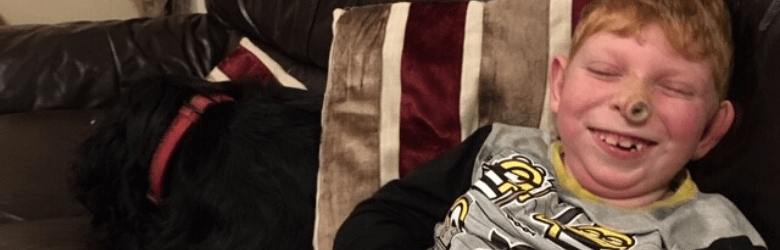
    Admittedly he is still classified as severely disabled as he is unable to walk or talk. He has spastic quadriplegia, a type of cerebral palsy that effects all four limbs. He has minimal head control and abnormal arm movements. His legs are extremely stiff and his feet are misshapen. Jack is fed purely through his PEG as he has a very poor swallow and no gag reflex which makes any attempt to eat or drink extremely dangerous. Jack also has a nasal pharyngeal airway (NPA) in permanent situ. This is because his tongue muscles are weak and his tongue will flop over his airway if it is not held back by the NPA.

    Catherine and Jack

    Jack’s Epilepsy

    So yes he isn’t without problems. However the biggest challenge we have and are facing at this time is Jack’s epilepsy. The epilepsy began just before his third birthday. One night we were all asleep (Jack has always slept next to me as he requires regular suctioning throughout the day and night), I woke to find that Jack was having a full on tonic clonic seizure. Having never had any experience with seizures in the past, we weren’t really sure what was happening so we called an ambulance. The seizure lasted over 40 minutes and was terrifying but the doctors managed to stabilise him eventually and he was allowed home the following day.

    A Learning Curve

    Since then Jack has been in and out of hospital with various types of seizures. I learnt early on to ensure I knew the correct way of pronouncing the names of the cocktail of medications that Jack was taking in order to gain any kind of confidence from the number of doctors we met along our journey. The professionals I have met along the way have taught me so much. We were lucky enough to have a friend who is the best paediatric physio in the world (in my opinion anyway) and she has helped us immensely. Without her, I know we would not be where we are now so a huge thank you to Alison.

    I have often been asked if I have a medical background due to being able to spout out so much information about Jack’s condition and spastic quadriplegia. This couldn’t be further from the truth, I used to faint at the sight of needles or blood and couldn’t even watch casualty on the television! When you’re faced with such a situation you learn so much as you go along.

    I’ve watched Jack go through having 8 large needles of Botox injected into the backs of his legs twice a year in order to help with his spastic quadriplegia. I change Jack’s PEG every three months (although I admit I still feel rather queasy when faced with an unnatural gaping hole leading straight into his tummy but every time I change it I’m getting that bit better), I can change his NPA with my eyes shut and do things that no mother should ever have to do.

    The Most Rewarding Job

    I would have had to return to work if Jack had been born healthy. However, because of the situation, I gave up my job and became Jacks full time carer, the most rewarding and wonderful job ever. I’ve since gone on to have a beautiful daughter and a rather mischievous little boy. When my third child was born we arranged to have his stem cells collected from the placenta in the hope that one day Jack might be stable enough to travel to America to have stem cell treatment. There’s no guarantees but a stem cell treatment may help improve Jacks abilities.

    What I am trying to say is that you can do anything when you really put your mind to it. Whatever life throws at you there are always ways to turn negatives into positives. If ever I feel a bit down, Jack’s beautiful smile turns my frown upside down! I am one extremely lucky mummy!

  • Disabled TV Characters Played by Disabled Actors

    Disabled TV Characters Played by Disabled Actors

    Diversity is something that should be celebrated, and we think it’s great to see that characters on TV and in film are becoming more and more inclusive. This includes portraying those with disabilities and minority communities. Although representation of people with disabilities in television is still only estimated at around 2.5%, this is something which we hope will increase in the coming years.

    However, it can still be difficult to find a TV show or film that has accurate representations of disabilities. It is even more difficult to find a TV show or film that has an actor who actually has the disability they are portraying. It is estimated that approximately 95% of disabled characters on our screens don’t have a disability in real life, which could be perceived as an issue. Having said this, we thought it is worth celebrating the actors who have disabilities both on-screen and off-screen. Read on to discover just some of the disabled actors who play disabled characters on TV.

    Walter White Jr. – Breaking Bad

    This character is played by RJ Mitte who has cerebral palsy. In the series, he plays Walter White Jr. who also has CP. Mitte wanted to find acting opportunities where his disability would serve to educate viewers and increase awareness. Now a celebrity ambassador for United cerebral palsy, Mitte is proof that we need more actors with disabilities on the screen to help raise awareness of disabilities.

    https://www.instagram.com/p/urDOoaLzt6/

    Izzy Armstrong – Coronation Street

    Cherylee Houston plays the character of Izzy Armstrong on Coronation Street and both are wheelchair users. Houston has used a wheelchair from the age of 23 when she was diagnosed with a rare connective tissue disorder called Ehlers-Danlos Syndrome. Although her disability was not the focus of her character, her story-lines did tackle two important disability-related issues. Izzy Armstrong showed viewers what it was like to live with chronic pain and the logistical problems of being a disabled prisoner. Since Coronation Street, Cherylee has continued to raise awareness of disabilities. Currently, she is currently involved in a great social media campaign called #TakingtheDis. The campaign involves highlighting places in the UK that are not accessible for wheelchair users.

    https://www.instagram.com/p/9EPbr8gdqV/

    Becky Jackson – Glee

    Becky Jackson, played by Lauren Potter, has Down’s syndrome. In Glee, her character is the school’s head cheerleader. The sassy character is brilliantly played, showing complexities, dating boys and adjusting to college. It is also proof that her disability doesn’t stop her from reaching her goals. Becky’s disability is rarely spoken about during the series, making Glee a great example of including a disabled character that isn’t defined by their disability.

    https://www.instagram.com/p/B00aGC6oavc/

    Mr. Wrench – Fargo

    In the first season of Fargo, Russell Harvard plays the intimidating deaf hitman, Mr. Wrench. In his season, Harvard was able to communicate to his accomplice via sign language. This allowed viewers to gain some insight into using sign language. When asked about it, Harvard stated how being deaf doesn’t define this character. This is definitely a step in the right direction since Fargo portrays another way of communicating, showing how individuals use sign language. The crime-drama series has received ‘universal acclaim’ and has won 51 award nominations.

    https://www.instagram.com/p/BbhY6UznBrQ/

    Sally Harper – Call the Midwife

    Sarah Gorder, who plays Sally Harper in Call the Midwife, is a professional actress, dancer and model with Down’s syndrome. During the series, Sally has an on-screen relationship with Jacob Milligan (played by Colin Young) who has CP. Gorder states that her aim is to play roles where people see her as a woman and performer first rather than focusing on her Down’s syndrome – which ‘Call the Midwife’ does brilliantly.

    https://www.instagram.com/p/B6_TQt_JG2q/

    Although studies show that many of the actors playing disabled characters on our screens do not have disabilities themselves, the portrayal of disabled characters still points in the right direction through increasing diversity. This may give viewers a chance to gain a deeper understanding of what it means to have a particular disability.

    In the future, we hope to see more actors with disabilities portraying characters with disabilities on our screens.

    If you have a disability and would like free impartial information or advice about something, then please contact Disabled Living.

  • Advice from Paralympian Sophia Warner: Motivate Your Child Through Sport

    Advice from Paralympian Sophia Warner: Motivate Your Child Through Sport

    This post has been written by Jennifer Grey on behalf of Paralympian, Sophia Warner.

    Taking your child through the challenges of a cerebral palsy diagnosis can be a difficult process. For many parents, cerebral palsy is something they only become aware of when their child is diagnosed with the lifelong condition.

    But, with 1 in every 400 babies in the UK being born with some type of cerebral palsy, it’s not as uncommon as it might seem. And, as more and more people share their stories of living with the condition, it becomes easier to find the information, help and support that can be invaluable for anyone dealing with a cerebral palsy diagnosis.

    One such person is Sophia Warner, a Paralympian with cerebral palsy who won Silver at the 2011 IPC Athletics World Championships. Sophia began racing at the age of 19 and has since forged an incredibly successful career in athletics. In 2019, she received the British Empire Medal for voluntary service to disability sports. She’s a great example of how anyone – regardless of their condition – can excel in sports.

    We asked Sophia Warner to share with us some tips and advice for helping children with cerebral palsy (and similar conditions) find motivation through sports. Here are her top four tips for embracing sports:

    Disability has no limits

    Sophia swears by the benefits of sport, not only for improving her fitness, but also for allowing her to have a better quality of life overall. Not to mention the massive benefits to her mental health that go hand-in-hand with the improvements in her physical health (particularly as exercise helps keep her cerebral palsy symptoms at bay).

    As you look for ways to motivate your child through sport, however, Sophia recommends taking it slow and exploring as many options as possible. Try lots of different things, in order to find the sport or activity that best suits your child’s ability and interests.

    “It’s all about finding something that your child wants to do every day, and then supporting them through it,” says Sophia.

    Your confidence will come to you

    When it comes to introducing your child to sport, “it’s important to get over the initial barriers which are usually lack of confidence and motivation,” says Sophia, adding that “people with disabilities tend to be the ones who see the greatest benefits from exercise.”

    So, if your child is feeling nervous or self-conscious before starting a sport, try to be a source of gentle encouragement. Hopefully, as they gain a better understanding of their bodies and which sports work best for them, they’ll gain confidence as well.

    Whatever your favourite sport, add swimming to the list

    Sophia says that, while it’s important to explore the sports that you enjoy doing, swimming is one she absolutely recommends for all children with cerebral palsy.

    “From my experience,” she says, “swimming complements other sports and I know that I benefited from swimming sessions alongside my training.” To start off with, find a warm indoor pool and a swimming instructor with experience instructing children who have cerebral palsy.

    Choose a team sport to meet like-minded people

    One of the great benefits of sport is the boost of happy endorphins that exercise releases. But, Sophia reckons there’s more to it. “We all know that being active is great for your physical health, but it can also boost your happiness by enhancing your social life.” If they’re willing and ready, take your child to group sports to help them mingle with other children like them.

    As you adjust to your ‘new normal’ with your child, it can be useful, encouraging and empowering to read stories like Sophia’s. Read her full story in the Cerebral Palsy Advice for Parents hub, which also includes resources and information on other areas of life after a cerebral palsy diagnosis.

  • Cooper’s Journey with Cerebral Palsy

    Cooper’s Journey with Cerebral Palsy

    January’s Story of the Month goes to, Kerrie Keen, 37 years old who talks about her son’s journey with cerebral palsy. Kerrie is married to her husband, Owen and is a proud mum to her 15 year old son and 4 year old identical twin boys, Cooper and Lucas. If you would like to catch up with our previous Story of the Month, please click here

    Owen and I discovered we were expecting twins in November 2012 at our first scan. Once we got our heads around the practicalities, we loved the thought of our twins always having each other, always having a play mate and sharing an incredible bond for life.

    April 2013, Cooper was born along with his twin brother Lucas. Cooper was the first born and weighed a little 4lbs 14oz and Lucas was born two minutes later weighing a big 7lbs 9oz. However, 5 hours after birth, Cooper was unusually sleepy and not feeding. After a pin prick blood test showed he had low blood sugar, he was taken to neonatal for the night.

    The seizures began

    Cooper young boy cerebral palsy

    Cooper began to have seizures and had dangerously low oxygen levels on the first night. He was then moved to intensive care and put on machines and a tube was put into his nose to enable feeding.  At 6 days old he was transferred to Glasgow Children’s Hospital for a MRI.  After the scan, a neurologist told us that Cooper had suffered grade 4 bleeding on the brain and would be severely disabled, if he survived.

    After transferring back to hospital, where the boys were born, Cooper began to fight back. His oxygen levels become steady and he stopped having seizures. However, the paediatric consultant told us they suspect Cooper has hydrocephalus. We had never heard of this! He told us Cooper might possibly need a shunt at some point.  We had never heard of a shunt but we decided to take each day as it came and see if we encounter this in the future.

    At 5 weeks old, Cooper left hospital.  He was finally well enough to come home. He was still being tube fed every 3 hours, day and night, which I found so difficult. The tiredness on top of trying to come to terms with Cooper being ill was such a trying time for us as a family.

    Having a VP shunt fitted

    Cooper young boy cerebral palsy

    November 2013, only 7 months old, Cooper was admitted to hospital in Glasgow to undergo his first brain surgery to fit a VP shunt. The aim of the shunt was to drain cerebral spinal fluid (CSF) from his brain down to his abdominal area where it would be absorbed. It was amazing to see the changes in Cooper only hours after this operation. A baby, who tightly clenched his right arm across his body, was now open handed trying to grab his milk bottle. This was an amazing day for us all. It was like we could start to see progress – a light at the end of a very dark tunnel. Cooper’s stability carried on and he became stronger and bigger over the next few months.

    June 2014, Cooper had another routine paediatrician appointment. The aim of this was to keep track of his development and physiotherapy which would help make him stronger. There was nothing unusual about this appointment, I gave an up to date account of what Cooper could do and what I felt he was struggling to do milestone wise. However, two weeks later, I received the summary letter of this appointment and my heart was broken. These letters always start the same, in bullet points, with the conditions which your child suffers.

    Coming to terms with a diagnosis of cerebral palsy 

    Cooper young boy cerebral palsy

    I knew about Cooper’s grade 4 bleeds on the brain and I knew about his hydrocephalus and VP shunt. What I didn’t know was that Cooper had been diagnosed with cerebral palsy. This was mentioned months before by another paediatrician as a possibility for the future, but it wasn’t mentioned at all during the latest development appointment. I will always remember how I felt reading for the first time that my 1 year old son had cerebral palsy. I was distraught. Everything seems to hit you that bit harder when it’s on paper after re-reading the letter. I contacted the hospital and said I desperately needed to speak to this paediatrician. He apologised and said I should never have found out that way.

    Such a major diagnosis which will last my son a lifetime, this shock is something that will stay with me forever. Cooper’s cerebral palsy has since been defined as quadriplegic cerebral palsy with dystonia. He is a little boy who struggles with increasingly tight muscular spasms, mainly in his legs but in his arms too.

    We can’t take things for granted

    Since, he has mastered being able to roll both ways which is fantastic! He’s unable to walk but recently Cooper has learned to sit upright propping up with his arms. A truly inspiring day for us all! He has coped brilliantly with everything and he never complains.

    What I have learned from having a child with a severe disability is that, we can’t take things for granted. The world of disability is so up and down and we never truly know exactly what’s around the corner. Even the smallest expectations are not a given. One day things can be calm and you feel like you are making progress. Then the next day, you feel like you are back at the beginning. You feel scared, uncertain and angry at the thought of your child having to struggle with every area of their life.

    Also, the world of disability can be so isolated. I feel extra worries and pressure due to having one able bodied twin and one severely disabled twin. It is soul destroying seeing one child leaving behind their twin developmentally, physically and emotionally.

    I try to keep positive and remember that Cooper is alive, that is the most important outcome for us.


    Read more about Cooper’s journey by visiting Miracles and Me on Facebook.

  • A Quarter of the Public ‘Don’t Know What Cerebral Palsy Is’

    A Quarter of the Public ‘Don’t Know What Cerebral Palsy Is’

    This post has been written by JMW Solicitors. JMW Solicitors support families affected by cerebral palsy caused as a result of medical negligence. A team of expert solicitors ensure families receive the best possible care package and support to lead as normal life as possible. JMW fully support an initiative to raise awareness and highlight the importance of open discussions to support families.

    A new survey

    A new survey of 736 people has revealed a lack of understanding surrounding cerebral palsy in the UK. Conducted by the Clinical Negligence department at JMW Solicitors , the survey found that almost one-quarter (24%) of people do not know what cerebral palsy is.

    The research showed that despite almost one-quarter (24%) of respondents personally knowing someone with CP, a similar proportion said they do not know anything about the condition. More than four in ten (41%) of those questioned described their understanding of cerebral palsy as “poor”, while a further 15% described it as “very poor”. This compared to 38% with a “good” understanding of it and 6% with a “very good” understanding, highlighting the need for further awareness of the condition.

    cerebral palsy

    Just 22% know that roughly one in every 400 children is born with the condition. The other 78% believe cerebral palsy is less common; 21% answered one in every 800, 25% selected one in every 4,000 and 11% opted for one in every 8,000. Almost one-quarter (23%), meanwhile, concede that they are not aware cerebral palsy can vary in severity.

    Here’s what Eddie Jones has to say

    Eddie Jones, Partner and Head of Clinical Negligence at JMW, says: “Our findings highlight a real lack of knowledge among the general public regarding cerebral palsy. It is illuminating that almost one-quarter of the almost 750 people we asked confess to not knowing what the condition actually is. We believe that understanding cerebral palsy is an important step to helping both people with cerebral palsy and those closest to them and more can be done nationally to raise awareness.

    Many people freely admit they do not know much about cerebral palsy; indeed, the percentage of people claiming to have “very poor” or “poor” knowledge of the condition (a combined 56%) is significantly higher than those with a “very good” or “good” knowledge of it (a combined 44%).

    The survey also found that only 29% of respondents say they think £1 million or more is needed in compensation to adequately care for a child with cerebral palsy for the rest of their lives. The other 71% assume less compensation is required, including almost one-quarter (24%) selecting £500,000 to £1 million, and 3% choosing the lowest option; £1,000 to £10,000. Knowledge of the true extent of the care costs required to support children and adults with CP is limited.

    man holding child

    Eddie Jones added: “The majority of people not only don’t know how many children are born with cerebral palsy in the UK, they also believe prevalence of the condition is much lower than it actually is. As a law firm, JMW has helped many children and families to claim compensation that can run into the millions of pounds for a single case when the condition is caused by negligence at birth or in the newborn period. Every penny is essential for assisting that individual and their families, and it is alarming to see that so few people understand how much is needed.

    JMW Solicitors produced a guide to cerebral palsy diagnosis and more information is available on the NHS website.

    If you would like to submit a blog to us, please send an email to: info@disabledliving.co.uk

  • Greta McMillan Exhibits Artwork at Porty Art Wall

    Greta McMillan Exhibits Artwork at Porty Art Wall

    For September, we would like to dedicate our Story of the Month to Greta McMillan. Greta is a 13-year-old girl who, earlier this month stunned members of the public with her artistic skills. As a wheelchair user with cerebral palsy who can’t use her hands or arms like other artists, Greta had her artwork exhibited at Porty Art Wall. This project is run by volunteers and ‘celebrates the public space and creativity of Portobello, Edinburgh’s Seaside.’

    When talking about the Porty Art Wall, Greta’s mum, Thea says:

    It has been quite wonderful. She didn’t have a way of expressing herself before – she’s always been good at doing yes blinks but that is dependent on us asking her the right question. So it’s still a learning curve. – Source: The London Economic (TLE). 

    portobello, edinburgh
    Portobello, Edinburgh

    Greta communicates by blinking with her eyes. And now her parents are very pleased that she finally has an ‘eye tracker’ computer to assist with her communication. The computer was funded by people in Edinburgh through a fundraising campaign. The money raised has given Greta a life-changing opportunity to do what she loves the most.

    Both mum and dad are very proud to see Greta be able to do something which she enjoys. Read more about how the computer helps Greta to create her art here.


    Did you see our guest post on art therapy about a man named Patrick Samuel with Asperger’s Syndrome?

    If you would like to feature your story on Disabled Living’s blog please send an email to: info@disabledliving.co.uk.

  • Why Lee Kingsberry Is Our Story of the Month

    Why Lee Kingsberry Is Our Story of the Month

    Did you read our previous Story of the Month? For August’s feature, we are sharing a story about Lee Kingsberry who has caught our eye this month. Lee is a man with cerebral palsy who wants to make a change. He doesn’t believe in a world where people should be stared at because they’re a wheelchair user.

    Lee’s creation of a mobile disco

    His wheelchair is no ordinary wheelchair as it’s now complete with neon flashing lights and speakers to play his booming music.

    Lee Kingsberry

    Rather than giving people a negative reason to stare, he transformed his wheelchair to have a positive impact on others. He simply wants to give others a positive reason to look at him. In July Lee stated on twitter that:

    Everyone has their own way of dealing with how society portrays disabilities, so let’s bring the fun into awareness about disabilities.

    About Cerebral Palsy

    Cerebral palsy is the term used for a group of conditions that affect movement and coordination. There are several symptoms of the condition including: weak arms or legs and uncontrolled movements. The NHS explains that cerebral palsy is usually recognised within the first two to three year’s of a child’s life.

    Lee Kingsberry

    Lee plays a range genre of music from his wheelchair from classical to rock. He has gained a positive reaction from those who have passed by so far in the Salford Quays area.

    We asked Lee if there is a message he would like to send out and he replied:

    Don’t let society change or stop you from living your life.

    Disabled Living love to be inspired

    As Disabled Living want people with disabilities and additional needs to live a life as independent as possible, Lee has inspired the whole team. We hope to see Lee continue to inspire wheelchair users not only within Greater Manchester but all over the UK.

    Read more about his story here.

Disabled Living