Tag: disability awareness

  • Care Available for Disabled People

    Care Available for Disabled People

    This is a sponsored post by Country Cousins for Disabled Living’s blog about care for disabled people.

    Sometimes, having a disability can sometimes be very limiting and make day to day tasks difficult to complete. Fortunately, there are a number of care options that you can take advantage of to make your life easier to manage. Allowing you to start enjoying the little things in life and enjoy spending time with loved ones.

    In this guide we’re going to take you through some of the best options that are available to you. Hopefully then you can decide around what care you would like to take advantage of, allowing you to make the most of your life.

    Live-in Care

    Live-in care is one of the most popular forms of care amongst the elderly and disabled community. This is mainly due to the fact you get to stay in your own home amongst all the home comforts you’re used to. A carer will come round to your home and do as little or as much as you would like. We spoke to live-in care experts Country Cousins and they told us their top benefits of live-in care:

    • You can stay in your environment and choose how your house looks and how it’s decorated. It’s your space so you control it.
    • If you still like your independence, then you can make the most of having time to yourself in your home.
    • Routines are incredibly import and if you have your own routine you can stick to it. This includes things like wake up times, meal times and when you head out to the shops. You can stay active and keep your routines.
    • Your family can visit whenever you like and don’t have to stick to a schedule.
    • The care is tailor made depending on the individual and you get your own personal support. If you’re just wanting a chat and a coffee, they are there to do just that.
    • If you have a pet, you can keep them because you’re in your own home so the rules are your rules.

    Living with Family

    One option available is living with family if they have the capacity to care for you. When living with family, you are around people you’re comfortable with and they can help you as much or as little as you need. This can be anything from going to the shops for the basics or for days out and trips where you may need a little bit of help. Here are some of the benefits of living with your family:

    • You will still maintain some form of independence even though you are amongst your family.
    • The costs will be a lot lower because all you’ll need to pay for is upkeep and costs for things like bills and food shops. Care can sometimes be seen as quite expensive.
    • The people providing the care and assistance you need are people you know, love and trust so you can fully relax.

    Supported Living Services

    Supported living services are there to provide you with care if you don’t want to live in a care home but struggle to live independently at home. They’re a combo of live-in care and care homes where you get your own space to live with some help with basic tasks like cooking and washing.

    Some supported living accommodation can house around 2-3 people who may have similar health issues or particular disability. Staff will visit the home to help you with anything from getting out of bed to getting ready to go out or go to work and complete household tasks for you. You can find out more about supported living services on the NHS website.

    Hopefully, you’re able to find care that’s right for you and gives you everything you need. If you need any more help or advice, then feel free to get in touch with us and we’ll see how we can help you.


    If you would like information and advice on products or services for a disabled person you care for, please contact our Disabled Living helpline on 0161 214 4590.

  • Have Disabled People Been Forgotten in the Era of Social Distancing?

    Have Disabled People Been Forgotten in the Era of Social Distancing?

    This is a guest blog post written by Disabled Motoring UK (DMUK). Disabled Living are proud to support their campaign again this year to help raise awareness of parking bays for disabled people during Covid-19.

    As the UK’s shops and retail outlets begin to open DMUK is being contacted more and more by its members who are frustrated about their needs being forgotten with new measures being introduced resulting from the  Coronavirus pandemic.

    DMUK does support the government in the need to keep people safe and encourages everybody to follow the appropriate guidelines. We have seen socially distanced queues outside retailers of all natures and these are necessary in order to keep people safe. However, these organised queues often need to take over parts of the retailer’s car park in order to accommodate them. Often the disabled parking bays are nearest to the entrance and are therefore the automatic choice to be cordoned off for such queues.

    DMUK understands the predicament many retailers find themselves in and they need to put in place measures that protect everybody. However, we also want to see retailers think about their disabled customer’s needs. We encourage all retailers to think carefully about the position of queuing systems and the removal of disabled parking bays should be a last resort. If there is no other option, DMUK would like to see the suspended bays resited to an appropriate place in the car park, sign posted correctly and managed properly so they are kept free for genuine Blue Badge holders.

    Campaigning

    DMUK has a long campaigning history when it comes to protecting disabled parking and this is the latest situation where we have seen the needs of Blue Badge holders neglected. Disabled parking bays are always the first to be cordoned off for construction work, temporary toilets, storage and the list goes on. Social distancing is just the latest excuse to use these bays for which they are not intended. A disabled bay is a life line to a Blue Badge holder, and without one it could mean a dramatic loss of independence.

    Dave Smith, Head of Public Affairs and Communications at the British Parking Association, said:

    “Parking operators should work with landowners to ensure that disabled motorists are not unfairly penalised by a reduction in designated parking bays due to social distancing requirements. This means continuing to meet their obligations under the Equality Act and making reasonable adjustments where necessary. It’s also important that spaces allocated for Blue Badge holders continue to be effectively monitored to ensure they are not abused”

    We have also been contacted by members who have had difficulties when they are in shops, because the staff refuse to give them the assistance they require – citing health and safety concerns as the reason they cannot help at this time. For example staff refusing to lift things off high shelves or assistance with carrying shopping to the disabled person’s car. This is not acceptable and retailers should put in place the provision to give assistance to disabled customers whilst still keeping their staff safe. We’d also like to see a national policy that would exempt disabled people from queuing at retail outlets. Most retail outlets do not have the capabilities to put adjustments in place which would allow disabled people to queue, for example providing seating. A reasonable adjustment would be to let them go straight to the front.

    Disabled people who are shielding

    There is a common misconception that all disabled people are ‘clinically vulnerable’ and will be ‘shielding’ at home for as long as the Coronavirus is with us. This is certainly not the case and many disabled people are eager to get back to their everyday lives. However, they cannot do this unless the retailers put in place reasonable adjustments so that they can access goods and services just like everybody else.

    Protecting health for everybody also means protecting independence for everybody.

    DMUK’s asks to retailers:

    • Disabled parking bays should not be removed to provide a space for socially distanced queues.
    • If cordoning off disabled parking bays is the only option for a retailer these bays should be re-sited to another place in the car park, signposted and managed properly so they are kept available for genuine Blue Badge holders only
    • Blue Badge holders should be exempt from queuing at retail outlets
    • Disabled people should be able to access the assistance they require when shopping

    Heidi Turner, DMUK Communications and Campaigns Director, said:

    “DMUK has always been a champion for the independence of disabled people and there is a real danger that as we come out of lockdown this will be eroded. We are asking retailers not to forget their disabled customers when putting social distancing measures in place so that everybody can access their services. Not all disabled people are considered ‘clinically vulnerable’ and will desperate to get back to their ordinary life. However, they may be prevented from doing so if the correct reasonable adjustments are not put in place to help them do so.”

    For more information please visit the DMUK website: www.disabledmotoring.org

    To share your news with Disabled Living please email: info@disabledliving.co.uk 

  • 7 Sports Activities for People with Disabilities

    7 Sports Activities for People with Disabilities

    This is a guest blog for Disabled Living by Heidi Jones, who outlines 7 sports activities for people with disabilities. 

    Over the past couple of years, sports accessibility has increased for those with disabilities. Since the first official Paralympic Games in Rome 1960, more avenues have opened up for disabled people to showcase their talents. As a result, decorated careers have been made from the Paralympic Games and other disability-based championships.

    Aside from the Paralympic Games there are hundreds of different sports and workout routines that a disabled person can experiment with to ensure they stay in top shape, physically and mentally. Read on to discover more about these activities.

    a disabled person in a wheelchair

    Image Source

    The State of Disability and Sport

    According to recent statistics, around 17% of adults with long-term disability or illness participate in weekly sports activities.

    However, the question isn’t about their unwillingness to engage in physical fitness and sports activities. Instead, it has a lot to do with poorly-equipped gyms, inadequate disability-based competitions, and a few other limiting factors. As a matter of fact, a poll that was conducted by Parallel London revealed that up to 83% of disabled people long to participate in more physical activity than they currently do.

    Top 7 Disability-friendly Sports and Fitness Activities

    1.Sit to Stand

    Sit to Stand is a workout that’s suitable for people with a disability that weakens their lower bodies, hence the need to improve the strength around those areas. Examples of such conditions include multiple sclerosis (MS), rheumatoid arthritis, motor neuron disorder, obesity, peripheral neuropathy, Parkinson’s disease and fibromyalgia.

    Procedure:

    1. Perch your bottom on a chair near the front edge, while ensuring your feet rest flat on the ground and behind your knees.
    2. Gently tilt the upper portion of your body forward and make as if to push yourself up into a standing position.
    3. Return your body to the seated position that you started in.

    You may find it difficult to perform this exercise using your arms, especially when it comes to the part where you have to push yourself up. In that case, your knees might come in handy. Just place your hands on top of the knees and try to push yourself up.

    Also, if the disability has severely compromised your legs such that they can’t lift your body at all, you can always make use of a support. Think of a worktop, a crossbar, or a grab rail. Using these support frames, you can now exert as much force as possible on your leg and pull your body as high as you can, before letting it down gently back to the chair.

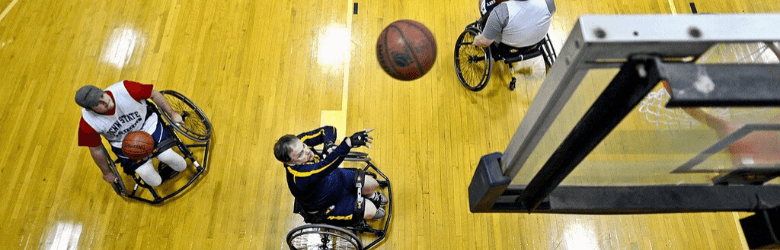
    2. Wheelchair Basketball

    Wheelchair Basketball is suitable for people with varying physical disabilities, especially those that affect their lower extremities. Examples of these disabilities include amputations, spina bifida, cerebral palsy, and disabilities resulting from accidents. To play this sport, you need to have full control of your upper body, including your shoulders, forearm, abdomen, and chest muscles.

    Procedure:

    If you’re pursuing wheelchair basketball professionally, the basketball hoop retains the 10-foot measurement and the court is of standard dimensions. However, if you’re playing the game for leisure, there could be a few modifications suited to the needs of the players.

    Your main intention of engaging in wheelchair basketball is to strengthen your lower extremities. So, when scoring, try as much as you can to lift your body off the seat by pressing your feet against the floor. However, monitor the height that your body rises to, to ensure you have a soft landing.

    two disabled persons playing basketball

    Image Source

    3. Seated Knee Raise

    Seated-knee-raises are excellent for people that are seeking to strengthen their hip flexors. Hip flexors are the muscles located around the hip section that aid movement in that area.

    People with weakened hip muscles often experience difficulties bending or walking. Seated-knee-raises are also best for people who have a degree of control over their lower bodies.

    Procedure:

    1. From a sitting position, raise one of your knees up till your foot is some inches above the ground.
    2. Lower the knee gently to the position where you began.
    3. Repeat the process as many times as possible with one leg, then do the same for the other leg.

    You may experience problems lifting your feet completely off the ground, depending on the level of control you have over them. In that case, you can leverage your calf muscles to help flex the ankle. Better yet, you could take it a notch higher by experimenting with power scooters. Just ensure you purchase your scooters from a reliable supplier.

    4. Seated Tricep Dips

    Seated-tricep-dips are ideal for people with significant strength in and control over their upper bodies. The exercise is intended to boost the strength of your triceps, chest muscles, and the muscles in front of the shoulders.

    If you use a wheelchair, this exercise will greatly help you to maneuver through difficult terrains and when you’re transferring from the wheelchair.

    Procedure:

    1. In a sitting position, rest your hands on your wheelchair’s armrests or another support nearby.
    2. Place the hands such that they’re positioned directly below your shoulders.
    3. Raise your body to a position where the arms are now fully extended.
    4. Lower your body to the original seated position.

    You can always complement the efforts of your arms using your legs, especially if you have more strength in your foot than you have in your hands. However, do much of the lifting using the arms.

    5. Seated Shoulder Press

    This is an exercise that’s perfect for those looking to boost the strength of their shoulder muscles, which translates to improved strength on the arms.

    If your disability doesn’t affect your grip strength, then this is the exercise for you.

    Procedure:

    1. Take weights into each hand, then sit down with your body upright.
    2. Raise the weights to a position above your shoulder line and hold them there for a few seconds, ensuring your palms are facing forward.
    3. With your palms still facing forward, push the weights over your head such that they somewhat meet around the middle.
    4. Lower them gently to the position that you began.

    The convention is to begin with no weight, then proceed to a lighter weight as you work your way up. You could also experiment with a resistance band in the place of weights.

    6. Reverse Crunches

    Reverse Crunches are recommended for people with a disability that doesn’t affect their abdominal muscles. This exercise is suitable for those who want to improve the strength of their abdominal muscles but are unable to perform crunches or sit-ups.

    Procedure:

    1. Sit on the floor and bend your knees at an angle of 90 degrees.
    2. Gradually push your upper body backward till the body rests flat on the ground but facing up.
    3. Gently return to the seated position that you started with, in whichever way that you can.
    4. Lower your body once again, this time rolling your spine and ensuring that your vertebrae touch the floor one after another.

    The secret to excelling in this exercise lies in focusing deeply as you lower your body and roll your spine. You don’t want to suffer a muscle sprain in the process.

    7. Resistance Band Leg Press

    This exercise is appropriate for people with disabilities that allow them a degree of control over their lower bodies. It’s the easier alternative to sit-to-stand, with a couple of more bonuses. This exercise is good for strengthening your thigh muscles and glutes.

    Procedure:

    1. Begin in a seated position and hold a resistance band such that each of your hands holds either end of that band.
    2. Keep the middle section of the band looped beneath one foot.
    3. Exert enough tension on the resistance-band such that your leg now appears bent, and your knee faces your chin.
    4. Maintain that tension for a few seconds and straighten your foot by pushing it towards the ground. That will ensure the band stretches even further.
    5. Now, let the resistance-band draw your leg back to its initial bent position.

    One expert advice while performing this exercise is to vary the intensity of slack in your resistance band, or the tension you exert on it.

    There are several workouts and sports activities that someone with a disability can perform to help stay active. We hope you found these workouts and sports activities helpful.

  • Jonathan’s Story About Not Being Able to Speak to Communicate

    Jonathan’s Story About Not Being Able to Speak to Communicate

    Can you imagine not being able to speak to communicate? The silence, the loneliness, the pain. Inside you disappear to magical places, but most of the time remain imprisoned within the isolation. Waiting, longing, hoping. Until someone realises you potential and discovers your key, so your unlocking can begin. Now you are free, flying like a wild bird in the open sky. A voice for the voiceless. This is me, and this is my story.

    Entering the Education System

    When I entered the education system I was labelled as having Profound and Multiple Learning Disabilities (PMLD). I was enrolled at a Special School.

    At first I enjoyed my time, making new friends and having fun with my lovely teacher – who made lessons engaging, varied and entertaining. Once a week, I attended my local primary school where I joined in with my able bodied peers for the afternoon. That first academic year set a foundation of friendship, forming the basis for my self-esteem; and belief that I can meaningfully join in with peers, despite my physical disabilities.

    Entering year one I was looking forward to learning more, but instead I found my learning stagnate at a preschool level. For example, during literacy the teacher would read us an oversized toddler book with occasional flashes of the pictures, whilst we were given objects to feel.

    How was I going to learn to read without access to text? Outwardly I looked vacantly stupid (giving credence to the idea that academically there was very little going on for me); inwardly I was amusing myself lost in my own thoughts. Meanwhile, I was increasingly enjoying my afternoon at the local primary and the learning I was joining them for.

    During the summer of Year 2 Marion Stanton, an AAC literacy specialist, suggested to my mother that she should try to teach me, and so at the start of year 3, I was taken out of my Special School for an hour a day to be taught, by my mother, to read, write and do basic maths. During the previous summer I had done some work on basic phonics at home using an eye gaze computer. It was frustrating because the computer couldn’t read my eyes very well, but my mother and carers could using an etran frame – my access to learning was found! Initially, the progress was slow, but thankfully, the advice my mother was given, resulted in her making the lessons more challenging and I haven’t looked back since.

    English, Maths and Science

    By year 5, two years after I started literacy and numeracy lessons at home, I had caught up with my peers and went on the roll of my local primary school. Now I am entering year 9 at my local mainstream secondary school studying English, maths and science.

    Being able to read and write has totally transformed my life. As a non-verbal child, I can now communicate exactly what I want to say, my relationships have been renewed as I can hold conversations with family and friends, and there is new life in my free time!

    My story of learning to read and write should not be unique. For this reason, I have set up my charity, Teach Us Too envisaging a world where all children are taught to read and write regardless of their educational label. Because labels should help educational practitioners understand the kind of barriers to learning a pupil will face, and the interventions that will help to overcome those barriers; but labels should never be an excuse not to teach children to read and write.

    eye can write front cover

    Whilst the vision behind Teach Us Too is my passion, my love is writing: prose and especially poetry. Last year these two amalgamated when my memoir Eye Can Write was published, with my share of the profits going to my charity. Sharing my story in the hope that it will change the stories of children like me.

    This post has been written by Jonathan Bryan at Eye Can Talk. Jonathan has a book which is available on Amazon and all good book stores. Find out more via: http://bit.ly/EyeCanWriteBook

    Facebook: Eye Can Talk
    Twitter: @eyecantalk

    If you would like to feature on Disabled Living’s blog please get in touch with us via email: info@disabledliving.co.uk

  • One in Five Supermarket Disabled Parking Bays Being Abused

    One in Five Supermarket Disabled Parking Bays Being Abused

    Supported by Baroness Grey-Thompson.

    In June Disabled Motoring UK (DMUK) asked the public to help with their Baywatch Campaign by surveying their local supermarket car park for disabled parking abuse. The results have now been calculated.

    DMUK would like to thank everybody who participated in this year’s Baywatch Campaign. This year we had the biggest number of responses that we’ve ever seen which goes to show how important the problem of disabled parking abuse is at supermarkets. Our total number of responses was 723. We’d also like to thank all of our supporting organisations that promoted the campaign and encouraged their members/supporters to take part.

    General Findings

    The overall level of disabled parking abuse across all supermarkets was 16%. In 2017, when we last carried out the Baywatch Campaign it was 18.5% and therefore this year’s result do show some improvement.

    Across all of the supermarkets surveyed the average number of disabled bays provided (to the nearest whole bay) is 15 bays with 3 of them being abused, meaning that roughly 1 in 5 disabled bays at supermarkets are abused by somebody parking in a disabled bay without displaying a Blue Badge.

    Looking generally at enforcement signage, we can see that 60% of the supermarkets surveyed had visible signage or other evidence that enforcement took place. When you isolate these supermarkets levels of abuse remained at 16%. However, the 40% that had no visible indication of enforcement taking place the percentage of abuse increased dramatically to 36%. This shows that using enforcement does decrease the levels of disabled parking abuse.

    Supermarket Specifics

    We had a wide spread of different supermarkets included in this year’s Baywatch survey responses, including; Aldi, ASDA, Co-Op, Lidl, M&S, Morrisons, Sainsbury’s, Tesco and Waitrose. Even though this year we had an increase in responses for Aldi and Lidl which reflects the general market share growth these chains have experienced we felt it was unfair to directly compare these stores with the big four – Tesco, Sainsbury’s, Morrison’s and ASDA because we had many more surveys returned for these chains.

    Morrisons were this year’s winner with just 10% of disabled parking abuse in their car parks. We’d like to congratulate Morrisons for having the least amount of disabled parking abuse.

    League Table

    Supermarket 2019 level of abuse 2017 level of abuse
    Morrisons 10% 11%
    Sainsbury’s 15% 8%
    ASDA 22% 17%
    Tesco 24% 23%

    All of the supermarkets that were surveyed have been contacted with the Baywatch results. We’ve encouraged them to start a dialogue with the charity so that we can help them improve their parking facilities for disabled motorists.

    Enforcement

    Similarly to the statistics from the 2017 campaign we can once again show that enforcement works. Where we see no visible signs of enforcement taking place the levels of abuse dramatically increase.

    The table clearly highlights the effect that enforcement has on levels of abuse. Across all the supermarket chains surveyed there were car parks which had no signs of enforcement. We call on all supermarkets to rectify this and to use enforcement across all of their stores.

    Blue Badge Extension

    On the 30th of August the criteria for the Blue Badge will change in England and more people with hidden disabilities will be eligible for a Blue Badge. DMUK predicts that this change will see a dramatic increase in Blue Badge holders meaning that disabled parking will be more pressured. The Blue Badge scheme is largely adopted by the private parking industry so the effects of this change will be felt across the entire parking sector, including parking at supermarkets.

    Supermarkets can do three things to help their disabled customers, the first is to properly enforce their disabled bays so that only genuine Blue badge holders park there. We can see from the results of the Baywatch campaign that if the supermarkets eradicate this problem they could make available up to 20% more bays for their genuine disabled customers without having to do any structural changes to their car parks.

    The second thing they can do is monitor their disabled parking provision closely to understand whether or not they actually provide enough disabled bays to meet the demand of their customer base. The third is to adopt the Disabled Parking Accreditation in their car parks. This would provide consumer confidence that their car park is accessible and properly enforced, and show a real commitment to the independence of their local disabled community.

    Baywatch Continued

    We have contacted the supermarkets surveyed and will encourage them to do more to enforce their disabled parking bays and take up the Disabled Parking Accreditation if appropriate. Baywatch will return in 2021 and we hope to see a further decrease in the levels of disabled parking abuse in supermarkets.

    In the meantime the most effective way of creating change at the supermarkets is choose wisely where you spend your money. The spending power of the disabled community is huge and according to figures obtained by ‘The Purple Pound’, supermarkets’ lose £501million every month because they aren’t accessible. If you experience problems parking at your local supermarket, you could choose to spend your money elsewhere. If you do decide to make a change because disabled parking is not enforced do write to the Chief Executive of the supermarket chain and explain why you will no longer be shopping at their store. If enough people do this it can create change.

    Heidi Turner, Communications and Campaigns Director at DMUK, said: “DMUK is ecstatic with the level of support it has received for this year’s Baywatch campaign. The statistics show that one in five disabled bays is abused. Disabled parking is under immense pressure to meet the demand for it and if supermarkets enforced their disabled bays properly they can increase the volume of available disabled parking by 20%. It is time that the supermarkets take this issue seriously and support their disabled customers”

    Baywatch Appeal

    To help DMUK to continue campaigning on the issue of disabled parking abuse we have launched the Baywatch Appeal. This is a fundraising appeal which will help the charity raise vital funds to keep advocating the need for proper management of disabled parking bays. The charity encourages all supporters of the Baywatch campaign to donate if they are able. Please visit https://www.disabledmotoring.org/donate

    DMUK Baywatch Sponsor

    DMUK has worked for many years with the British Parking Association (BPA) to improve parking for disabled motorists. This year the BPA has further shown their commitment to the work of DMUK by sponsoring DMUK Baywatch 2019.

    Kelvin Reynolds, BPA Director of Corporate and Public Affairs says, “We are encouraged to see some improvement in this year’s survey but almost 1 in 5 disabled bays at supermarkets continue to be abused. Parking spaces reserved for Blue Badge holders must be managed properly to ensure they are not obstructed and used only by people displaying a valid disabled Blue Badge and we encourage all those who manage parking to properly enforce their disabled bays so that only genuine Blue badge holders can park there.”

    Supporting organisations

    DMUK Baywatch is also supported by:

    • AccessAble
    • Whizz-Kidz
    • Phab
    • Independent Living
    • Honest John
    • Disabled Living

    *Data Source wearepurple.org.uk The Purple Pound

    This post was written by Disabled Motoring UK. For more information please contact: Heidi Turner, Communications & Campaigns Director at: Heidi@disabledmotoring.org or call: 01508 489449.

  • Why Standardising Objects of Reference Can Render Them Meaningless

    Why Standardising Objects of Reference Can Render Them Meaningless

    The phrase “Objects of Reference” refers to a communication support system whereby particular objects associated with particular activities are used to communicate to a person with complex disabilities that certain activities are about to take place. For example someone might be handed a continence pad before being taken to the toilet, or be given their swimming costume to hold before going swimming.

    To use Objects of Reference with someone you need to first identify objects that are meaningful to them and then use those objects consistently as markers for the associated events. It is no use showing them a plastic toy bus to tell them that they are going on the bus, this is neither what a bus looks like to them or what it feels like, it might be more relevant to get them a section of seat belt, or wouldn’t it be marvellous to have the ‘ding’ of the bell that is rung to disembark!

    I have seen Facebook posts from people asking for ideas for what to use for Objects of Reference

    Asking what someone else, somewhere else uses to represent something else for someone else is meaningless, by their very nature Objects of Reference are personal to the individual. If you are stuck, ask them. Ask them by observing closely, with all your senses, what their experience of that event is. Which part of their experience could you capture in an object to share with them? Consider which experience is the biggest marker of that event to them, for example with the swimming pool it is true that they are likely to change their clothes, and feel a towel upon their skin, but this also happens to them at other times as well. It is likely that the scent of the water is the most distinctive factor for them – could you have a sample of pool water in a container for them to smell?

    I have been to settings who proudly tell me they have a standardised set of Objects of Reference that everyone in their setting uses. Standardised systems are not individualised systems. Objects of Reference are intended to be highly personal not standard.

    If you are standardising your use of Objects of Reference you are presuming the people who are using them will become symbolic communicators

    Some people do use Objects of Reference as a stepping stone to other symbolic forms of communication, such as symbol communication, and some people do not. For the people who do not, Objects of Reference may be the only system of communication available to them so it is all the more important that we protect its individualised nature.

    Consider the experience of the world for someone who has limited cognitive and sensory abilities. Most of life is a confusing soup of experience, things happen to them, their brain does not have the chance to fully process what is going on as it is going on, so by the time they have heard a sound they may already be far from the object that emitted that sound. Light might be processed swifter than touch, so you see a hand on your skin but do not feel the touch until several moments later, and do not associate that sight with that sensation. From time to time something in this confusion makes sense.

    These times are the times that repeat often, times when the same thing happens in the same place and means the same thing

    girl riding her bike with a helmet on

    Times they have had so many chances to explore that they begin to hold a sensory memory. It is not that they have stored them in their memory as we would understand it, they cannot go back and “remember” being here before, it is more of an embodied memory, like the muscle memory formed riding a bike, their bodies recognise where they are.

    If you collect one aspect of that known place and can share it with them when they are not there, you reach into that blur of experience and say “something is going to happen, something you know” it is like a rope thrown into the confused soup that connects them to a place of solid ground. Throwing a rope that someone else, somewhere else, uses with someone else, won’t have that connective communicative effect.

    Ah but in time they will learn that the plastic bus means the real bus.

    …well they might, especially if the plastic bus goes on the real bus with them and is not taken away, but why are we insisting they do more work to access communication, when if we did a little more work and found a relevant object they could access it already?

    But it is such a faff to have different objects for different people, having a standardised set means we all know what to use.

    …it is true that to meaningfully use Objects of Reference you will require a different set for each person, and this is inconvenient. But this was never about our convenience was it, it was about communication. We are able to organise a storage system and label it carefully so everyone knows whose objects are whose. We would go to the ends of the earth to reach into their confusion and share communication, so it really is not so much bother to ensure Objects of Reference are meaningful to each individual using them.

    This post was written by Joanna Grace, a new contributor to Disabled Living’s blog. Sensory Engagement Specialist, trainer, author, TEDx speaker and founder of The Sensory Projects.

  • Encouraging Amputees and Individuals with Limb Difference to Get Active and Improve Their Physical and Mental Health

    Encouraging Amputees and Individuals with Limb Difference to Get Active and Improve Their Physical and Mental Health

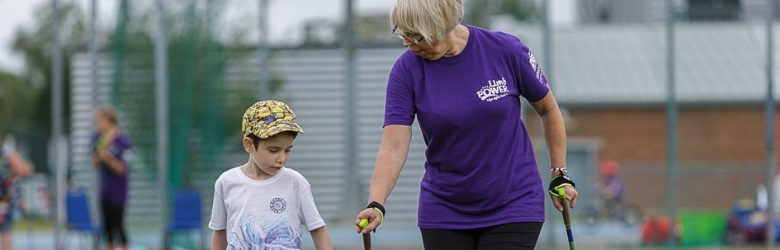
    The charity LimbPower are working throughout the month of August to encourage and engage with people with a limb difference, to help them kick start a healthy and active lifestyle.

    Being active has so many health benefits, including aiding mobility, rehabilitation and improving quality of life. Through sharing and promoting the Ottobock Fitness App (available through the Apple store and on android mobile phones) as well as LimbPower’s exercise videos (available on YouTube and the LimbPower website www.limbpower.com) we aim to support and encourage more members of our community, as they build their independence through increased mobility.  

    Join the social media campaign - #ActiveAugust – to raise awareness of the physical and mental health benefits of engaging in physical activity with a focus on moving more.

    Amputees and individuals with limb difference can join LimbPower for #ActiveAugust and challenge themselves to get fitter through the #OttobockFitnessChallenge. They will be doing a daily morning workout using the OttoBock fitness app, choosing between strength and endurance, condition and balance, or stretch and relax. Participants can do as little or as much as they want to, in the comfort of their own home.  

    “Over 25,000 amputees around the world use the Ottobock fitness app for targeted physical fitness and increasing their strength,” says Amanda Sarson from Otto Bock Healthcare PLC. 

    The exercises available have been designed by Ottobock’s leading physiotherapists and are easy to follow, with videos and guides to ensure users get the most from their rehabilitation and exercise. While the app cannot replace a professional course of therapy, the exercises are designed to help maintain fitness for amputees and can be integrated in their daily routines.” 

    LimbPower will also be running a social media and fundraising campaign called #IPledge for individuals who are already active and want to challenge themselves to do more or achieve a new goal.

    Participants will be encouraged to share their story with other amputees and individuals with limb difference on social media and create a JustGiving page (www.justgiving.com) to raise funds for LimbPower, so that they can continue to support and encourage individuals with limb difference through the provision of participation events, workshops and resources.  

    Active August logo

    To find out more about #ActiveAugust or to get involved contact Kiera Roche atkiera@limbpower.com or Kerry Munroe at kerry@limbpower.com or telephone 07968 760001. 

    #Active August eventJoin up to #ActiveAugust campaign on our Facebook events page

    This post was sent to us by LimbPower, a National Disability Sports Organisation working to support amputees and individuals with limb impairments in physical activity, sport and the arts. We do this through advocacy, events, workshops and resources. 

    Would you like to have your story featured on Disabled Living’s blog? Get in touch with us via info@disabledliving.co.uk

  • So What Was Chris Doing at Coronation Street?

    So What Was Chris Doing at Coronation Street?

    This post has been written by Chris Cammis, Disabled Living’s Disability Awareness Trainer. He talks about why he had a lovely day out at MediaCityUK.

    I had been invited by Simon Lord of Continuum Entertainment to deliver Disability Awareness Training to a group of their Tour Guides. Simon is the General Manager of their Manchester office with responsibility for recruiting, organising and training staff to deliver the official Coronation Street Tours. I hadn’t realised beforehand what a big deal this was. Continuum organise official tours around many of the major UK tourist venues as well as Coronation Street – The York Chocolate Tour, Emmerdale Village Tour, Spinnaker Tower Portsmouth and Oxford Castle and Prison to name a few. 

    The tours run every Saturday and Sunday (filming takes place all through the week!), setting off every 15 minutes, with up to 50 people per group. That adds up to thousands of people every weekend which inevitably means the tour guides will encounter many people with all sorts of disabilities on a daily basis.

    Unfortunately, we weren’t located anywhere near Coronation Street’s set so I saw no famous faces running through their lines but we did start the session with a private showing of a new publicity DVD that Continuum had just completed, which was well received by all.

    I then organised a session covering ‘Appropriate Language and Appropriate Behaviour’ to use when dealing with disabled visitors, including all the standard issues around wheelchair etiquette, accommodating assistance dogs, working alongside BSL (British Sign Language) interpreters and so on. Delegates were given the opportunity to ask questions relating to their experiences of tour participants who might be on the autistic spectrum, exhibit over-familiarity with the guide, and show no apparent sign of interaction and so on.

    There was a fascinating mix of real-life experiences to add to my own stock of issues and anecdotes. This all led to an absorbing session enjoyed by all. It’s always exciting to deal with a group who can cope with my material and are then prompted to ask questions of their own – sometimes unexpected.

    Hopefully this event will become a regular occurrence as new guides are recruited and will also lead to similar work around the UK at other Continuum tourist venues.

    It is so important for any business or location to have a welcoming environment for those with disabilities or limited mobility. More information on some great initiatives to make your business more accessible. including disability awareness training, can be found here: https://www.cibeslift.com/gb/news/great-initiatives-to-make-your-business-more-accessible/

  • Story of the Month Feature: Ben Andrews

    Story of the Month Feature: Ben Andrews

    This Story of the Month is dedicated to Ben Andrews from Empower You. The vision of the programme is to revolutionise the health and leisure industry and make it a much more inclusive place for disabled people. Ben understands the barriers that disabled people face when trying to exercise. And Ben wants to support disabled people to knock down these barriers and teach them how they can have an active lifestyle as possible. 

    Ben’s background

    Ben has a strong level of experience in the industry. Not only has he gained a 1st class qualification at University of Salford in Exercise and Health Sciences but he’s built up many years of experience working with disabled people. He believes that:

    Everyone can profit from the many benefits of that an active lifestyle can offer.

    His supportive work has been recognised by NHS Salford Clinical Commissioning Group. This has helped Ben to gain a greater understanding of lifestyle goals that disabled people want to achieve in an exercise environment.

    Success stories

    Below are two examples of success stories from those who have used the services at Empower You with Ben.

    Katie

    Katie and Ben Empower Health

    Through the Empower You programme Katie has lost weight as well as improving her lung capacity, something that is much lower in people with Down Syndrome. Katie is now regularly attending her dancing and drama as well as another gym group, which is made up of her newly found friends. Katie now has a much busier social life and is becoming more independent through it.

    Craig

    Craig and Ben Empower Health

    Craig has Retinitis Pigmentosa, which has resulted in near enough complete blindness.

    Our initial consultation identified Craig’s goals were to become fitter, gain muscle and get out of the house more.

    My programme incorporated big lifts such as presses, squats and dead lifts, focusing on the higher rep ranges to optimise muscle growth and keeping the sessions as high tempo as possible with short rest periods. These lifts are difficult to perfect as anybody who trains will know, doing that with no vision is even harder, yet Craig has progressed in both technique and workload week in week out. Craig is now seeing a noticeable difference in his size, filling out clothes, which used to be baggy as well as strength, specifically in his legs.


    Ben’s personal training offers specialist programming, lifestyle support, regular reviews, and customised. If you know someone who would benefit from this programme, contact Ben today via Twitter.

    If you would like to feature your story please contact Disabled Living.

  • Disabled Living’s Work and How Small Charity Week Helps Us

    Disabled Living’s Work and How Small Charity Week Helps Us

    For our second blog supporting Small Charity Week, we would like to share the impact that Disabled Living’s work over the last 120 years has given people. Ever since Disabled Living established in 1897, we were a small charity in Salford and Manchester.

    There were even more events and highlights that happened in between these days. A full list of our history can be found here which includes an expansion to include training, continence service, extended occupational therapy services and craft classes.

    Two more recent highlights are the refurbishment of Redbank House in 2011 and our new centre in Worsley being opened by Sir Alex Ferguson in 2012.

    Redbank House

    Alex Ferguson 2012

    Disabled Living 2012

    Now we have grown nationally, and even parts have developed internationally. Developing products is very important to us. Not only does it help to keep us financially stable but it also means we are helping people with the equipment and services that they need as the world evolves each day.

    We work across all types of long-term disabilities providing people with solutions and building our relationships.

    Debra Evans, Chief Executive of Disabled Living

    Small Charity Week helps us to:

    • Promote what it is that Disabled Living do as a charity
    • Raise awareness of our different services
    • Raise awareness and build relationships with charities across the UK

    Follow Disabled Living on Twitter to see how we’ll be involved with Small Charity Week.

Disabled Living