Author: Daryl

  • Tips for Preparing for Your Child with Autism’s First Dental Appointment

    Tips for Preparing for Your Child with Autism’s First Dental Appointment

    This post has been written by Dr Greg Grillo, director of dentistry and dental expert at Dentably. He talks about the ways you can prepare your child with autism when going to their first dental appointment.

    Going to the dentist for the first time can be overwhelming for any child. There are many sensory elements at the dentist’s office. These include loud noises, bright lights, new tastes and smells. While nerves usually go away the more a child visits the dentist, these sensory issues can be much harder for children with autism in the United Kingdom. Despite these difficulties, there are many ways to help your child with autism prepare for the dentist and have a positive experience. I have been practising family dentistry for 17 years and have worked with many families to help prepare their children for dental visits. I’ve compiled a list of the best tips that you and your child can try before their first dental appointment.

    Ask plenty of questions

    As you and your child prepare for their first dental appointment, be sure to talk with your dentist and ask a lot of questions. Questions are the best way to get detailed information about what dental appointments are like and what you and your child can expect. Here are a few questions to guide your conversations with your dentist:

    • What kind of experience have you had working with children with autism?
    • What can I expect at my child’s first dental visit?
    • Can you make any accommodations at my child’s appointment?

    These are just a few questions to get you started as you and your child prepare for the dentist. Anything that comes to your mind should be asked so you can feel comfortable at your child’s visit and so can they.

    Familiarise your child

    There are a lot of things you can do to help familiarise your child with what happens at the dentist.

    One great way that many families have benefited from in the UK is by scheduling a familiarisation appointment. These appointments involve you and your child visiting the dental office before any work is done on your child’s teeth. It gives you both the opportunity to meet the office and staff members and get a sense of what the office is like.

    Another way to prepare your child for their visit is practising at home. Visual tools are a great way for your child to get a sense of what the dental visit will be like. You can read story books or watch videos about dental checkups to put a picture in your child’s head of what their visit might be like. You can also play pretend and turn a dental appointment into a game. Also, you can play the dentist and your child will be the patient and you can have them practice laying with their feet out flat and their mouth opens wide. This will give them an idea of how they will be sitting during their actual checkup.

    Be supportive

    Being supportive is the most effective, yet simple way to help your child prepare for their first visit. While the both of you may be nervous, as a parent, your child will look up to you for comfort. Be reassuring to them that their dental appointment will go well and take the time to teach them the importance of dental care. Listen to their concerns and fears and work through ways to make some of those overwhelming feelings less strong. With enough preparation, love, and support your child will be able to have a positive dental appointment.

    While a child’s first dental appointment can be overwhelming, there are many ways to prepare them for a positive first visit. A child with autism may have difficulty processing the sensory elements that come with visiting the dentist. But by asking questions, familiarising them, and being supportive, they can work to be comfortable at future visits. Dentists in the UK are experienced and more than willing to work with your child and their unique needs. Dental care is extremely important to your overall health. So, never give up on helping your child with autism to be confident at the dentist.

    You might also like to read Social Stories for Autistic Children.

  • Access Audit Training at the Foreign Office

    Access Audit Training at the Foreign Office

    This post has been written by Chris Cammis, Disabled Living’s Disability Trainer & Advisor. He shares his experience of delivering Access Audit training at the Foreign Office.

    This is Chris signing in to tell you about my latest exploit – the Foreign Office, no less!

    We’d been contacted months ago to create a course on how to conduct an Access Audit. Not for me to carry one out, but to teach others. Not an easy task when you don’t know the skills of the delegates and you have to cover all major areas of disability.

    It turns out there’s a “Services” team in the Foreign Office who may be called to visit and give advice to any of our embassies around the globe. “The Foreign Minister of Outer… is a wheelchair user and can’t get into the embassy”, “The Prime Minister of Inner… is huge and he cannot get into our toilets or find a comfortable chair to sit in”, “The wife of the Minister has very little sight and keeps tripping over the furniture” and so on.

    So, my delegates have a very interesting job but don’t yet have sufficient skills to carry it out under all circumstances. Still, I’m always up for a challenge so I accepted.

    In the event the travel was more of an issue than the course. I’ve never encountered so many random accidents, detours and road works in one journey for years. Still, I managed to travel down the day before and eventually reach my hotel in Southwark – a lovely area I know quite well – and parked up. Parking can be hard to find in Central London so guaranteed, on-site parking was a huge plus.

    Unfortunately though, no on-site restaurant, so off I wandered down the High Street, which was crammed with restaurants serving every cuisine known to humankind. I eventually settled on Italian at Vapiano on Southwark Street. Brilliant staff, lovely food, and lots of atmosphere – I was so well looked after that at one point I left my table to order some more food and a fellow customer raced after me with my gloves because he thought I was leaving without them!

    Arriving at the Foreign Office to begin the Access Audit training

    Next morning my trusty Sat Nav got me to my destination. It actually told me “You have reached your destination” when I was exactly in the middle of a six lane major road, but off to the right I could see an archway, some huge bollards and several very serious looking security guards so I guessed I’d arrived.

    In I drove. Security man puts his hand up. “Stop Sir. Back, back, back!” I reversed quickly until he was satisfied I was at a safe distance then he proceeded to do a mirror check of the underside of the car. “I’m going to open every door Sir” which he did. “Who are you?” ”Who are you seeing?” “Proceed slowly, park over there, and enter over there. Avoid the diplomatic spaces”

    Eventually I arrive at an inner entrance, body search, bag search, “Look into the camera!” I find myself wearing a badge with my new pic on it! Into reception, more questions and finally I’m met by Sam and taken through to the training venue.

    Lovely people, a great course, superb surroundings, well looked after – enjoyed every minute.

    I wasn’t left on my own for a second. At one point I said “You don’t need to follow me to the toilet thanks – I know where it is.” “Oh, but I do sir, officially I can’t leave you alone until you eventually leave the premises.”

    At the end of a very successful day Sam offered me a quick tour. Painted, vaulted ceilings, ornate staircases, cobbled courtyards, impressive statues and eventually some serious looking metal doors. Sam had all the passes and opened the last door to show me “Number 10”! We were actually on Downing Street exactly opposite the famous black door!

    Completely deserted, not a soul in sight – everyone in Parliament as the Prime Minister suffered yet another Brexit defeat, but what an unexpected thrill?!

    I love this job!

    More information on our Access Audit Training service

    Does your company or organisation meet the needs of everyone who is using your building? Disabled Living provide Access Audit Training. To find out more please visit our website: www.disabledliving.co.uk/equipment/audit-access/ or contact us on 0161 214 4590/email: info@disabledliving.co.uk

  • 6 Fun Activities to Help You Bond with Your Autistic Child

    6 Fun Activities to Help You Bond with Your Autistic Child

    Brenda Kimble is a writer and stay-at-home mother of two daughters and a son, plus their beagle named Duke! She loves blogging, crafting, and spending time with her family. She is also a strong advocate for those with special needs and writes to give a voice to the often unheard. She shares some fun activities to help you bond with your autistic child.

    One of the common challenges parents with an autistic child experience is finding an activity or hobby that can help them form a stronger bond while providing their child with a sense of accomplishment.

    But the fact that autistic children do not interact with the world in the same way that neurotypical children do does not mean they are unable to form bonds. It simply means they find a different way to do so.

    mother and son with building blocks

    These six fun activities and hobbies are great, offbeat ways to spend time building a sense of trust and connection that both you and your child can enjoy.

    Video Games

    Today, it’s hard to find a child who doesn’t enjoy video games, and for children affected by autism, video games are especially appealing. This is due in part to the fact that video games are highly visual and structured and provide immediate feedback.

    Video games can also help children on the spectrum practice social and communication skills in a safe and comfortable setting.

    Minecraft, Pokémon and Mario Bros are classic games that can be played in two-player mode, so you can join in on the fun and help children connect social skills and sustained perception with the activity.

    If you or your child don’t know how to play, it’s the perfect opportunity to bond over learning something together. It also gives your child something to talk about with you and others, which allows them to practice their social skills.

    Art Therapy

    range of arts and crafts on the floor

    Art therapy is a form of occupational therapy that helps individuals communicate, understand and cope with the world they live in.

    The art or craft you choose can be as simple or as complex as you and your child would like. It’s entirely up to you! Some autistic children enjoy working with paints and taking a child outside to paint what they see is a great way to expose them to new environments.

    Beading is another excellent choice, as threading beads helps children practice their fine motor, concentration and planning skills. As your child’s interest progresses, incorporate gemstones, pearls or other standout beads to create statement pieces that your child can be proud of.

    Some autistic children have an affinity for understanding how things work. If this describes your child, you may want to try making devices, such as clocks or small engines. There’s a growing community for device makers and inventors, and starting with small, uncomplicated devices can help your child develop their cognitive skills and engage in a community of individuals with similar interests.

    Lego

    boy in grey playing with LEGO blocks

    For many children and nostalgic parents, Legos aren’t just a toy. They open up a whole new world of imaginative play, creativity and possibilities. For children with autism, Legos are a form of play therapy that allows them to develop various skills at their own pace.

    Legos can help your child apply their current interests, such as science fiction or a certain movie franchise, to a new medium and expose them to new challenges or changes that are outside of their calming repetitive play.

    For children who become upset with change, begin slowly. Work with sets that have instructions the child can follow before beginning to show them how designs can be altered to make new creations. In this way, instead of forbidding your child to engage in their repetitive and calming activities, you are using Legos to enhance and complicate those activities while encouraging them to engage with you and not just play parallel to you.

    Science Fiction/Fantasy

    assorted comic books on brown wooden shelf

    Sci-fi comics and novels are popular and, for people with autism, these universes can be engrossing. Autistic children engage with the stories of their favourite characters by reading graphic novels and comics and watching the movies to learn every detail–and they can even socialise with fellow fans in clubs or try out cosplay.

    If these worlds appeal to your child, spend some quality time bonding with him or her by joining in. Try making costumes together, learning the details by reading the books or watching the movies together and ask your child to share their knowledge with you.

    Trains

    Train spotting is a popular hobby that can be very appealing for autistic children, as train schedules, numbers and specs are complicated but logical and easy for children with autism to engage with.

    If you do not live near trains, try watching Thomas The Tank Engine with younger kids and playing with the associated toys and railroad track sets. The franchise is very popular with children on the spectrum, and some speculate this is because the characters are easy to associate with. The trains crash, fall and bump, and the toys can be lined up logically.

    If trains do capture your child’s interest, try expanding on that interest together. Watch videos, read books or consider collecting model trains, as many model train collectors have regular meet-ups, clubs and events your child may like to participate in eventually.

    Animal and Pet Care

    boy holding pet

    Autistic individuals often enjoy the company of animals and pets because they are less invasive and decoding their social cues requires less “work” than interacting with people. In fact, studies have even shown that, after interacting with animals, autistic children become more responsive to people and they are often more able to communicate with people in the presence of animals.

    If your child has an interest in animals, use this interest as an opportunity to bond. Consider fostering animals if you have the means.

    How to choose the right activity

    Bonding with your child is one of the most rewarding experiences you can have, but you need to approach it in the right way. If your child is nonverbal, watch how they play and pay attention to how they try to share this with you. If your child is verbal, you can ask what they like and what they think they might like. Always try to join in where possible. Follow their lead and try to match their structure and pace of play.

    You may also want to consider an activity that expands on your child’s interests. For example, if they enjoy reading, try a trip to the library. If they like baseball cards, they might like to watch a game or try out the batting cages.

    However, remember to take small steps. Going from an interest in baseball cards to watching a full game may be too much for your child. Try a comfortable in-between instead, like watching an inning on TV or at a local school game.

    Finally, stay relaxed and have fun. If you or your child find the activity too stressful to enjoy, take a step back and consider a new approach.

    The Takeaway

    In finding new activities to enjoy with your child, always remember that children with autism don’t interact with the world in the way you might expect.

    Build up to new, more complicated activities slowly, and don’t give up too quickly if your child does not react how you expect them to. Give your child time to get used to these new activities.

    Most of all, be proud of all the new achievements that you and your child accomplish together–no matter how small.

    Do you have an autistic child and would like to share their story on Disabled Living’s blog? Please get in touch with us via email: info@disabledliving.co.uk. We look forward to hearing from you.

  • Advice from Paralympian Sophia Warner: Motivate Your Child Through Sport

    Advice from Paralympian Sophia Warner: Motivate Your Child Through Sport

    This post has been written by Jennifer Grey on behalf of Paralympian, Sophia Warner.

    Taking your child through the challenges of a cerebral palsy diagnosis can be a difficult process. For many parents, cerebral palsy is something they only become aware of when their child is diagnosed with the lifelong condition.

    But, with 1 in every 400 babies in the UK being born with some type of cerebral palsy, it’s not as uncommon as it might seem. And, as more and more people share their stories of living with the condition, it becomes easier to find the information, help and support that can be invaluable for anyone dealing with a cerebral palsy diagnosis.

    One such person is Sophia Warner, a Paralympian with cerebral palsy who won Silver at the 2011 IPC Athletics World Championships. Sophia began racing at the age of 19 and has since forged an incredibly successful career in athletics. In 2019, she received the British Empire Medal for voluntary service to disability sports. She’s a great example of how anyone – regardless of their condition – can excel in sports.

    We asked Sophia Warner to share with us some tips and advice for helping children with cerebral palsy (and similar conditions) find motivation through sports. Here are her top four tips for embracing sports:

    Disability has no limits

    Sophia swears by the benefits of sport, not only for improving her fitness, but also for allowing her to have a better quality of life overall. Not to mention the massive benefits to her mental health that go hand-in-hand with the improvements in her physical health (particularly as exercise helps keep her cerebral palsy symptoms at bay).

    As you look for ways to motivate your child through sport, however, Sophia recommends taking it slow and exploring as many options as possible. Try lots of different things, in order to find the sport or activity that best suits your child’s ability and interests.

    “It’s all about finding something that your child wants to do every day, and then supporting them through it,” says Sophia.

    Your confidence will come to you

    When it comes to introducing your child to sport, “it’s important to get over the initial barriers which are usually lack of confidence and motivation,” says Sophia, adding that “people with disabilities tend to be the ones who see the greatest benefits from exercise.”

    So, if your child is feeling nervous or self-conscious before starting a sport, try to be a source of gentle encouragement. Hopefully, as they gain a better understanding of their bodies and which sports work best for them, they’ll gain confidence as well.

    Whatever your favourite sport, add swimming to the list

    Sophia says that, while it’s important to explore the sports that you enjoy doing, swimming is one she absolutely recommends for all children with cerebral palsy.

    “From my experience,” she says, “swimming complements other sports and I know that I benefited from swimming sessions alongside my training.” To start off with, find a warm indoor pool and a swimming instructor with experience instructing children who have cerebral palsy.

    Choose a team sport to meet like-minded people

    One of the great benefits of sport is the boost of happy endorphins that exercise releases. But, Sophia reckons there’s more to it. “We all know that being active is great for your physical health, but it can also boost your happiness by enhancing your social life.” If they’re willing and ready, take your child to group sports to help them mingle with other children like them.

    As you adjust to your ‘new normal’ with your child, it can be useful, encouraging and empowering to read stories like Sophia’s. Read her full story in the Cerebral Palsy Advice for Parents hub, which also includes resources and information on other areas of life after a cerebral palsy diagnosis.

  • So What Was Chris Doing at Coronation Street?

    So What Was Chris Doing at Coronation Street?

    This post has been written by Chris Cammis, Disabled Living’s Disability Awareness Trainer. He talks about why he had a lovely day out at MediaCityUK.

    I had been invited by Simon Lord of Continuum Entertainment to deliver Disability Awareness Training to a group of their Tour Guides. Simon is the General Manager of their Manchester office with responsibility for recruiting, organising and training staff to deliver the official Coronation Street Tours. I hadn’t realised beforehand what a big deal this was. Continuum organise official tours around many of the major UK tourist venues as well as Coronation Street – The York Chocolate Tour, Emmerdale Village Tour, Spinnaker Tower Portsmouth and Oxford Castle and Prison to name a few. 

    The tours run every Saturday and Sunday (filming takes place all through the week!), setting off every 15 minutes, with up to 50 people per group. That adds up to thousands of people every weekend which inevitably means the tour guides will encounter many people with all sorts of disabilities on a daily basis.

    Unfortunately, we weren’t located anywhere near Coronation Street’s set so I saw no famous faces running through their lines but we did start the session with a private showing of a new publicity DVD that Continuum had just completed, which was well received by all.

    I then organised a session covering ‘Appropriate Language and Appropriate Behaviour’ to use when dealing with disabled visitors, including all the standard issues around wheelchair etiquette, accommodating assistance dogs, working alongside BSL (British Sign Language) interpreters and so on. Delegates were given the opportunity to ask questions relating to their experiences of tour participants who might be on the autistic spectrum, exhibit over-familiarity with the guide, and show no apparent sign of interaction and so on.

    There was a fascinating mix of real-life experiences to add to my own stock of issues and anecdotes. This all led to an absorbing session enjoyed by all. It’s always exciting to deal with a group who can cope with my material and are then prompted to ask questions of their own – sometimes unexpected.

    Hopefully this event will become a regular occurrence as new guides are recruited and will also lead to similar work around the UK at other Continuum tourist venues.

    It is so important for any business or location to have a welcoming environment for those with disabilities or limited mobility. More information on some great initiatives to make your business more accessible. including disability awareness training, can be found here: https://www.cibeslift.com/gb/news/great-initiatives-to-make-your-business-more-accessible/

  • Cerebra Innovation Centre Wins Prestigious St David Award

    Cerebra Innovation Centre Wins Prestigious St David Award

    This post has been written by Cerebra on behalf of Disabled Living.

    The Cerebra Innovation Centre (CIC), a partnership between Carmarthen based charity Cerebra and the University of Wales Trinity Saint David (UWTSD), has won a prestigious award for Innovation, Science and Technology Award at the annual St David Awards ceremony organised by Welsh Government.

    Cerebra Innovation Centre is a team of engineers based within UWTSD’s Swansea College of Art. They design and build innovative, bespoke products to help disabled children to discover the world around them. Their designs are desirable and exciting as well as functional, promoting social inclusion and peer acceptance for the children they help. Products and advice are provided to families free of charge.

    The St David Awards are the national awards of Wales and are nominated for by the public.

    Now in their sixth year, the Awards offer the opportunity to celebrate the nation’s most inspiring and talented people, and to give them the national recognition they deserve.  The finalists and winners are decided upon by the First Minister of the Welsh Government and his advisers.  The winners of the nine St David Awards categories were announced at a special ceremony that took place in the Senedd in Cardiff on March 21st.

    “The CIC team are so proud to have won the St David Award!” said Dr Ross Head, Product Design Manager, CIC. Our jobs give us so much satisfaction; to be able to help children access activities that most people take for granted is a great privilege but to be recognised nationally for our work is simply amazing. A huge thank you to all of the Cerebra staff and our supporters, without whom we would not be able to fund this work. We believe that, with a little bit of help, anything is possible – I hope that winning this award will pave the way to helping many more children across the UK.”

    Tracy Elliot, Head of Research and Information at Cerebra added:  “We are delighted to have won the St David Award 2019 for Innovation, Science and Technology.  We believe passionately that the young people we support should be able to take part and participate fully in society.  We develop innovative and, above all, fun solutions to the problems and barriers parents raise with us. Our designs aim to reduce some of the social stigma attached to disabilities by making not only functional but beautiful products that enable our young people to participate in activities that are too often closed to them.  We aim to demonstrate what can be achieved with the right attitude and support and hope that by winning this award some of our passion and belief will influence others.”

    Ross and the team develop logical, innovative and fun solutions for children with brain conditions.

    Their designs aim to reduce some of the social stigma attached to disabilities by making not only functional but also beautiful products for amazing young people. Some of their products are ‘one-off’ bespoke designs, others are made in small batches and some are designed with the commercial market in mind.

    The ethos of CIC is simple – if they can dream big, they can do big. Never accept it’s not possible. The Team have designed lots of equipment to help children in disabilities participate in activities such as surfing, horse riding and even triathlons. Last Autumn CIC helped six-year-old Imogen, who has cerebral palsy, reach the top of south Wales’ highest mountain in a specially modified four wheeled mountain bike.

    Imogen’s mum, Catherine, explained the difference the team have made to her family:

    Imogen was so thrilled and excited to have completed the climb. It’s only thanks to the team at Cerebra that she’s been able to have this adventure. She’s never been able to do anything like this before because of her cerebral palsy. There have been so many times that she hasn’t been able to join in with physical activities which leaves her feeling left out. Being able to do things like this is a real boost to her confidence and self-esteem. We really are over the moon that CIC have won this Award.

    Professor Ian Walsh, Dean of UWTSD’s Swansea College of Art is extremely proud of the team, adding: “The University is delighted that the Cerebra Innovation Centre has won such a prestigious award. The innovative and inspirational work of the Centre has transformed countless lives over the past 15-years”.

    For more information on Cerebra and the Cerebra Innovation Centre, please visit www.cerebra.org.uk

  • Providing Freedom and Independence this Summer

    Providing Freedom and Independence this Summer

    This post has been written by Katie O’Thy, Digital Marketing Assistant at Pro Rider Mobility, who are listed in our Supplier Directory.

    If you or a family member have a disability which means having to use a mobility scooter then you will know how difficult it can be to get out and about during the cold, wet, winter months.

    Fortunately enough we have now said goodbye to winter and hello to spring, we’re more than ready to welcome some sunshine and the days being lighter for longer. With the change in season comes a change in possibilities for those who use a wheelchair or mobility scooter.

    The spring and summer days allows those who are disabled to access more opportunities and not be restricted by the confines of the house – day in, day out.

    A mobility scooter can give freedom and independence to those who want it the most, from being able to go to the local supermarket to do some shopping, taking their fluffy companion for a walk or even being able to go for a day out with the family.

    red and black scooter with basket by pro rider mobility

    There are a variety of mobility scooters available to cater and meet everyone’s needs, from a light, foldable scooter which is easy to store and place, to pavement and road scooters which are available in different speeds and sizes.

    A foldable mobility scooter is a great choice for the upcoming summer months, it doesn’t limit you to where you can go and what you can do because with the easy to fold option it only takes a minute to fold the scooter up, pack it in the car and head out with the family for a fun filled day. We’re sure this is something that the whole family will love, being able to spend time with all of their loved ones and not feeling as if anybody is left out due to their disability.

    Summer Scooter Safety

    While thinking about how the warmer weather makes for a more pleasant day out, now is a good time to mention how the roads and pavements will be much safer compared to winter.

    During the colder months we find it to be a lot wetter and potentially icy outside, causing accidents to all people of all ages. These conditions however, put our elderly or disabled family members at more risk so it’s no wonder that staying in during winter can seem like a better and of course, safer option.

    With the sun now beginning to shine and the rain not making as many appearances, the pavements are dry, accessible and most importantly safe for mobility scooter users; there is no risk of slipping on ice or getting soaked!

    We know that independence to someone with a disability is massively important and that’s why we aim to help with providing as much increased independence as possible along with making sure awareness of safety is paramount; not just in the summer months but all year round.

    By opting for a mobility scooter you’re guaranteeing yourself a much more positive future, no longer being stuck and having to rely on others, no more worried family members fearing you might injure yourself on your feet. Operating a mobility scooter it is so straightforward; it can be gotten to grips with in no time, and with further support always available, it really is worth making this investment to an improved and more fulfilled lifestyle!

    For more information please visit: www.proridermobility.com

    If you would like to submit a blog post to Disabled Living please send an email to: info@disabledliving.co.uk

  • The Trekinetic Wheelchair by Beyond the Boundary Wheelchairs

    The Trekinetic Wheelchair by Beyond the Boundary Wheelchairs

    This post has been written by Michelle Katz from Beyond the Boundary Wheelchairs who are listed in our Supplier Directory.

    Viv and I are partners in Beyond The Boundary Wheelchairs. We are also sisters and counsellors, and we both chose our profession so we could ‘make a difference’ and help people live their lives in a happier, more fulfilling way.

    When we first discovered the Trekinetic wheelchair we realised, surprisingly so, that these lightweight and all terrain chairs offered the same betterments for disabled people, their families and caregivers, as counselling did for our clients.

    Feeling safe and confident that the chair will cope with most terrains, means people can live their lives in an increasingly freeing, independent and happier way. And as horizons broaden, and challenges previously unattainable or withdrawn from, are faced, self esteem and confidence increases, enabling even more obstacles to be tackled. One might call it a forward propelling cycle..mentally, physically, emotionally and probably spiritually too.

    Meeting incredible people

    In the 5 years we’ve been selling Trekinetics we have met some of the most incredible people, and when we’re told how much difference the chair has made to their lives, we are simply tickled pink.

    GTE silver side view

    To witness someone who has lived opposite the moors at Dartmoor for years but never been able to access them until she tried the powered trekinetic GTE, was just magical for everyone, and truly an emotional experience. A year later, Hannah sent us this:

    I’ve lived on Dartmoor’s doorstep my entire life end yet until now I have been unable to negotiate any of its undulations, styles, see its beautiful sunsets, visit any of my favourite places or experience new ones without much effort. Now I’m pleased to say that’s a thing of the past. The speed is awesome! The chair is very comfortable and light. In all honesty when you look at the chair for the first time you could be forgiven for thinking it would make it at all, to anywhere but then it does! I’ve owned the GTE for over a year and am having a fantastic time and I’m looking forward to many more fantastic times.

    Much to our wonderful designer and manufacturer’s delight, (petrolhead and former tool maker for Formula 1, Mike Spindle) Hannah went on to say:

    “As amazing as perhaps collecting the keys to a brand-new F type Jaguar – the Trekinetic GTE is smart, beautiful, sharp and in a league of its own; this is infinitely better, it’s life changing.”

    woman in wheelchair looking at the view
    Helen looking over the scenery in New York
    woman in wheelchair outside in the snow
    Helen outside in the snow

    We love gathering information about what people think of the Trekinetic, but it was with a little trepidation when we asked Julia what she thought of our State of The Art, Funky 3 Wheeled Off Road Powered Chair, as she too is an engineer! Mike was of course thrilled with her 10/10 for style and we were delighted she’d get to keep her husband!

    I wanted a chair that was light weight, powered and all terrain, and would enable me to go for walks with my husband so he didn’t have to go alone (or find a new partner!) I absolutely loved the design, and would, if asked, give it 10/10 for style. Thank you for your time, attention to detail & patience. I can’t think of anything that would have improved my first experience, and my order is in the post. Julia V. – Slough, UK

    Helen has travelled some 230 miles in the 2.5 years she’s had her chair. She’s been to wonderful places in the UK and abroad. She was especially pleased she could continue to go out when it snowed.

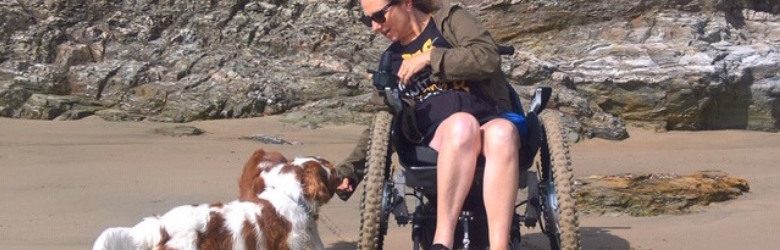
    Maggie takes her dogs to their agility classes, and then for a lovely run and playtime on the beach.

    woman in wheelchair with 2 dogs on the beach

    And then I met Elisabeth. Beautiful, energetic, crazy, shoe addict, and owner of the Ultimate Vegan Cafe (opening soon in Lichfield). There is no denying the Trekinetics are eye catching, and Elisabeth has certainly caught the eye of several celebrities, including Steven Fry and her idol, Eric Cantona.

    elisabeth and eric cantona smiling for photo

    Elisabeth said: “I have had my green chair for two months now and it has changed my life.” 

    She continued to say:

    I loved the wheelchair immediately. It was comfortable, practical and looked great. I was amazed at all the options available for the chair. A dog walking attachment for a dog lead an umbrella, a fitted water bottle and a range of colours for the chair. I have had my green chair for two months now and it has changed my life. I cannot wait to go out the house now, the chair is so easy to drive, I get stopped so many times by strangers asking me about my chair.

    I have been across fields and around London shopping. I love it. It fits into our car a lot easier than my old one and is much lighter. I love my chair so much I have ordered a second one. I am going to Vegas in October and can’t wait, as I know how comfortable and agile my chair will be. Thank you Beyond the Boundary Wheelchairs for making my life a happier and more fulfilled one. – All–terrain Trekinetic GTE Wheelchair owner

    GTE folded away in car woman in wheelchair in front of van with her dog

    We are so proud to be involved with Trekinetic

    There is simply no other chair like it. We know it won’t suit everyone, and that the majority of wheelchair users generally have at least 2 chairs. However because they’re bespoke, so many adaptations are possible. They’re great outdoors and incredibly maneuverable indoors. They can be lifted and put it any almost every car. To our knowledge the GTE is the only Powered All Terrain wheelchair in the world where that’s possible. It’s suitable for children and can be adapted as they grow and reach adulthood. And the chairs are incredibly comfortable and safe.

    Viv and I really enjoy meeting people and enabling them to try the Trekinetic out in their homes. If you’re interested in having a no obligation demo, please do call us 07973 731194 / 07885 059990

    Follow Beyond the Boundary Wheelchairs on social media

    Facebook
    YouTube
    Twitter
    Instagram

  • Never Wrestle a Pig! Benefits of Online Training

    Never Wrestle a Pig! Benefits of Online Training

    This post has been written by Deborah Bell, Enablement Team Manager at Disabled Living about the benefits of online training.

    George Bernard Shaw: “I learned long ago, never to wrestle with a pig. You get dirty, and besides, the pig likes it.”

    This quote makes me chuckle but it’s so true. I used to feel like I was wrestling with a pig when I was trying to get my team to learn how to do their job. Let me explain what I mean…

    Before working at Disabled Living I was nursing with a team of staff who cared for a young chap (let’s call him M) in his own home. I did this both part-time and full-time for around six years.

    M had been in an accident in his late teens and had spent a long time in hospital in various parts of the country. He had close family and friends who would appear at all times of the day and night to keep him company.

    M was ventilated and as a quadriplegic could only move his head

    Whilst he made great effort to remain positive, he did at times have bouts of grumpiness and understandably could be quite sharp tongued. His voice was the only way he could control things and sometimes the team members would get spoken to in a way that could upset them. This would lead to times when there was a high turnover of staff which in turn led to some difficult days when there wasn’t enough staff to care  for M. On these days he couldn’t go out as two people were needed for this. We spent one year in particular where this had become a vicious circle. Members of staff were not staying, which in turn made M less confident in the staff that were new. He would become critical and point out mistakes and they would leave. It was a very difficult situation to work in and I am sure it was a very difficult situation to live in.

    When well staffed, M was active despite his very complex needs and he had an active social life which involved members of my team. As I said, he always had two people with him at all times and regular trips to the pub were the norm.

    Team members varied in age and experience, originally all employed via an agency. Eventually they were all employed directly by M who was their employee. Some had been there a few years and knew how to perform the everyday tasks whilst others had no experience in care and had come from very different walks of life.

    There were different personalities…

    Some loud and some quiet which was evident with the volume in the house sometimes.
    As with many care situations the common issue of staff leaving and new staff coming on board was just part of the job. When I first started I found it challenging to keep up with organising the inductions and mandatory courses needed alongside all the specialist knowledge the carers needed in order to look after our employer.

    At the time I started, all the training was done on a face to face basis. There needed to be 10 regular staff working a 24 hour rota 7 days a week. You can imagine how difficult it was to ensure everyone was available to attend the training. There were regular occasions when training would be booked and paid for and the number of staff who actually attended made it financially unfeasible. I couldn’t get the staff to training on their days off and if they were working nights it wasn’t reasonable for them to attend training either before or after a night shift.

    It was at a point when we were trying to organise a series of mandatory training around food hygiene that I felt like I was really trying to wrestle a pig. I felt like I was always nagging staff about their time and effort. It made me feel more stressed than I should have been.

    Something needed to change

    As a nurse I had done some online training and e-learning and I decided it was time to see if this method would be more attractive to the team and to M who was adamant that the training was high quality and relevant to him.

    We chose some courses initially and began to implement the new process where staff could log on in the afternoon of their shift when M had visitors so they could do their training during work time.

    The first e-learning course we chose was Food Safety. It went down a treat. Within two weeks all the staff had completed the course and were up to date with their skills. The next course we chose was Equality and Diversity followed by Communication which I felt was important for the team to become highly skilled in.

    The transition to training online for this team was smooth and effortless

    I cannot say whether it was the support the team felt from being offered the training or whether it was this particular group of people. But the same team stayed for the next three years (I know! Almost unheard of). M calmed down quite a lot in this period. He even went on holiday abroad which took a lot of organising but was so worth it in the end.

    I’m sure that not all the improvements were down to online training. However, the staff were definitely more motivated. They could ask for training on specific subjects knowing they would be listened to.

    I wouldn’t have been able to arrange all the training they received on a face to face basis. It wasn’t financially possible. But e-learning gave us a much wider opportunity to include subjects relevant to M and his condition.

    For some subjects such as Moving and Handling, face to face training is necessary and invaluable. But I wouldn’t hesitate to recommend online training for many other subjects.

    Get in touch with Disabled Living

    Disabled Living have partnered with Innovue to deliver these very popular courses; the majority are £15 each per person. It is so easy to do and it makes investment in your staff a no brainer. I highly recommend it if you want to stop wrestling with pigs.

    Get in touch with our Training team for more information on 0161 214 4590 or email info@disabledliving.co.uk

  • New Wheelchair Gives Carole the Push She Needed!

    New Wheelchair Gives Carole the Push She Needed!

    This post has been written by Yorkshire Care Equipment for Disabled Living.

    Carole had been given a wheelchair by the NHS Wheelchair Services that met her needs but was simply too heavy for her to push herself in. She decided to take matters into her own hands and started looking for a new wheelchair which was lightweight and would give her some well-deserved independence.

    Carole searched for mobility equipment shops in her local area and found Yorkshire Care Equipment. She had a quick phone call with a member of their team and arranged to visit their showroom to look at different wheelchairs that would be easier for her to propel herself in.

    Looking specifically at active user wheelchairs, Carole wanted to find a chair that would give her all the comfort and support she needed whilst being lightweight enough to self-propel.

    Yorkshire Care Equipment showroom advisor Gary Hornsby-Shawe said:

    I showed Carole a range of active user chairs so she could pick the one that suited her needs the most. She had been a bit worried about funding, so I gave her a copy of our charities database just so she knew that help was available should she need it.

    We got the perfect chair in the end; Carole is loving it and says it’s the best chair she has ever had!

    After test driving the different wheelchairs available, Carole settled on a Küschall Champion SK wheelchair in a matte black finish. She personalised it by adding on some matte black Spinergy wheels and specially design oval-shaped hand rims with a built-in rubber lining for extra grip.

    Carole then returned to Yorkshire Care a few weeks later to buy a SmartDrive powered add-on which will give her some extra power when pushing her new chair.

    Carole said:

    Before, I was using a heavy old chair. It was uncomfortable and hard to propel.

    Gary was very patient with me when we bought the chair and he gave me the advantages and disadvantages of all the models I tried. Yorkshire Care helped me choose a chair that fitted me.

    The Champion SK wheelchair weighs less than 10kg and folds down to a very compact size so Carole can enjoy days out with no hassle at all. To see the SmartDrive powered add-on in action, watch this video.

    Yorkshire Care Equipment are listed in our Supplier Directory.

Disabled Living