Category: General

  • Never Wrestle a Pig! Benefits of Online Training

    Never Wrestle a Pig! Benefits of Online Training

    This post has been written by Deborah Bell, Enablement Team Manager at Disabled Living about the benefits of online training.

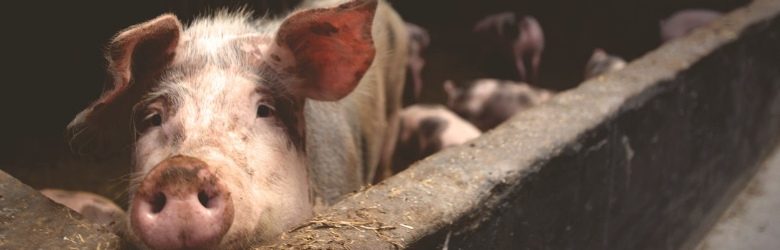
    George Bernard Shaw: “I learned long ago, never to wrestle with a pig. You get dirty, and besides, the pig likes it.”

    This quote makes me chuckle but it’s so true. I used to feel like I was wrestling with a pig when I was trying to get my team to learn how to do their job. Let me explain what I mean…

    Before working at Disabled Living I was nursing with a team of staff who cared for a young chap (let’s call him M) in his own home. I did this both part-time and full-time for around six years.

    M had been in an accident in his late teens and had spent a long time in hospital in various parts of the country. He had close family and friends who would appear at all times of the day and night to keep him company.

    M was ventilated and as a quadriplegic could only move his head

    Whilst he made great effort to remain positive, he did at times have bouts of grumpiness and understandably could be quite sharp tongued. His voice was the only way he could control things and sometimes the team members would get spoken to in a way that could upset them. This would lead to times when there was a high turnover of staff which in turn led to some difficult days when there wasn’t enough staff to care  for M. On these days he couldn’t go out as two people were needed for this. We spent one year in particular where this had become a vicious circle. Members of staff were not staying, which in turn made M less confident in the staff that were new. He would become critical and point out mistakes and they would leave. It was a very difficult situation to work in and I am sure it was a very difficult situation to live in.

    When well staffed, M was active despite his very complex needs and he had an active social life which involved members of my team. As I said, he always had two people with him at all times and regular trips to the pub were the norm.

    Team members varied in age and experience, originally all employed via an agency. Eventually they were all employed directly by M who was their employee. Some had been there a few years and knew how to perform the everyday tasks whilst others had no experience in care and had come from very different walks of life.

    There were different personalities…

    Some loud and some quiet which was evident with the volume in the house sometimes.
    As with many care situations the common issue of staff leaving and new staff coming on board was just part of the job. When I first started I found it challenging to keep up with organising the inductions and mandatory courses needed alongside all the specialist knowledge the carers needed in order to look after our employer.

    At the time I started, all the training was done on a face to face basis. There needed to be 10 regular staff working a 24 hour rota 7 days a week. You can imagine how difficult it was to ensure everyone was available to attend the training. There were regular occasions when training would be booked and paid for and the number of staff who actually attended made it financially unfeasible. I couldn’t get the staff to training on their days off and if they were working nights it wasn’t reasonable for them to attend training either before or after a night shift.

    It was at a point when we were trying to organise a series of mandatory training around food hygiene that I felt like I was really trying to wrestle a pig. I felt like I was always nagging staff about their time and effort. It made me feel more stressed than I should have been.

    Something needed to change

    As a nurse I had done some online training and e-learning and I decided it was time to see if this method would be more attractive to the team and to M who was adamant that the training was high quality and relevant to him.

    We chose some courses initially and began to implement the new process where staff could log on in the afternoon of their shift when M had visitors so they could do their training during work time.

    The first e-learning course we chose was Food Safety. It went down a treat. Within two weeks all the staff had completed the course and were up to date with their skills. The next course we chose was Equality and Diversity followed by Communication which I felt was important for the team to become highly skilled in.

    The transition to training online for this team was smooth and effortless

    I cannot say whether it was the support the team felt from being offered the training or whether it was this particular group of people. But the same team stayed for the next three years (I know! Almost unheard of). M calmed down quite a lot in this period. He even went on holiday abroad which took a lot of organising but was so worth it in the end.

    I’m sure that not all the improvements were down to online training. However, the staff were definitely more motivated. They could ask for training on specific subjects knowing they would be listened to.

    I wouldn’t have been able to arrange all the training they received on a face to face basis. It wasn’t financially possible. But e-learning gave us a much wider opportunity to include subjects relevant to M and his condition.

    For some subjects such as Moving and Handling, face to face training is necessary and invaluable. But I wouldn’t hesitate to recommend online training for many other subjects.

    Get in touch with Disabled Living

    Disabled Living have partnered with Innovue to deliver these very popular courses; the majority are £15 each per person. It is so easy to do and it makes investment in your staff a no brainer. I highly recommend it if you want to stop wrestling with pigs.

    Get in touch with our Training team for more information on 0161 214 4590 or email info@disabledliving.co.uk

  • New Wheelchair Gives Carole the Push She Needed!

    New Wheelchair Gives Carole the Push She Needed!

    This post has been written by Yorkshire Care Equipment for Disabled Living.

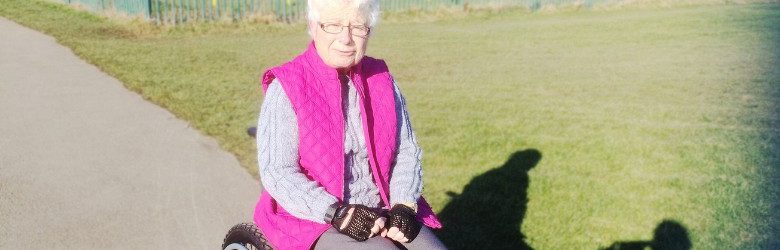
    Carole had been given a wheelchair by the NHS Wheelchair Services that met her needs but was simply too heavy for her to push herself in. She decided to take matters into her own hands and started looking for a new wheelchair which was lightweight and would give her some well-deserved independence.

    Carole searched for mobility equipment shops in her local area and found Yorkshire Care Equipment. She had a quick phone call with a member of their team and arranged to visit their showroom to look at different wheelchairs that would be easier for her to propel herself in.

    Looking specifically at active user wheelchairs, Carole wanted to find a chair that would give her all the comfort and support she needed whilst being lightweight enough to self-propel.

    Yorkshire Care Equipment showroom advisor Gary Hornsby-Shawe said:

    I showed Carole a range of active user chairs so she could pick the one that suited her needs the most. She had been a bit worried about funding, so I gave her a copy of our charities database just so she knew that help was available should she need it.

    We got the perfect chair in the end; Carole is loving it and says it’s the best chair she has ever had!

    After test driving the different wheelchairs available, Carole settled on a Küschall Champion SK wheelchair in a matte black finish. She personalised it by adding on some matte black Spinergy wheels and specially design oval-shaped hand rims with a built-in rubber lining for extra grip.

    Carole then returned to Yorkshire Care a few weeks later to buy a SmartDrive powered add-on which will give her some extra power when pushing her new chair.

    Carole said:

    Before, I was using a heavy old chair. It was uncomfortable and hard to propel.

    Gary was very patient with me when we bought the chair and he gave me the advantages and disadvantages of all the models I tried. Yorkshire Care helped me choose a chair that fitted me.

    The Champion SK wheelchair weighs less than 10kg and folds down to a very compact size so Carole can enjoy days out with no hassle at all. To see the SmartDrive powered add-on in action, watch this video.

    Yorkshire Care Equipment are listed in our Supplier Directory.

  • The Community Grocer Food Project

    The Community Grocer Food Project

    This post has been written by Sally Devine at Healthy Me Healthy Communities for Disabled Living. Healthy Me Healthy Communities is a Manchester social enterprise for strengthening communities, improving health, well-being and quality of life outcomes by working with people most affected by poverty and social exclusion.

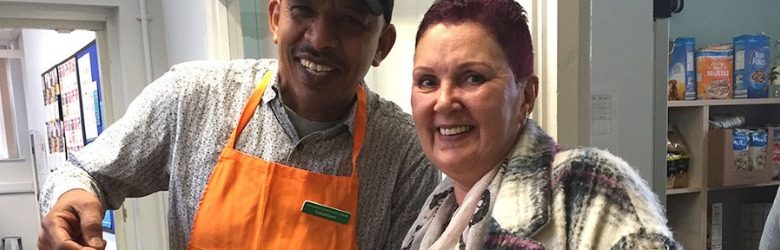
    Our food project, the Community Grocer, is a key part of Healthy Me Healthy Communities. It is a redistribution scheme for surplus food and household items that would otherwise go to waste. They look and feel like a traditional shop with members paying £2.50 for around £12 worth of goods including fresh produce. But they are more than just a shop, they are a valued community hub.

    Each Community Grocer is locally managed and controlled, meeting local needs and a place where people want to go. Along with tackling food poverty, they are a starting point for transforming lives by offering activities, training, volunteer opportunities and access to partner services.

    We have been very successful with our Grocers which continue to thrive

    We are opening our 6th Community Grocers in Hulme on 26th February. Members of our existing Community Grocers who recently took one of our Food Skills courses stated,

    “As a result of the course I find it very easy to go out and do shopping. I feel confident to converse with people and feel more sociable.”

    Rich Browning, CEO of Healthy Me Healthy Communities said:

    “The Community Grocers are a great way of bringing people together and connecting people to activities and services, tackling the long-term causes of poverty and isolation.”

    We have some exciting events coming up we’d love you to come to:

    Gorton One year anniversary party

    Date: Friday 15th February
    Time: 9.30am – 12.00pm
    Venue: 543 Abbey Hey Lane, Gorton, M18 8PF

    Miles Platting Half Term party

    Date: Thursday 21st Feb
    Time: 9.30am – 12.00pm
    Venue: Queensbury Court, Wardle Street, Miles Platting, M40 7DD

    Coverdale and Newbank CG cook and taste sessions

    Date: Thursday 7th and 14th February
    Time:
    Venue: Cornbrook House, 217 Stockport Road, Longsight, M12 4DY

    Hulme Community Grocers Opening Launch

    Date: 26th February
    Time: 11:30am – 3.00pm
    Venue: Aquarius Community Centre, Hulme, M15 6AX

    Fallowfield Community Grocers 1 year anniversary party

    Date: 1st March
    Time: 9:30am – 12.00pm
    Venue: The Place at Platt Lane, Platt Lane, M14 7FZ

    If you would like any further information please contact us on 07305 325 369 or email on info@healthymehealthycommunities.co.uk

    Julie’s over 50’s information:

    • Would you like to make a difference to your community?
    • Want to meet other like – minded people?
    • Would you like to put your life skills and experience to good use?
    • Are you aged 50 years or over?

    Join Healthy Me Healthy Communities for a new project for developing new social ventures in Manchester. The project is for people aged 50-years or over and will include training, mentoring and on-going support. We will be starting at the Aquarius Centre (Hulme) developing a community-café at the centre. Interested? Come along for an informal chat over tea and biscuits on Wednesday 27th February 11.00am – 12.00pm. The training dates are Wednesdays 6th, 20th and 27th March and 3rd April.

    Booking your place

    Please call Julie Thornhill, Development Worker (Ambition For Ageing) on 07305 053660 or email julie@healthymehealthycommunities.co.uk

  • Kintsugi Clothing Launch Fashionable Women’s Inclusive Wear

    Kintsugi Clothing Launch Fashionable Women’s Inclusive Wear

    This post has been written by Emma McClelland from Kintsugi Clothing. Our Marketing Coordinator & Content Writer, Natasha provided Emma with a few questions to answer about the company she works at.

    Where does the meaning of Kintsugi Clothing come from?

    Kintsugi is the Japanese art and philosophy of mending broken pottery with gold lacquer. When I read about it, it struck me as really beautiful. We all pick up scars as we go through life, both emotional and physical, but they don’t make us “less than” or take away from our value or beauty. They enhance us and make us unique. We shouldn’t feel like we have to hide them. This message means a lot to me and it’s a real driver for Kintsugi as a company.

    How Emma started to work on Kintsugi Clothing

    Seeing a TED Talk by Stephanie Thomas, founder of Cur8able and a disability activist led Emma to where she is with Kintsugi Clothing. The talk was called ‘Fashion Styling for People With Disabilities’. Emma explained:

    “Stephanie pointed out that there are more clothing lines made with dogs in mind than disabled people, and that the fashion industry doesn’t see disabled people as consumers. And, by extension, just doesn’t really see them.”

    black and white photo of lady in wheelchair lady modelling kintsugi clothing

    Stephanie’s argument was that there are millions of disabled people who enjoy fashion but whose opinions and suggestions just weren’t being sought. Once that thought was in my mind, I couldn’t shake it. I spoke to people from across the disabled community and realised a separate offering, or “clothing for disabled people” per se wasn’t what most people wanted. It was inclusive clothing, designed universally to work for more body types than just tall, non-disabled, size 6 models. Universal design is something I’ve learned about over the past year and I think it’s the future of fashion.

    What do you wish for Kintsugi in the future?

    I want to grow the company so that we can offer a bigger range of sizes, as well as menswear and potentially children’s wear, although there are a few really good children’s clothing companies (Willow Bug, for example, and I believe M&S do a small range too) out there already.

    rose gold zip on lady's trousers kintsugi top

    Above all else, I want Kintsugi to be a success because it could help steer the fashion industry towards greater inclusivity and to show that universal design opens up possibilities to more people and benefits everybody.

    Are there any key stories from people who have used Kintsugi Clothing?

    We’ve only just launched our website and are keen to hear feedback from our customers, so hopefully, in a few months time, we’ll have stories to share.

    Facebook@Kintsugiclothing

    Instagram: @kintsugi_clothing

    Twitter@kintsugiclothes

  • Summer’s Story of Life with Spina Bifida

    Summer’s Story of Life with Spina Bifida

    January’s Story of the Month has been written by Shaun Finlay from Hastings. He tells us the story of his daughter’s life with spina bifida.

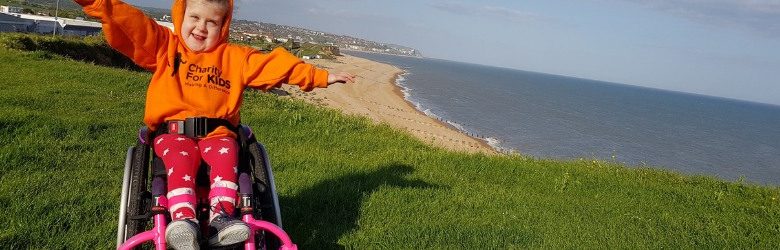
    Summer was born with a hole in her spine. Her nerves were all exposed causing her to be paralysed from her chest down. This has resulted in her now being a full-time wheelchair user, double incontinent and very reliant on those around her for daily support.

    On top of this she was also born with Hydrocephalus (extra fluid on the brain). This is controlled by a ‘shunt’ which drains the fluid from her brain down to her belly. It is essentially a valve, which is programmed using magnets, to control the amount of fluid to be drained. Unfortunately this means she must avoid heavy magnetic fields, e.g. airport scanners, MRI scanners, as they can adjust the setting of the shunt.

    With all of these diagnoses, she has had to deal with much more than the average 6 year old. Currently she has had 4 brain surgeries, 1 major spinal surgery, multiple bladder surgeries and regular scans and check-ups, most of which are done in the Evelina Children’s Hospital in London. She also has many more operations planned for her future, including a full bladder reconstruction.

    Fighting for Summer’s needs

    As a family we often have to fight on Summer’s behalf, for equipment and services that she should be entitled to and should be receiving as standard. For example; when Summer was just 2 ½ years old, her consultant in Evelina recommended she have a wheelchair for her own independence and self esteem. However, her local wheelchair service declined. This then bought our first big fight for her!

    summer practicing moto cross

    We were very lucky to come across a small local charity (Charity For Kids) who were able to fund a Quickie Youngster 3. This is a lightweight wheelchair that suited all of her needs. Since then the charity has assisted in the purchase of further equipment which was declined by the NHS, including physio equipment and her 2nd wheelchair, a Ti-Lite Twist. The local community also pulled together to raise money for a specialist bed for Summer, again cementing our faith in the community spirit of Hastings.

    All of this obviously takes its toll on Summer and the whole family, however to meet Summer you would never guess! She is a very bright and cheery little girl, who loves unicorns, fairies and princesses. Summer has an extremely kind and caring nature. She is one of the most selfless people I know, regularly engaging in charity events to ‘give back what they have given’. She is currently training with her dad for her 1st half marathon! Summer is a big personality in the local community, spreading joy and smiles everyday.

    Summer’s favourite hobbies and activities

    summer group photo smiling

    Despite her obvious challenges, Summer loves to join in playing with her peers and is involved with an inclusive cheer group, performing in shows and events. She has recently begun ballet, with the prospect of shows and dance exams in the near future and also involves herself with local charities attending events and raising funds to support others. To date, Summer (with help from family and friends) has raised nearly £10,000 for charity and has more planned for future events.

    When she isn’t dancing, Summer has a daredevil streak within her. Having discovered para-athlete Aaron Fotheringham on YouTube, Summer has been interested and involved in WCMX (wheelchair moto cross). She has followed her older brothers and taken her wheelchair to skate parks and ramps and also to BMX pump tracks. Although she finds it rather daunting and scary to start, she loves the thrill of speed and pushing herself and her chair to its limits.

    Her WCMX dreams came true in June 2016, when she got to meet Aaron. Nitro Circus (who Aaron performs with) were performing in Sussex. Aaron invited Summer to have VIP tickets to watch the show and meet with Aaron afterwards. Here, Summer watched him do his back flip in his wheelchair, off a 50ft ramp! Summer said to her mum and dad, “I want to do that!”

    What we love the most about Summer

    Any parent would agree that, every achievement your child makes will make you proud. As a parent of a child with additional needs those achievements can be very different. With Summer’s paralysis and the challenges that come with that, her sheer determination and perseverance inspires us, her friends, peers and everyone she meets. This was recognised last year when Summer was awarded with the ‘Gold Award’ at the ‘2018 Child Of Sussex Awards’ in Brighton. Today, it’s still a huge highlight in her life. And it gives her the recognition of the brave, strong and amazing little girl she is.

    summer receiving her award

    In the six years of her life, we have become more than just parents. We have become carers and nurses to her, advocates for hers and all disabled rights. We have become specialists in her conditions and a voice to stand up for her rights and needs. This is part of the ‘behind-the-scenes’ of parenting a child with extra needs, which no one ever tells you about. But we wouldn’t change a thing!

    You can follow Summer’s Story through social media on Facebook, Twitter and Instagram using the links below.

    www.facebook.com/summers.story1

    www.instagram.com/Summers.story1

    www.twitter.com/summersstory1

    Does your child have spina bifida? If you would like to submit a story to Disabled Living’s blog please send an email to: info@disabledliving.co.uk

  • Learn about the New BAS Push/Pull Brake/Accelerator

    Learn about the New BAS Push/Pull Brake/Accelerator

    This is a post by BAS who are featured in Disabled Living‘s Supplier Directory.

    BAS are thrilled to announce the launch of their brand new Push/Pull Brake/Accelerator to the Vehicle Adaptations market. With over 35 years’ experience in the Vehicle Adaptations industry, BAS are constantly striving to develop and manufacture innovative and pioneering products and their new Push/Pull Brake/Accelerator is certainly no exception.

    Did you know that with over 90% of current Push/Pull Brake/Accelerators on the market, you are restricted to a pre-determined fixed steering wheel? Did you also know that many on the market require the airbag to be removed or disconnected?

    With their new Push/Pull Brake/Accelerator, BAS have engineered a new design concept where customer safety is never compromised!

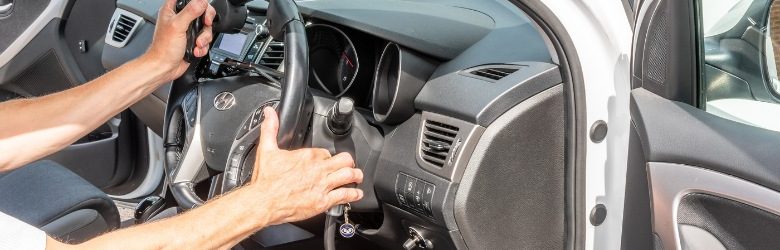
    The new design allows for full movement of the steering wheel, allowing each driver to set the wheel at the best and safest driving position for them. In addition to this there are a range of handles and handle bars to choose from, ensuring a bespoke driving experience for every customer.

    Furthermore, the new design means that the vehicle’s airbags are never removed or interfered with. The positioning of the Push/Pull is such that if the airbag is deployed, the driver’s safety is not compromised.

    An added bonus with the new design is that on 95% of vehicles, there is no cutting or reshaping of the vehicle’s trim or components. This is unlike current Push/Pull Brake/Accelerators, where almost all require some cutting of vehicle trims.

    In their opinion, the BAS Push/Pull is the safest accelerator on the market!

    The product is available on the Motability scheme from 1st January 2019, with nil customer contribution!! Contact your local dealer for more information on the BAS Push/Pull Brake/Accelerator or contact BAS directly on 0161 776 1594. You can also visit the BAS website to find out more at www.basnw.co.uk

  • Accessibility at Longleat Safari Park and Cheddar Gorge

    Accessibility at Longleat Safari Park and Cheddar Gorge

    This post has been written by Chris Cammiss, Disability Awareness Trainer at Disabled Living. He talks about how accessible Longleat Safari Park and Cheddar Gorge are as a wheelchair user.

    So, who’s up for some extreme tourism? My latest escapade was to spend a couple of days looking at Longleat and sister attraction Cheddar GorgeSome simple cave exploration in the Gorge and dancing with lions at Longleat – no problem at all for a wheelchair user!

    I have to admit I was intrigued. How romantic, how interesting, but how much would I see? How would I manage in the caves and how would I get around the Safari Park?

    Well, I found the whole experience fascinating and much more accessible than you might have thought. With the help of some very well-motivated staff I had a great time. Both sites were an absolute pleasure to visit. Yes, I saw plenty of features that could be improved but the sites are well worth a visit now.

    cheddar-gorge-natural-valley

    First day was Cheddar Gorge – an attraction consisting of several caves developed in Victorian times as a tourist venue. With introductory film shows, a modern museum, caves, walks, viewpoints and shops, there’s a full family day out here.

    After purchasing tickets see the introductory film. This sets the scene beautifully with colourful history, wildlife, flora, what to visit and what can be managed. Then try the caves!

    The main cave – Gough’s Cave – after the man who made a public attraction out of it, is unfortunately inaccessible to many wheelchair users and mobility impaired visitors because of four large, sloping steps, but is very rewarding indeed. If you can be carried or otherwise helped down it is well worth the effort.

    (Personally, as I was on my own at a very quiet time so a staff member bumped me down but this is definitely not company policy!)

    A long winding tunnel then takes you into the rock – Cheddar Man, unique rock formations, dramatic twists and turns, audio description points – very special indeed.

    The ground surface is excellent – the slightly ridged concrete path carries you along with no trips, bumps or slips.

    Try the Museum of Prehistory. It’s small enough not to be daunting but large enough to house a huge array of exhibits all displayed with imagination. This is a very accessible venue. I was lucky enough to be accompanied by an enthusiastic school party who were greatly entertained by the Stone Age re-enactor who dressed them in animal skins, told them about skinning a rabbit and finally showed them how to start a fire with a few sticks – hugely impressive!

    My favourite destination was Cox’s Cave. This is a network of several inter-connected chambers. Complex and challenging for many with mobility or visual impairments, it rewards those who can manage handsomely. A brilliant multi media film show depicting the development of Early Man is displayed on the raw walls of each chamber, carrying you through his history, changing environment and the animals he hunted. Sound and lights enhance this extremely entertaining production. Different episodes lead you through the cave complex. In my wheelchair I was able to see the first parts and the last parts with the help and advice of the brilliant staff. Nothing was too much trouble.

    The next day I visited nearby Longleat

    deer at longleat safari park
    Photo by Mark Woodbury – https://www.flickr.com/photos/markwoodbury/38962211774

    Driving through the grounds for the first time my first impression was how fabulous the actual house appears. After parking I planned my day to include all the major attractions. There’s so much here for everyone to enjoy and again the staff were incredible. It’s also obvious thought has already gone into improving access.

    The House itself was a delight. As often happens, the dedicated disabled entrance takes you through several rooms the public may never see before joining the beginning of the public flow along the official tourist route through the House. Volunteer guides in every room – all dressed as 20’s flappers on my visit – will inform as much as you want or transport you into their world if you prefer!

    Outside there are formal grounds, endless playgrounds, many animal enclosures, all generally accessible. There’s a fully accessible miniature train to carry you around the grounds while you catch your breath, even a fully accessible cruise around the huge lake.

    There are many shops and eating places – all very accessible, and most of the rides are accessible as well.

    The only downside in my opinion was the Adventure Castle play area. This was a stunning looking space, castle, drawbridge, aerial rope walks but all completely inaccessible to anyone with a major mobility issue.

    If you have your own transport it all works brilliantly – you just drive around at your own pace, stopping at the fully accessible African Village as you go. If not, you can catch the fully accessible Safari Bus and sit back in comfort. It’s all there around you – elephants, giraffes, lions, tigers, rhinos and flamingos.

    Throw in the firework display and light show after dark – what’s not to like? It was a challenging trip but well worth the effort.

  • What Are the Best Accessible Christmas Activities in the UK?

    What Are the Best Accessible Christmas Activities in the UK?

    This post has been written by George Finney on behalf of CareCo who feature in our Supplier Directory.

    Here’s our 2018 guide to the best accessible festive activities on offer:

    We know Christmas activities can be challenging if you live with limited mobility or a disability. Busy high streets and Christmas markets can be stressful if they aren’t built with accessibility in mind. That’s why we’ve put together a list of the top three accessible Christmas activities this year.

    If you are limited by disability, illness or an injury, there is definitely something in our list for you. There are so many incredible festive activities this year. Here are three of the best accessible activities for festive fun with family and friends.

    Hyde-Park-Winter-Wonderland

    Image Source

    Accessible Christmas Markets

    Christmas markets are a highlight on the UK Christmas calendar. Full of tasty treats and handmade presents, these cosy markets will really give you that Christmas feeling. Here are three of best accessible Christmas markets in the UK. If you have any extra special requirements, you should always contact the market hosts for advice.

    Winter Wonderland – Hyde Park London

    Hyde Park is home to one of the nation’s favourite Christmas markets. Full of mouth-watering food and festive attractions, including that famous Ice bar, the Winter Wonderland has been built with plenty of accessible features in mind. Disabled access ramps, accessible toilets and allocated disabled car parking are available at Winter Wonderland. There is even a wheelchair accessible pod on the giant wheel!

    Frankfurt Christmas Market – Birmingham

    The food and craft market located in Birmingham is the largest authentic German Christmas market outside of Germany! With plenty of traditional German goods and a live music programme in Victoria Square, the Birmingham Christmas market is one of the best festive events to visit with friends and family. The fully accessible market includes a wheelchair and disability route, which completely avoids stairs and obstacles.

    Edinburgh Christmas Market

    Edinburgh’s Christmas Market is another top Christmas market for accessibility in the UK. With a vibrant festive atmosphere full of beautiful lights, it’s a great place to socialise with friends and family. With accessible parking, toilets and ramps to all entrances, you won’t struggle to manoeuvre around this market! There is even a wheelchair accessible Christmas tree maze.

    Christmas_Market_at_Dusk

    Image source

    Wheelchair Ice Skating

    This Christmas there are lots of ice rinks popping up around the UK, and lots of them are disability friendly! Many ice rinks welcome wheelchairs and cater for disability requirements. It is advised that you ring the venues beforehand to find out whether they can cater for your requirements and if there are specific times and dates. Here are three of the best accessible ice rinks this Christmas.

    Winter Wonderland – Cardiff

    The Winter Wonderland ice rink in Cardiff welcomes everyone on to the ice this Christmas. Wheelchair users must be accompanied by a companion wearing ice grips or ice skates, although skating is free for all companions. The Winter Wonderland is also running specific sessions for wheelchair users, visually impaired and autistic people. For more information, visit Cardiff’s Winter Wonderland.

    Natural History Museum Ice Rink – London

    The Natural History Museum in London is running a number of quiet sessions this Christmas, which are suitable for wheelchair users and people with disabilities. You can have a look around The National History Museum while you’re there!

    Before visiting the Natural History Museum or its famous ice rink, it is recommended to contact the venue. Just so you can be reassured the facilities are for suitable for your needs.

    The Royal Pavilion Ice Rink – Brighton

    With accessible sessions 10.00am -11.00am every day from November 3rd 2018 until January 13th 2019 (expect Christmas Eve and New Year’s Day), wheelchair users can skate in the same session as family and friends. Accessible features at The Royal Pavilion Ice Rink include exit and entrance ramps and plenty of disabled toilets on site.

    ice skating outdoors

    Image Source

    Shopping Centres

    Shopping centres are an accessible way to get your shopping done and have a bit of festive fun! With plenty of accessible features including lifts, ramps and first aid facilities, shopping centres are a safe and warm place to have fun this Christmas.

    There are plenty of indoor shopping centres dotted around the UK, so chances are there is a good one near you!

    Once you’ve finished your Christmas shopping, there’s so many more activities you can get involved in at UK shopping centres this Christmas. Why not visit a Christmas arts and crafts shop? You’ll get the opportunity to new meet people and learn some new skills.

    If you’re in the mood for a movie, why not visit one of the many cinemas and settle down to watch a cosy film? Nothing will get you in the festive spirit like this year’s latest Christmas release.

    And let’s not forget almost every shopping centre in the UK has an accessible Santa’s grotto. Children of all ages are able pop in to pay Santa and his elves a visit and take away a small gift.

    Accessible Christmas events at UK shopping centres to look out for:

    Santa’s Snowflake Grotto: A World of Magical Snow, Westfield London, Shepherd’s Bush

    This magical Santa’s grotto takes you to a snow factory in the north pole, where you’ll make your own snowflake. And you’ll even explore Santa’s toy factory! Photo opportunities are available with Santa, right before you’re magically transported back to London.

    The venue recommends making Santa and his elves aware of any special requirements prior to attending. Pop an email to uk.ticketing@westfield.com and they’ll do their best to make your visit to Santa’s grotto as special as possible.

    Centre:MK’s Christmas Market , Milton Keynes

    Between the 16th of November and the 23rd of December 2018, you’ll discover a Christmas market inside Centre:MK. Festive food, drinks and gifts are all on offer, at this very accessible friendly location. Due to its location, there is lots of fun to be had both at the market and in the rest of the shopping centre.

    Musical Dome at the Trafford Centre, Manchester

    Every Friday from  6.00pm – 10.00pm, December 7th to December 28th, the Trafford centre will be hosting live music each evening, completely free of charge. You will find live acts including Craig Owen and many more performing in the music dome to get you in the festive spirit.

    Need More Accessible Ideas?

    If you didn’t like any of that, or you just don’t like crowded places, there are lots of accessible activities for everyone this Christmas. Why not cosy up and watch a Christmas film, visit friends and family, or even take part in some arts and crafts?

    Creative Christmas arts and crafts ideas:

    10 Sensory Christmas Activities for Children Who are Blind

    From sweet smelling festive ornaments to tasty treats, there are some lovely sensory activities for blind children in this post.

    50 amazing arts and Crafts Ideas for seniors

    Losing finger dexterity as you age can make it difficult to do arts and crafts. This post contains plenty of arts and crafts ideas for elderly and limited people.

    Christmas Water Balloon Ice Balls

    This is a really easy and fun activity for everyone. You can use water balloons to create delightful decorative ice balls.

    Thank you for reading our top three accessible Christmas activities. With so many festive activities and attractions to do and visit this Christmas, we hope this post helped you find the perfect event for you. Have a very merry Christmas from CareCo.

  • Top Tips for Accessible Interior Design

    Top Tips for Accessible Interior Design

    This post has been written by Tabby Farrar for Disabled Living.

    Great accessible interior design isn’t just about making a space look good. While we all want a beautiful home or work environment, we also need them to be functional – and realistically, we also need them to be comfortable, welcoming and inviting. Designers will have different goals for different interiors, but the outcome should always suit the user.

    When it comes to accessible interior design, it can sometimes be a challenge for designers to know which aspects of their ideas could be an issue. If you’ve never had need for accessible rooms and spaces yourself, where do you start in planning them for somebody else?

    If you’re keen to create beautiful places that are tailored to those with mobility needs – whether that means wheelchair-accessible or simply free of certain obstructions, here are a few things to consider from room to room.

    In the bathroom

    While it’s important to get every detail right, the bathroom is an area of the house where there’s no room for error. A poorly placed object or ill-thought-out design is all it takes to create a barrier between the user and everyday tasks like washing, brushing their teeth and using the toilet.

    accessible bathroom

    Starting with the very basics, a non-slip or low-slip floor is a must for accessible interior design. It’s easy to get distracted by beautiful bathroom tiles, and luxury choices like marble or slate in high budget designs, but a stylish take on non-slip flooring is crucial to ensure that the risk of falls is reduced. In the case of designing for wheelchair users, this also makes it easier to control a wheelchair once the flooring is wet.

    Depending on the user’s specific needs, consider whether a walk-in, sit-down shower is the best option, or whether the bathroom design should aim to create a peaceful ‘wet room’ environment.

    Wet rooms have picked up popularity in boutique hotels as well as in accessible design, and they’re an ideal way to maximise space. Creating an open, tranquil finish. When done well, wet rooms remove the need for moving parts, doors to open and close, and raised bath sides to tackle.

    In terms of colour and feel, any bathroom can be future-proofed with neutral tones and white sanitary ware. And as far as furnishings go, think carefully about the height you hang cupboards at to ensure they don’t obstruct movement, but can also be easily reached.

    If in doubt, consult Disabled Living for advice – an experienced OT will know exactly what works and what doesn’t for different individual needs.

    In the kitchen

    One of the main hindrances for wheelchair users in traditional kitchens is inability to comfortably access counter tops which house cupboards underneath. Simply the height of some counters can be an obstacle in itself, along with features like hanging pot and pan racks that are too high to access.

    woman in wheelchair reaching oven knob

    Rather than create a kitchen where a user must reach awkwardly over a cupboard to prepare food on the counter, plan spaces where a wheelchair can get up close with legroom underneath. Particularly with something like a hob, accessibility becomes a major safety issue if someone is forced to struggle while cooking with hot kitchenware.

    Regardless of whether a space needs to accommodate a wheelchair or not, roominess and ease of movement around the kitchen are key. Avoid narrow gaps between counters where possible, and arrange functional elements within easy reach of each other. For example, placing a sink and drying area directly next to an induction hob is a simple way to ensure people don’t need to traverse the room carrying kitchen implements once they’ve finished using them.

    Most importantly, and possibly most obviously, consider what the kitchen will actually be used for. If its user is a keen cook, they’ll need different appliances and a different layout than someone who struggles with cooking and mainly eats pre-prepared meals. It’s also worth bearing in mind how needs might change in the future – to avoid creating something that’s functional now, but which might not be fit for purpose before long.

    Around the home

    In either of these rooms, and in more casual living spaces like bedrooms and lounges, the devil is in the detail.

    artificial plants in plant pots

    Houseplants have become all the rage in recent years, and Instagram and Pinterest are bursting at the seams with monstera plants, succulents and other easy-care vegetation. While low-maintenance plants are suitable for many, in some instances your best bet is to add colour and ‘life’ to a room with no-maintenance artificial plants instead.

    Perfect for those who struggle to keep real plants watered, fed and re-potted – as well as those who’d simply rather be doing other things – modern artificial plants are becoming impossible to tell from the real thing. They’re also great for seasonal changes, as different types and colours of plant can be stored away and brought out to suit.

    Whether it’s adding a bright floral centerpiece in summer or rich, wintry greenery when the weather gets cold, faux plants require no maintenance by the user but can have the same mood-boosting properties as real ones.

    Creating accessible interior design can feel daunting if you’re unfamiliar with the territory, but there’s plenty of advice and guidance out there. Whether you’re working on a professional project or simply trying to update a family home or guest room, start by thinking about the user’s needs and work from there, rather than starting with appealing features and trying to fit someone’s needs around them.

  • Why Barcelona Is One of the Best Accessible Travel Destinations

    Why Barcelona Is One of the Best Accessible Travel Destinations

    Our latest Story of the Month feature is by Chris Cammiss, Disability Trainer and Advisor at Disabled Living. He tells us about his recent travels to Barcelona.

    It’s that time of year again – the weather is changing and the clocks have gone back. So we decided to have a city break away to enjoy the last of the autumn heat. We chose Barcelona because Spain has a decent reputation for disabled access. It could still be warm and there are plenty of indoor destinations if the skies were to open!

    We were not disappointed in any way

    Three days out of four were sunny and hot and only one was partly rainy. Spain lived up to its reputation with great accessibility everywhere. We had each visited Barcelona briefly, but a long time ago so had no useful memories of the city layout. Together we chose a small, quirky hotel which was located close to the old centre. And we loved our fabulous room with all the appropriate facilities.

    people walking through barcelona

    We were only a ten minute walk away from Catalunya Square and the start of Las Ramblas. Both of these are very popular destinations for locals and visitors alike.

    “As a wheelchair user, what made a great immediate impression were the excellent surfaces everywhere. All the pavements were level, no evidence of trip hazards from lifting or cracked flagstones, dropped kerbs at every crossing, smooth surfaces everywhere and tactiles where required for those with a visual impairment.”

    It’s no surprise either that bike riding is strongly encouraged here – easy to do and keeps motor traffic down.

    Thoughts on the Gothic Quarter

    When entering the old area – the Gothic Quarter which forms the ancient centre of the city – the same applies. Roads may be narrow and winding here but still all is step-free. Sometimes there will be a gradient, even steep sometimes. But I never saw a single flight of steps I had to avoid. I did see the occasional cobbled surface here in an old square but there were always flagged paths set into the surface. I thought this was very impressive.

    taxis and tour bus in the street of barcelona

    Every bus and taxi was accessible including the shuttle bus to the airport, and every building I wanted to see had level access and/or discreet ramps throughout. Having realised this in the first few hours then we proceeded to relax and planned the course of each day knowing access was not going to be an issue.

    So, what to do in just a few days? Presumably we all like to eat and drink, spend some cash on local specialities and visit the historical sites? This is the place to do just that!

    The Gothic Quarter particularly had a wealth of ancient buildings – including the medieval Cathedral (with its ramped access), its geese and its candles – fascinating markets and winding streets full of bars and restaurants.

    The best highlights from the trip

    • A wonderful walk along the beach on a perfectly level path alongside the sand
    • A wander down a tiny street where every other shop seemed to be an artisan chocolate maker
    • Plates of tapas washed down with rather more local Cava and Rioja than is strictly recommended
    • A meal in a simple enough looking bistro which was actually set inside an old cinema
    • Sitting in a bar drinking beer with the locals watching Barcelona thrashing Real Madrid 5 – 1!

    serving of paella

    With paella in the restaurant/bar along the street, more patatas bravas than you can shake a stick at, the discovery of an excellent local brandy and churros with hot chocolate in a street cafe; I can safely say we didn’t miss much. But don’t think it was all excessive consumption, we also found a brilliant, extensive Picasso exhibition just a block away and we made the customary visit to the Gaudi buildings dotted around this beautiful city, including the almost-completed Gaudi Cathedral which is like no other building I have ever seen. There were huge queues here but a quick indication from someone in the information kiosk sent us to a back entrance where we both gained free, instant access! Brilliant!

    If you want an exciting weekend away with lots to see and do, knowing the terrain will be really accessible, then you couldn’t do much better than a trip to Barcelona.

Disabled Living